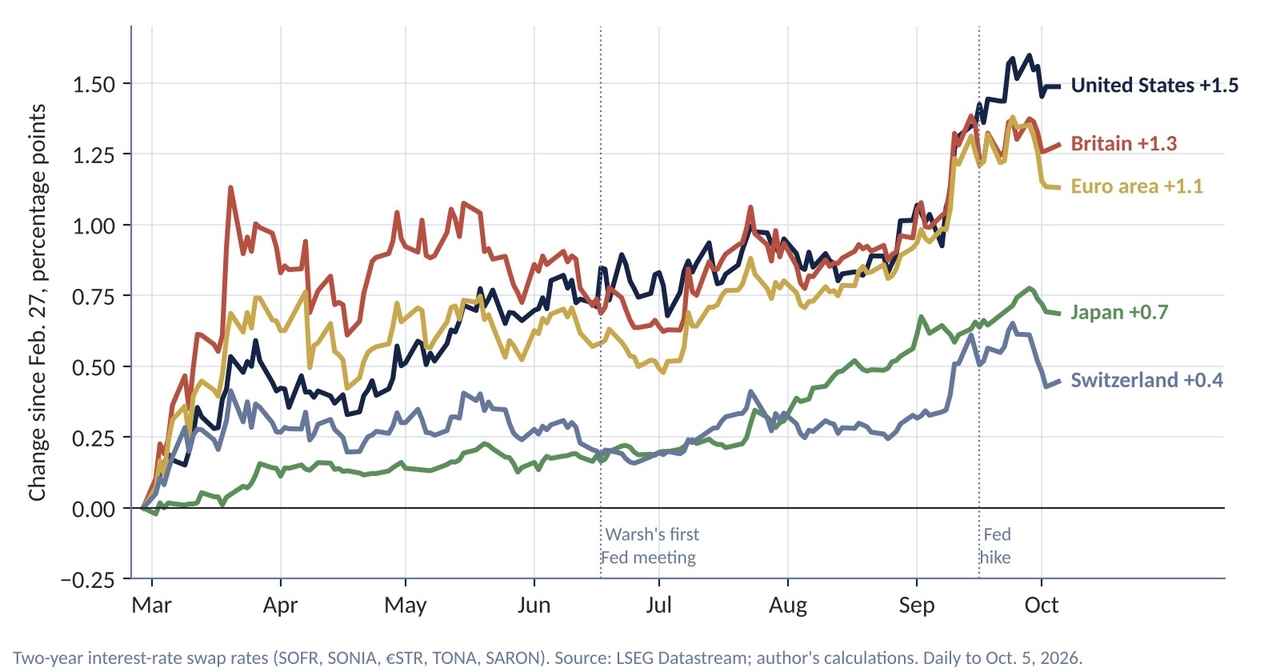
Long-term interest rates have surged across the rich world, and government debt is the usual suspect. For most of this year, the evidence points elsewhere: To central banks responding to an energy shock, each in its own way.
After the 2001 recession, the Federal Reserve cut its policy rate, eventually to 1 percent in 2003. As the economy recovered, in 2004, it began to remove that extraordinary support, saying in June that policy accommodation "can be removed at a pace that is likely to be measured." Short-term rates rose as planned. Yet in February 2005, Alan Greenspan, then the Fed's chairman, told the US Senate that long-term interest rates had fallen even though the Fed had raised short-term rates by 1.5 percentage points. "For the moment," he said, "the broadly unanticipated behavior of world bond markets remains a conundrum."
The most influential answer came from Ben Bernanke: A global glut of savings, much of it from Asia and the oil exporters, was pouring into safe American bonds and holding their yields down. Long-term rates were being set by global forces beyond the Fed's control.
Twenty-one years on, the conundrum has returned in reverse.
The puzzle of 2026
War in the Middle East broke out on Feb. 28. Since then the Fed has raised its policy rate only once, by a quarter point in September, while the 10-year Treasury yield has climbed by more than 1.3 percentage points, to about 5.3 percent. In 2005 long-term rates ignored a tightening that was under way. In 2026 they have run ahead of any immediate policy action. This is not just a US story: Long-term yields have surged in Britain, the euro area and Japan as well. Even Switzerland, where inflation is below 1 percent, has seen its long-term yields rise.
This matters well beyond bond markets. Long-term yields set the cost of mortgages, of the bonds companies issue to finance investment, and of the debt governments must refinance. When they rise, households, businesses and finance ministries all pay more.
A common explanation is fiscal policy. Governments are borrowing heavily, and public debt is much higher after the pandemic. Central banks that bought government bonds by the trillion during the years of quantitative easing are now buying fewer or letting their holdings shrink, so private investors must absorb more of the supply, and they want to be paid more for doing so.
The fiscal concerns have a firm basis. In the United States, government debt has risen from about 66 percent of GDP in 2005 to about 124 percent in 2025, and the deficit has more than doubled as a share of the economy, from 3.1 to 6.8 percent. Elsewhere the picture is mixed. Britain's debt has stayed around 100 percent of GDP since the pandemic. France's reached 119 percent in the second quarter of 2026, above its pandemic peak. Italy's is creeping up again, and Japan's has fallen back from its pandemic peak to roughly where it stood before.
Is this the story of 2026?
The lens of the market
How can we tell whether investors are turning against government debt? One way is to compare what governments pay to borrow with the rate on interest-rate swaps, contracts in which banks and investors trade fixed interest payments for floating ones without any government bond involved. A rise driven by worries about a particular government's debt would normally push its borrowing costs up relative to swap rates. That is not the broad pattern. Since the eve of the war, America's 10-year borrowing cost has risen by 1.35 percentage points, and the 10-year swap rate by slightly more. Germany, Japan and Switzerland show the same pattern. Only in Britain did the government's 10-year cost climb a little faster than the market benchmark, and by less than a tenth of a percentage point.
The dollar points the same way. When investors lose faith in a government, they often sell its bonds and its currency together, as they did with Britain in September 2022. Instead, the dollar has gained almost 5 percent against other major currencies since the war began.
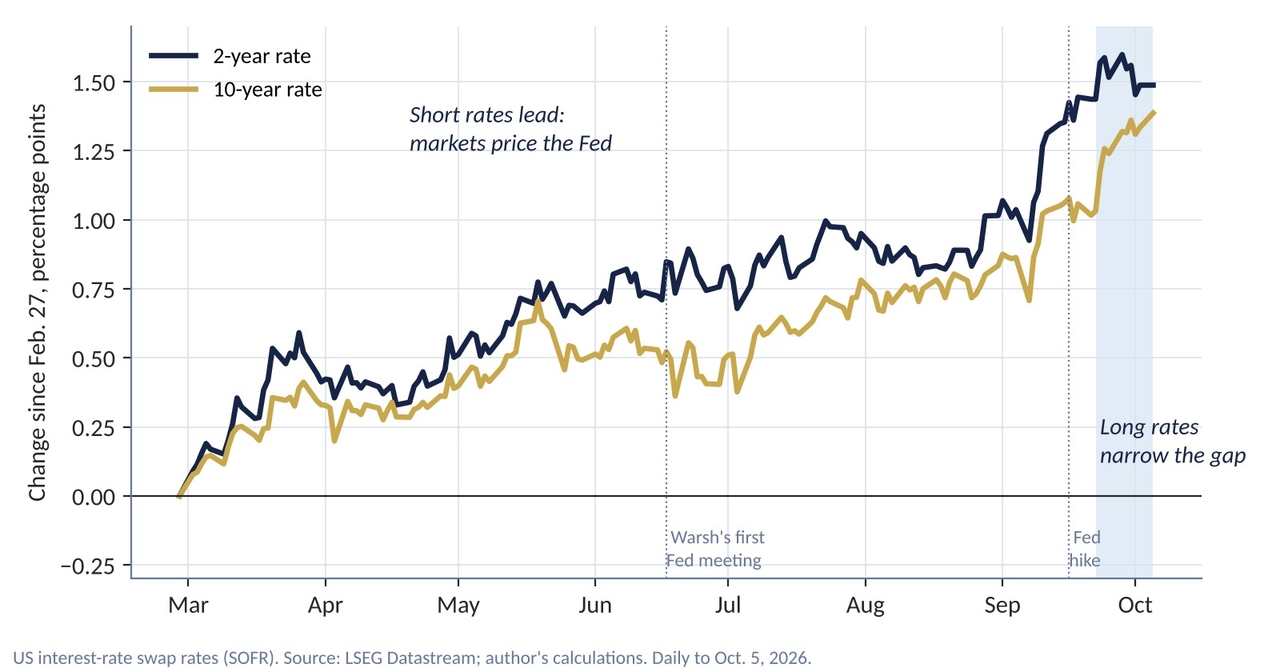
These comparisons offer little support for a broad loss of confidence in government debt. What, then, explains the rise? My starting point is which rates rose most. The two-year rate is a useful guide: It largely reflects where investors expect central-bank rates to go over the next couple of years, so when it rises faster than the 10-year rate, markets are rethinking monetary policy. That is what happened. From the start of the war until late September, the US two-year market rate rose by about 1.4 percentage points, while the 10-year rate rose by about 1. Only in the final two weeks did the 10-year rate narrow the gap, a shift I return to below. Britain, the euro area and Switzerland followed the same pattern; Japan, where rates are climbing back from years near zero, was the exception.
There is little sign, either, of investors losing confidence in inflation control. Market measures of where inflation will be five to ten years from now barely moved in America, the euro area or Britain.
One global shock, different central banks
The world economy has been hit by another common shock. Disruption to shipping through the Strait of Hormuz sent oil prices soaring: Front-month Brent crude futures rose from about $72 a barrel before the war to $118 by the end of March, fell back to $72 after a ceasefire, and climbed above $100 again in September. Every major economy faced the same problem and the same question: How will our central bank respond?
The answers differed, and so did the moves in interest rates. The European Central Bank raised rates in June and again in September, saying that "inflation is set to remain well above target for an extended period." The Bank of Japan raised its rate twice, to 1.25 percent, noting that "medium- to long-term inflation expectations have continued to rise." The Bank of England has not raised rates, but it warned that the risk of inflation feeding into wages and prices "is greater the longer higher energy prices persist." British two-year rates have risen by well over a percentage point without a single hike: Investors are anticipating how the central bank will respond.
Switzerland is the clearest contrast. It faced the same oil shock, but Swiss inflation was only 0.8 percent in August, and the Swiss National Bank kept its rate at zero in September. In its words, "Medium-term inflationary pressure has increased only slightly." Swiss two-year rates have risen by less than half a percentage point since the war, about a third of the American rise. The biggest shift came in the United States, where markets went from expecting the Fed to cut rates to expecting it to raise them.
Paul Krugman puts more weight on artificial intelligence: The enormous demand for funds from technology companies building data centers is, he argues, likely the biggest force pushing interest rates higher. I share his skepticism about a debt crisis, and he too sees the war as the trigger that reset expectations for the Fed. Where we differ is emphasis. The two explanations overlap, since strong investment demand can itself lead investors to expect higher policy rates. The cross-country pattern, with each market tracking what its own central bank was expected to do, nevertheless leads me to put central banks' response to the energy shock at the center of this year's repricing.
The Warsh factor
Why did America move most? AI may be part of the answer. Another part lies in how the Fed now talks to markets. In an essay published in August I argued that the Fed under its new chairman, Kevin Warsh, has stopped telling investors where interest rates are heading. Instead it tells them how it will react to the data and leaves the pricing to them. Warsh's phrase for this was that markets are learning to "play the ball, not the referee": To watch the economy, not the central bank's hints. And he left no doubt about the rule they should apply: "There's only a target, and it's 2 percent." With an energy shock pushing inflation up, investors drew the obvious conclusion and priced a firmer Fed.
September was the test of whether they had read the Fed correctly. The Fed raised rates on Sept. 16, by a unanimous vote, stating that "The Committee will deliver price stability." My reading is that markets are pricing a credible tightening. Since mid-June the yield on inflation-protected 10-year Treasuries, a measure of the inflation-adjusted cost of borrowing, has risen by about 0.8 percentage points, while market measures of inflation expectations have barely moved. That pattern is consistent with investors expecting tighter policy to contain inflation.
The last two weeks
In late September, the pattern I described earlier changed. Between Sept. 22 and Oct. 5, two-year market rates were broadly stable while 10-year rates kept climbing: by about a third of a percentage point in the United States and by less in Britain, the euro area and Japan. That divergence is consistent with investors demanding more to bear the risk of holding long-term bonds. It could also reflect higher expected policy rates further into the future. The New York Fed's model of Treasury yields favors the first reading: over those two weeks it shows the expected path for the Fed's policy rate essentially unchanged, and the whole of the rise in its estimate of the 10-year yield coming from that extra return. It is one model over a short window. But if the extra return reflects worries about debt, this is where they would show up.
In one country, they already have. In the last weeks, the extra cost France pays to borrow for ten years compared with Germany jumped from about one percentage point to almost one and a half, consistent with concerns about French public finances and politics. This is what a debt worry looks like in the data: One government's borrowing costs pulling away from Germany's. It is precisely the pattern that is missing in the United States, Germany, Japan and Switzerland. Whether the French scare spilled over into the premium investors demand for long-term bonds everywhere, or the two simply coincided, it is hard to say at this point.
Why it matters for Asia
For Korea and its neighbors, telling these forces apart has practical consequences. A rise in American yields driven by expectations of a tougher Fed travels through the exchange rate, dollar funding costs and capital flows, and it can lift Korean borrowing costs even when nothing about Korea's public finances has changed. Treating such a move as a verdict on fiscal policy, and tightening the budget in response, would not address the source of the increase.
The lesson so far
In 2005 the forces behind the bond market were global and overwhelmed a well-signalled domestic tightening. In 2026 the shock is global, but for most of the year the response was local: Each country's short-term rates followed the path investors expect its central bank to take, even where, as in Britain, it has not yet acted.
The test ahead is conditional. If inflation recedes and investors lower their expectations for future central-bank rates, do long-term yields come down with them? If they do, that would support the central-bank explanation. If they remain high relative to that revised path, investors are charging a premium, and wider spreads like France's would strengthen the case that fiscal stress is behind it. France, like other euro-area countries, borrows in a currency it does not control, which is one reason doubts about its public finances show up so plainly in what it pays to borrow. For now, the great repricing of 2026 has been first of all a story about central banks fighting an inflation shock, and about bond markets that have learned to read their intentions.
Gianluca Benigno
Gianluca Benigno is a professor of economics at the University of Lausanne. The views expressed here are the writer’s own. — Ed.
khnews@heraldcorp.com