UNC stops short of blaming Pyongyang
The US-led United Nations Command said Wednesday that an Armistice Agreement violation had occurred after investigators found a North Korean antipersonnel mine on the South Korean side of the inter-Korean border.
"During the investigation, the team identified an active Democratic People's Republic of Korea anti-personnel mine on the ROK side of the Military Demarcation Line," UNC said in a statement, referring to the official names of North and South Korea, respectively.
"Based on the findings of the investigation, UNC determined that an Armistice Agreement violation occurred," it said.
The UNC did not explicitly say which side had committed the violation, how the presence of the North Korean mine constituted a breach or which provision of the agreement had been violated.
The statement said the UNC was addressing the violation through "established Armistice mechanisms."
Asked separately why the command had not identified either side as responsible for the violation, the UNC said the statement should be "interpreted as written."
The finding followed two explosions on Sept. 21 inside the Demilitarized Zone that injured three South Korean military personnel while they were conducting operations south of the MDL.
South Korea's Joint Chiefs of Staff had earlier said North Korean land mines were likely to have caused the explosions, citing the blast craters, flame patterns and extent of the soldiers' injuries. The assessment came from an investigation conducted jointly with UNC's Military Armistice Commission.
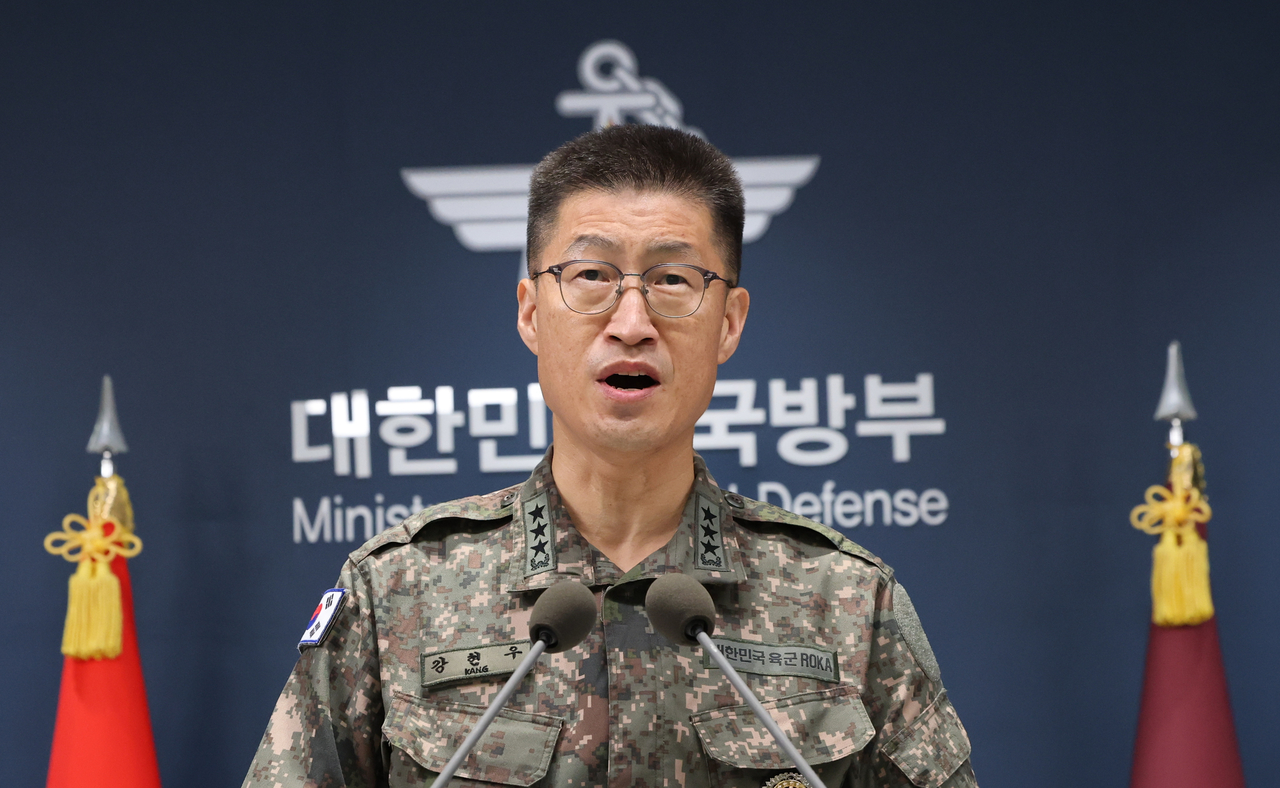
Following the UNC statement Wednesday, Lt. Gen. Kang Hyun-woo, chief director of operations at the JCS, called on North Korea to immediately halt activities that heighten tensions on the Korean Peninsula, including what Pyongyang calls "border fortification" work, urging it to apologize and take responsible measures.
Kang also warned that North Korea would bear full responsibility for any situation that may arise going forward.
An additional North Korean antipersonnel mine was later found near the site of the explosions during an on-site inspection involving South Korean and UNC personnel.
Defense Minister Kang Shin-chul went further than the UNC in assigning responsibility, calling the incident a "clear violation" of the Armistice Agreement and explicitly blaming North Korea.
"It is clearly a violation of the Armistice Agreement, and the responsibility lies with North Korea, so we will take corresponding measures," Kang told lawmakers during a plenary meeting of the National Assembly's National Defense Committee in Seoul on Tuesday.
"If confirmed, we will cooperate with UNC and the international community, and clearly hold those responsible to account," he added.
The UNC, which administers the southern portion of the DMZ and is charged with maintaining and enforcing the Armistice Agreement that halted the 1950-53 Korean War, is led by Gen. Xavier Brunson, who concurrently commands the South Korea-US Combined Forces Command and US Forces Korea.
The command has explicitly assigned responsibility in previous border incidents.
In August 2015, a UNC investigation concluded that the Korean People's Army had violated three provisions of the Armistice Agreement by planting wooden-box mines along a South Korean patrol route in the southern half of the DMZ, severely injuring two South Korean soldiers.
Unlike Wednesday's statement, the UNC at the time explicitly said the North Korean military had violated paragraphs 6, 7 and 8 of the agreement. Investigators also determined that the mines had been recently planted and ruled out the possibility that they were older mines displaced by rain or shifting soil.
South Korea responded to the 2015 incident by resuming anti-North Korea loudspeaker broadcasts along the border.
The UNC has also found Armistice violations involving both Koreas. In May 2020, it concluded that North and South Korea had each violated the agreement after four North Korean rounds struck a South Korean guard post and South Korean troops returned fire.
The command said at the time, however, that it could not definitively determine whether North Korea's initial gunfire was intentional.
flylikekite@heraldcorp.com