Defense Ministry, ruling party unveil revised integration plan retaining service-specific campuses, with Army academy to relocate to Chungcheong region
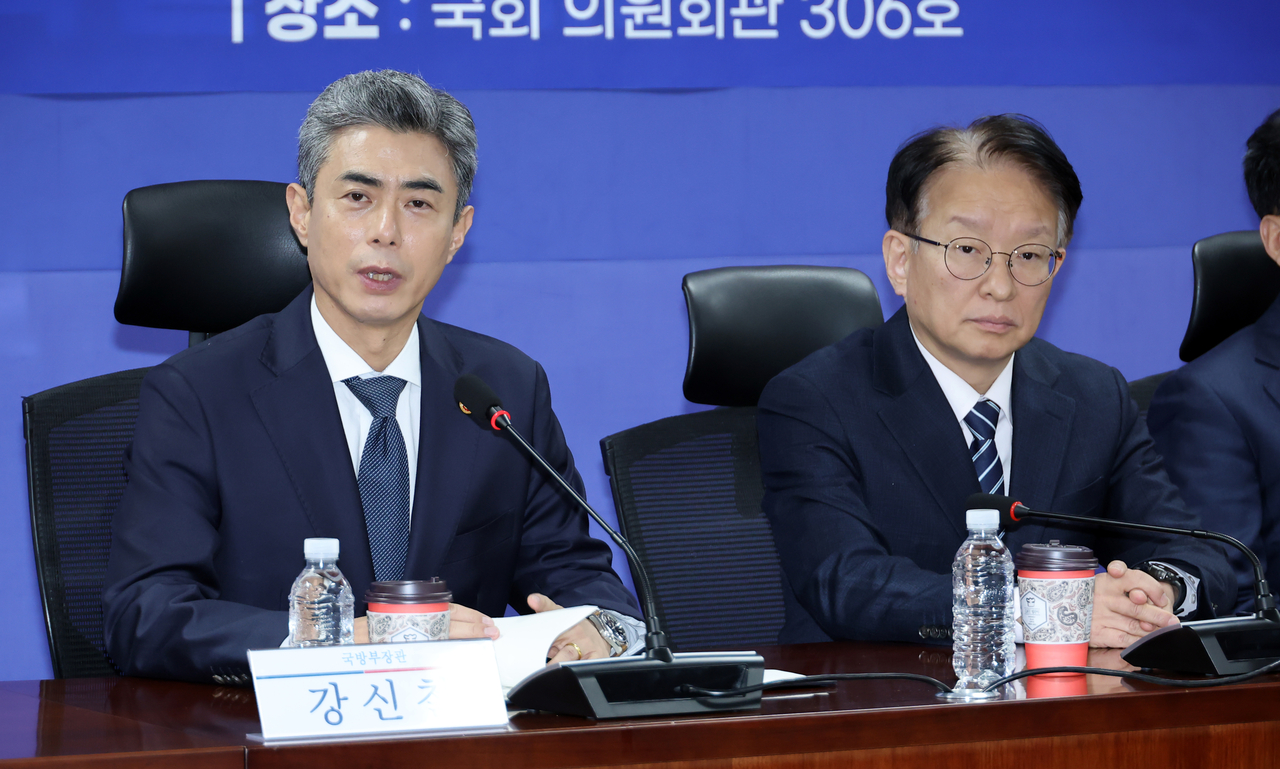
The Defense Ministry and the ruling Democratic Party of Korea on Wednesday unveiled a revised plan to merge the country's three military academies into a single institution, with the first class of cadets scheduled to enroll in March 2029.
Announced after a policy consultation between the ministry and ruling-party lawmakers, the revised plan scales back an earlier proposal for full integration. Instead, each military branch will retain much of its existing education system through separate regional campuses.
Before the meeting, Defense Minister Kang Shin-chul stressed the need to overhaul military education to prepare officers for increasingly complex warfare involving artificial intelligence and advanced technologies.
"The goal of establishing the National Armed Forces Academy is to cultivate elite officers who are loyal to the Constitution and the people and capable of leading victories in future warfare," Kang said.
Following the meeting, Rep. Kim Byung-joo of the Democratic Party said the revisions reflected feedback from military personnel, academy cadets, veterans and civilian experts.
From full integration to separate campuses
Under the original proposal announced in July, cadets from the Army, Navy and Air Force academies would have spent all four years together at a new campus in Daejeon.
The revised plan instead adopts a so-called 1-2-1 system, bringing cadets together for their first year, sending them to their respective service campuses for the next two years and reuniting them for their final year.
First-year cadets would study humanities, philosophy, basic sciences and emerging technologies, while second- and third-year cadets would undergo specialized training tailored to their respective military branches. They would reunite in their final year to develop the skills needed for joint military operations.
The integrated academy's main campus would be established at the Jaun-dae military complex in Daejeon, alongside a new graduate school offering master's and doctoral programs in advanced science, technology and military strategy.
The Navy and Air Force academies would remain at their current locations in Jinhae, South Gyeongsang Province, and Cheongju, North Chungcheong Province, respectively, to preserve specialized training environments.
The Army academy, however, would relocate from the Taereung area in northeastern Seoul to the Chungcheong region, although its exact destination remains undecided.
The ministry plans to introduce the new education system in March 2029, initially conducting first-year integrated training at the existing Army academy campus in Seoul.
Army cadets would also continue their second- and third-year specialized training at the existing campus until the relocation is completed.
The government aims to complete the permanent facilities and Army academy relocation by 2032.
The new system would apply only to cadets entering in 2029 or later, with those already enrolled continuing under the existing arrangements.
Admissions and faculty reform
Under the revised plan, cadets would continue to be recruited separately for each military branch but would enter under the unified academy, with an opportunity to switch branches after their first year.
The ministry plans to announce detailed admission procedures by April 2027.
Marine Corps cadets would be selected separately within the Navy's recruitment allocation and receive specialized training in areas such as amphibious operations, supporting the Lee administration's push toward a quasi-four-branch military structure.
The new academy would operate directly under the Defense Ministry, rather than under the individual armed services.
Its president, either a civilian education specialist or retired military officer, would serve a two-year term, renewable once for a maximum of four years.
The plan also calls for increasing the proportion of civilian professors to 50 percent.
The revised project is preliminarily estimated to cost approximately 1.5 trillion won ($1.1 billion), down from 2.7 trillion won under the original proposal, partly through greater use of existing facilities. The final budget has yet to be determined.
Asked whether integrated education could disadvantage officers commissioned through other routes in future promotions, the ministry dismissed the concern, saying the new graduate school would also offer educational opportunities to officers from those backgrounds.
Army academy relocation draws political scrutiny
Meanwhile, the decision to relocate only the Army academy has raised questions about whether the move could amount to punitive treatment, particularly as the Navy and Air Force academies would retain their existing campuses.
The controversy follows remarks by President Lee Jae Myung during a government briefing at Cheong Wa Dae on Aug. 5, when he questioned why the Army academy had never been held accountable for producing officers involved in three military coups or attempted coups.
His remarks referred to the 1961 coup led by Army academy graduate Park Chung-hee, the 1979 military rebellion led by fellow graduate Chun Doo-hwan and the December 2024 martial law crisis under former President Yoon Suk Yeol, in which several senior officers who graduated from the academy played key roles.
Asked Wednesday whether the relocation was politically motivated, a Defense Ministry official rejected the suggestion, citing educational considerations, including proximity to the integrated main campus and other military education facilities.
The ministry also said the existing Army, Navy and Air Force academy names would no longer be used under the unified institution, despite the retention of separate service-specific campuses.
That position appeared to depart from remarks Kang made during a Nov. 9 meeting with representatives of the three academies' alumni associations, when he said the existing schools would not be abolished and their names would remain.
At the time, Kang also said cadets would receive diplomas from their respective academies, remarks that appeared to ease opposition from alumni groups concerned about losing their schools' identities.
However, a ministry official clarified Wednesday that the institution would operate under a single academy name, although its final official English designation has yet to be confirmed.
flylikekite@heraldcorp.com