A look behind the man known as the 'drug king'
Park Wang-yeol left South Korea a failed businessman and accused of fraud.
Then came a triple murder in a Philippine sugarcane field, two prison escapes, and an international drug ring run from behind bars that stretched back into South Korea.
Repatriated in March, after years of efforts by South Korea, Park was escorted at the airport by several police officers and surrounded by journalists. Seemingly unfazed, he recognized a reporter who had interviewed him while in prison in the Philippines and exposed the VIP life he enjoyed behind bars.
Park turned to the reporter and said on camera, “You’re not even a man.”
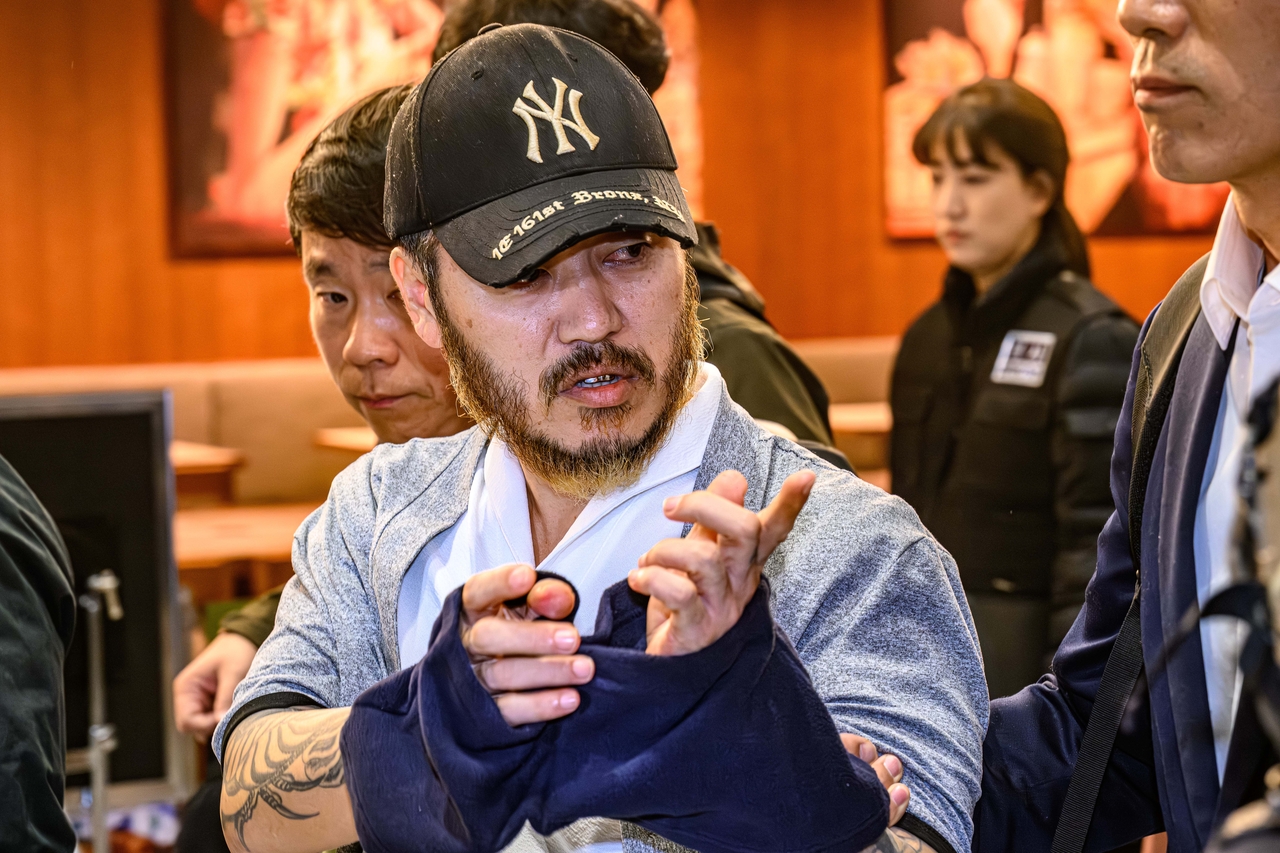
In this episode of True Crime, we follow Park Wang-yeol, whose criminal career sounds like something out of a thriller.
Bloodshed in the Philippines
Long before earning the moniker “drug king,” Park led a surprisingly ordinary life as a businessman.
In the early 2010s, Park ran a seafood distribution business called Juventas, importing fresh tuna and other seafood from the Philippines to sell at local department stores. The business briefly put him in the public eye.
In a 2011 interview with a local media outlet, the then-32-year-old spoke of his ambition to introduce a new dining culture centered on fresh tuna.
After his business failed, Park became involved in the IDS Holdings fraud case, a Ponzi scheme worth nearly 1 trillion won ($744 million). He was not a central figure in that operation, but worked as a recruiter. As authorities began investigating the case and the net tightened around those involved, he fled to the Philippines.
There, Park entered the casino trade as a broker. He brought in Korean clients, guided them through local casinos and quietly took a cut, handling chips, cash and money behind the scenes.
His business brought him into contact with Korean fugitives, gambling operators and local intermediaries, giving him access to people who could provide shelter, move money and help others evade authorities. By 2016, Park was deeply involved in that network.
In August that year, three South Koreans who had defrauded victims of some 15 billion won fled to the Philippines and turned to Park for help. He provided them with a safe house, and in return, they handed him 720 million won in casino investment funds.
But the arrangement took a darker turn when Park and the fugitives reportedly agreed to co-invest in a casino in the Philippines, and soon fell into a dispute over money.
As profits began to flow and the time came to divide the proceeds, Park chose to take all the money — and murder the others.
On Oct. 11, 2016, he lured the three to a sugarcane field in Bacolor, Pampanga province. Days later, the bodies of two men and a woman — all older than 40 — were found with gunshot wounds to the head and bruises on the body. One male victim was found with his legs bound, while the woman’s wrists had been tied, according to the Philippine authorities.
After 37 days on the run, Park was arrested on Nov. 17, 2016, and jailed in the Philippines on charges of murdering three compatriots.
On March 6 2017, just four months after he was jailed, Park escaped by cutting through the ceiling of an immigration detention facility. He was recaptured three months later at an apartment in northern Philippines, where he was found in possession of a large quantity of drugs.
Two years after being reimprisoned, Park escaped for a second time on Oct. 16, 2019. After this escape, he became involved in drug trafficking until he was eventually arrested again on Oct. 28, 2020.
In April 2022, a Philippine court sentenced him to 60 years in prison.
‘Mr. worldwide’
A 60-year prison sentence might have seemed to mark the end of Park’s criminal career. Instead, his time behind bars opened another chapter.
At the Philippine prison where he was held, Park reportedly enjoyed a comfortable life behind bars, playing tennis and meeting acquaintances. Money and connections gave him access to privileges far beyond those of ordinary inmates. He was able to maintain contact with people outside the prison and, allegedly, continued directing criminal operations from his cell.
Among his contacts was a woman known as Sarah Kim, who is believed to have ties to international drug trafficking networks. Investigators said Park learned how modern drug networks operated through her, such as ways to stay anonymous online while incarcerated.
While in jail, Park operated under the alias “jeonsegye,” which translates as “worldwide,” on the Telegram messaging app and funneled drugs into Korea. Park is suspected of using accomplices to smuggle large quantities of drugs from the Philippines into South Korea and distribute them on the domestic market.
Authorities believe he worked through a network of accomplices, using drug couriers and international cargo shipments to bring narcotics into Korea. Once the drugs arrived, domestic distributors allegedly stored them at designated locations and supplied buyers contacted through Telegram.
Drugs linked to Park’s network were funneled into a major domestic distribution ring, giving him a significant share of the illicit drug market — all allegedly directed from his prison cell.
A high-profile crackdown on drug crimes in South Korea led to the arrest of 96 people on Jan. 7, 2021, revealing links between the drug supply chain and Park’s network. The case drew nationwide attention because those implicated included Hwang Hana, a member of the founding family of Namyang Dairy Products, one of South Korea’s leading dairy companies, and several other celebrities.
A man who operated under the Telegram alias “Vatican Kingdom” was also charged with trafficking 640 grams of methamphetamine, 6,364 ecstasy pills, 3,560 grams of ketamine, 39 LSD blotter tabs, 280 milliliters of synthetic cannabis and 90 grams of cannabis between April 12 and Dec. 10 in 2020.
Investigators believe the man sourced the drugs from overseas suppliers, smuggled them in via international courier services, and marketed and sold them through Telegram in South Korea.
Authorities estimate that at least 4.9 billion won worth of drugs passed through the network, though they believe the actual figure is much larger.
Drug kingpin returns to Seoul
South Korean police were aware of Park as a central figure in the drug cases. But he was beyond the reach of Korean investigators, already serving time in the Philippines.
To bring him back to face investigations in Korea, South Korean President Lee Jae Myung personally asked Philippine President Ferdinand Marcos Jr. to temporarily hand Park over during their summit in Manila on March 4.
About three weeks later, on March 25, Park was brought back to South Korea, ending what the presidential office described as years of unsuccessful diplomatic and judicial efforts to investigate him directly.
“The government will thoroughly uncover all criminal acts as soon as Park is transferred into custody and will track down accomplices and criminal proceeds to the end and strictly punish them,” presidential spokesperson Kang Yu-jung said in a statement announcing his repatriation.
Park was detained shortly after arriving in Korea and indicted on April 22 on drug smuggling and distribution charges. At his first trial hearing in May, he denied smuggling drugs into Korea while admitting to distributing drugs through Telegram.
South Korean authorities accuse Park of orchestrating a large drug operation involving the smuggling, distribution and attempted sale of drugs worth 13.1 billion won in Korea. Police say he attempted to distribute 17.7 kilograms of drugs, including 12.7 kilograms of methamphetamine, between November 2019 and August 2024, earning an estimated 6.8 billion won.
But the investigation did not end with his indictment. Prosecutors have since uncovered additional suspected drug offenses, including an alleged attempt to smuggle hundreds of grams of methamphetamine into Korea as recently as January 2026.
As these cases fall outside the scope of the Philippines’ temporary transfer approval, Korean authorities must obtain Manila’s consent before indicting him on the additional charges.
The investigation is also widening beyond Park himself. Officials are tracking down suspected accomplices and working to dismantle the broader international trafficking network linked to him.
That has led authorities to Choi Byung-min, known by the alias “Cheongdam boss,” who allegedly supplied drugs to Park’s Southeast Asian trafficking network. Investigators identified Choi while looking into Park and arrested him in Thailand in April.
As the Korean investigation continues to uncover new suspected crimes and accomplices, authorities are also considering ways to extend Park’s temporary stay in South Korea, allowing them more time to investigate and prosecute the expanding case.
Once the Korean proceedings are completed, Park is expected to be returned to the Philippines to serve the remainder of his sentence there. Only after completing that sentence could he be brought back to South Korea to serve any sentence imposed by Korean courts.