Disputes over reactor models, upfront cash, risk-sharing leave agreement expected this week uncertain
An agreement expected this week concerning South Korea’s $200 billion US investment commitment remains uncertain, as Seoul and Washington seek to resolve differences over nuclear projects, funding schedules and how to share investment risks.
Signs of strain emerged when the Industry Ministry postponed a briefing to lawmakers on the first project under the plan, fueling speculation that negotiations had stalled.
Foreign Minister Cho Hyun played down concerns about a rift before departing for Washington on Thursday.
“It is less a matter of differences between South Korea and the US than of clarifying domestic procedures,” Cho told reporters at Incheon Airport.
Cho said he would clearly convey Seoul’s position and stand firm on issues affecting national interests. He is set to meet US Secretary of State Marco Rubio on Friday, with the Korean Peninsula and broader regional and global affairs also on the agenda.
The Industry Ministry said the disputes cited in media reports remained part of ongoing negotiations and that no decisions had been finalized.
Dispute over nuclear projects
Nuclear power has emerged as a major sticking point.
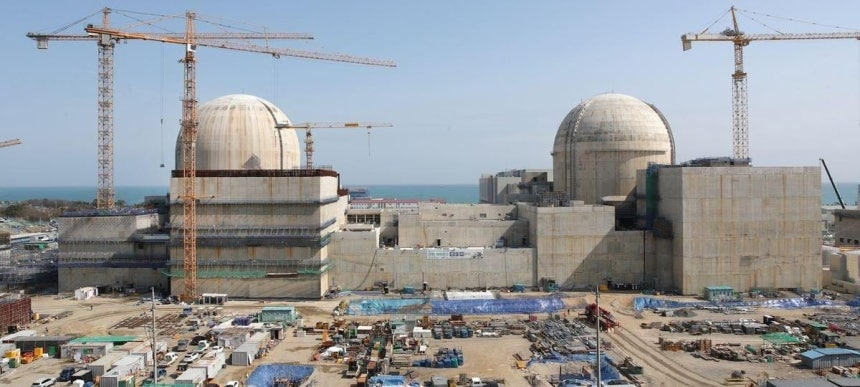
The two sides have discussed building eight reactors in the US — six based on Westinghouse’s AP1000 design and two using Korea’s APR1400 — with Seoul potentially investing $120 billion, or most of its $200 billion commitment.
US officials and Westinghouse have opposed including the Korean model, complicating efforts to finalize the package, the Chosun Ilbo reported Thursday.
Westinghouse provided core technology during the early development of Korea’s nuclear industry and retains leverage over Korean reactor exports under a 2025 intellectual-property settlement.
“Building the APR1400 in the US would mean fewer contracts for American nuclear companies,” an industry official said. “With the November midterm elections approaching, choosing a Korean design would be difficult for the Trump administration.”
The two sides are also reportedly at odds over Seoul’s proposed investment in Westinghouse, which is considering an initial public offering.
Korea is seeking a stake of 15 percent to 20 percent, along with voting rights and a board seat. Westinghouse wants to keep the holding below 10 percent, reportedly the threshold for nominating a director under its shareholder agreement.
Korea’s experience in constructing large reactors could help Westinghouse execute US projects and strengthen its appeal ahead of a potential listing. Seoul, however, wants greater influence over a company whose intellectual-property claims have constrained Korean reactor exports.
Washington has also proposed Korean investment in a US project to process spent nuclear fuel, according to a ruling party official. The proposed technology, known as pyroprocessing, uses molten salt and electricity to recover reusable materials from nuclear waste.
The US had more than 95,000 metric tons of spent nuclear fuel in storage in 2025, according to the US Energy Department.
Upfront payment and risk-sharing
Another dispute concerns how quickly Seoul must transfer funds.
Washington has requested more than 13 trillion won ($9.4 billion) by year-end — nearly half of the plan’s $20 billion annual ceiling — before projects and funding allocations are finalized, Herald Business reported.
The request has raised concerns about pressure on Korea’s public finances and foreign-exchange reserves. Seoul had initially considered providing at least $2.2 billion this year, followed by annual investments of up to $20 billion from 2027 under the 10-year plan.
Korea is also reviewing possible participation in the Alaska liquefied natural gas project promoted by US President Donald Trump. High pipeline costs and uncertain long-term returns remain concerns, while backing the LNG, nuclear and spent-fuel projects could push the total investment beyond the $200 billion ceiling.
Questions also remain over a proposed gas-fired power plant in Encinal, Texas, expected to cost more than $20 billion. Seoul wants Washington to arrange and guarantee long-term power purchase agreements for the plant, which would supply data centers but has yet to secure enough buyers.
The two countries are further divided over how investment returns should be calculated.
Seoul wants profits from successful projects to offset losses elsewhere in the portfolio. Washington favors settling each project separately.
Under the agreed upon framework, the US would receive 90 percent of net profits after principal and interest are recovered. Project-by-project accounting could accelerate US payouts from profitable investments while leaving Korea to absorb losses on unsuccessful ones.
The Industry Ministry reiterated that all options remained under discussion and no final project or funding structure had been decided.
herim@heraldcorp.com