Defense Ministry confirms US request but denies November deadline, while experts warn against reading into on-site assessment team

South Korea's dispatch of an assessment team to the United Arab Emirates should not be seen as a sign that Seoul has decided to send forces to the Strait of Hormuz, experts said Wednesday, as the government weighs possible military support for US-led efforts amid the war with Iran.
The assessment came after the Defense Ministry confirmed Tuesday that a team had traveled to the UAE over the weekend to examine security conditions and operational circumstances around the strait.
The US has asked South Korea for military support related to security in the Strait of Hormuz, but Seoul has stressed that no decision has been made.
The ministry also pushed back against reports that Washington had set November as a deadline for Seoul to deploy military assets.
"It is not true that the United States requested the deployment of our assets to the Strait of Hormuz with a specific deadline," a Defense Ministry official said Tuesday evening.
The US Defense Department did not respond to The Korea Herald's request for clarification on whether Washington had asked Seoul to make a deployment decision, or actually send forces, by November as of Wednesday afternoon.
Among the options reportedly under consideration are P-8A Poseidon maritime patrol aircraft, explosive ordnance disposal personnel and uncrewed mine-detection and clearance systems. The Navy's Soyang-class logistics support ship had also been considered, although its large crew requirement and age have reportedly lowered its priority.

Nothing set in stone
Yu Ji-hoon, an associate research fellow at the Korea Institute for Defense Analyses, said the UAE visit showed that Seoul was seriously examining its options, but not that it had settled on deploying forces.
"The assessment should be seen as a process of determining whether a deployment or another form of contribution is necessary and, if so, what level would be feasible," Yu said.
He said the mission was meant to assess the necessity, effectiveness and risks of a deployment, rather than to justify one already decided.
Depending on the findings, Seoul could opt for a smaller deployment, a different mission or another form of contribution if security risks, readiness concerns or diplomatic costs were judged too high, he said.
Yu said the choice of the UAE also offered some indication of the kinds of missions Seoul may be considering.
"The UAE is geographically close to the Strait of Hormuz and has relatively well-developed military and logistics support infrastructure," Yu said.
He said the country could serve as a rear-area base for noncombat or defensive missions such as maritime surveillance, navigation safety, explosive ordnance disposal and logistics support, rather than placing South Korean forces directly on the front line.
A P-8A could support wide-area maritime surveillance, while explosive ordnance disposal personnel and uncrewed systems could respond to mines and other explosive threats.
"The fact that options such as the P-8A or EOD personnel are being examined does not mean their deployment has already been decided," Yu said.
Shin Beom-chul, a senior research fellow at the Sejong Institute and former vice defense minister, also cautioned against treating a Hormuz deployment as the primary response to Washington, though he said Seoul should keep it among the options under consideration.
"We should first have looked at various options together, including weapons support and the use of the Cheonghae Unit," Shin said.
The Cheonghae Unit has operated in waters off the Middle East since 2009, primarily conducting antipiracy missions and protecting commercial vessels.
Shin said a deployment could benefit ties with Washington, but cautioned against expecting it to resolve broader bilateral issues, including wartime operational control, North Korea policy and Seoul's push for nuclear-powered submarines.
"A deployment could help improve South Korea-US relations, but it cannot immediately solve all the complicated issues between the two countries," he said.
Any decision to send forces would also face a major political hurdle at home.
Under South Korea's Constitution, the government must obtain National Assembly consent before deploying armed forces overseas. Previous overseas missions have gone through that process, including the dispatch of the Zaytun Unit to Iraq under the Roh Moo-hyun administration, which faced strong political and public opposition.
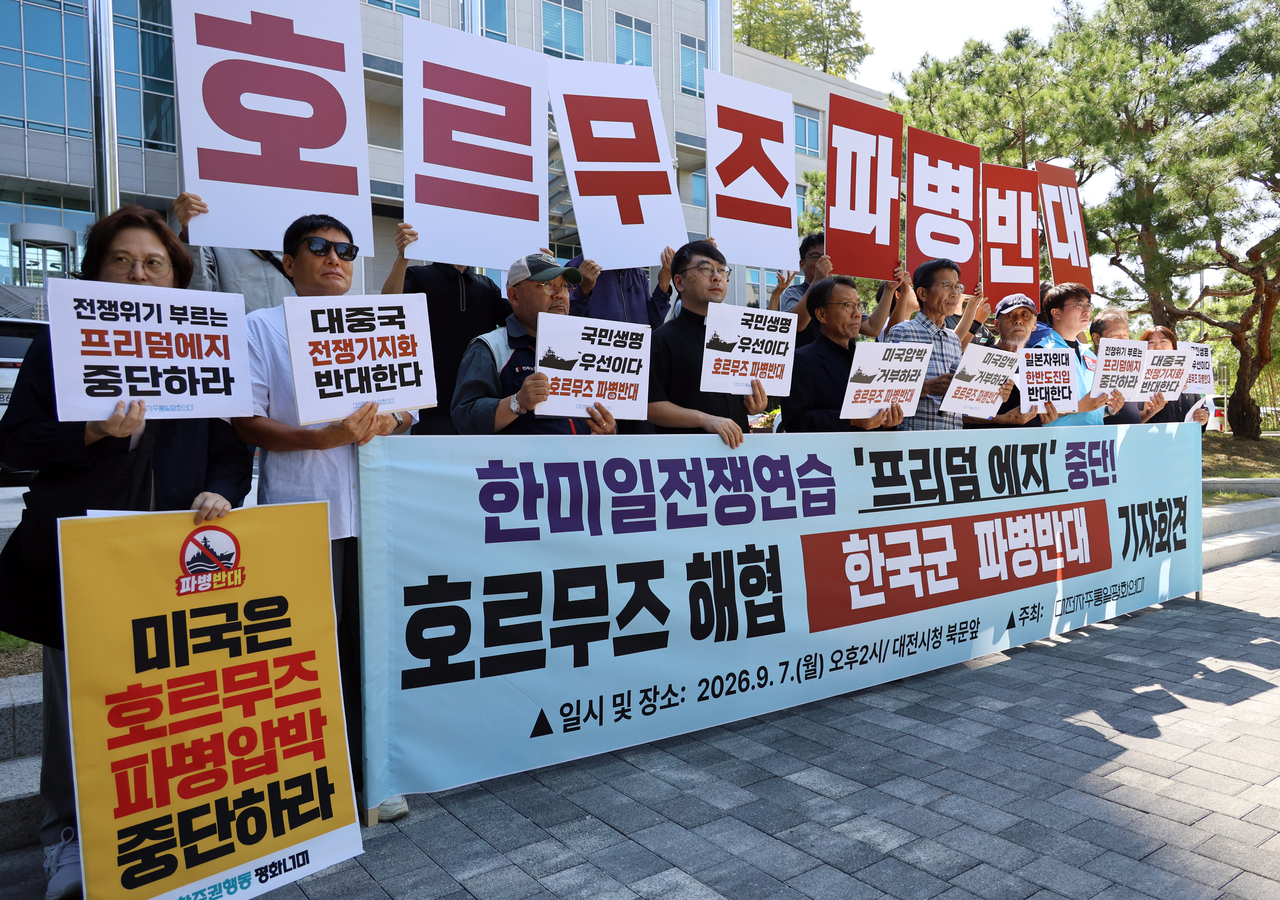
Resistance has already emerged within the ruling camp, with several Democratic Party of Korea lawmakers arguing that sending even noncombat forces to Hormuz could amount to participation in the US war against Iran.
Strategic calculus
Despite those concerns, Shin said Seoul had strategic reasons not to rule out a contribution altogether, particularly as Washington and Pyongyang explore the possibility of renewed dialogue.
He said the government's changing approach may partly reflect concern that Seoul could be sidelined if direct US-North Korea talks resume.
"At a time when the United States could hold talks with North Korea and South Korea could be sidelined, isn't the government trying to restore its relationship with Washington through a deployment?" Shin said.
He also said a contribution could have longer-term alliance value by giving Seoul stronger grounds to seek US support in a future security crisis.
"If South Korea decides to deploy, it would leave a track record that South Korea supported the United States in its war," Shin said. "That could become a strong basis for asking the United States for support if the Korean Peninsula later faces a serious crisis."
flylikekite@heraldcorp.com