Ahn, Hegseth discuss OPCON transfer, nuclear-powered submarines
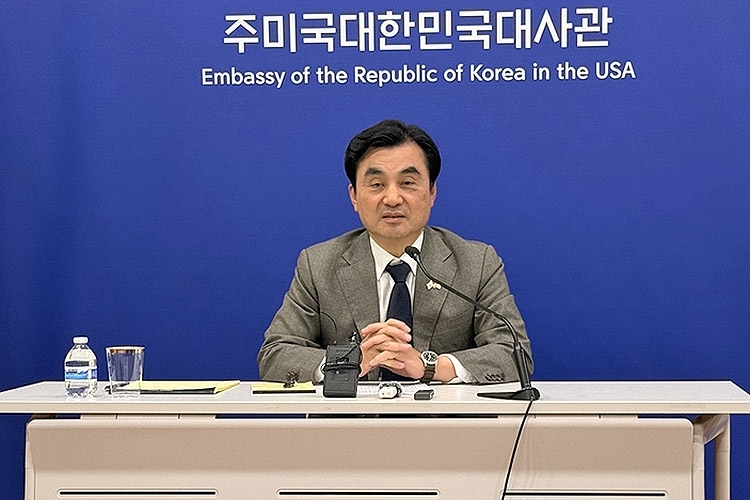
South Korea has informed the US that it is willing to consider phased contributions to efforts to restore safe maritime transit through the Strait of Hormuz, Defense Minister Ahn Gyu-back said Tuesday.
Speaking to reporters at the South Korean Embassy in Washington after talks with US Defense Secretary Pete Hegseth, Ahn said Seoul would review “step-by-step” ways to contribute as a “responsible member of the international community.”
Ahn has been in Washington since Monday for annual ministerial-level defense talks with his US counterpart. The visit is scheduled to continue through Thursday.
“We said we would participate in principle and consider phased measures for contribution,” Ahn said, referring to discussions on restoring normal shipping operations in the Strait of Hormuz.
According to Ahn, the options discussed included expressing political support, dispatching personnel, sharing information and potentially providing military assets. He went on to stress that any decision would be made in accordance with both international and domestic legal procedures.
His remarks came after US President Donald Trump and Hegseth publicly called on allies, including South Korea, to support efforts to secure maritime routes in the Gulf region.
During opening remarks at Monday’s South Korea-US defense ministerial talks, Hegseth also urged Seoul to “stand shoulder to shoulder” with Washington regarding the conflict involving Iran.
The issue has gained urgency after a fire aboard the South Korean-linked HHM Namu vessel in the Strait of Hormuz was determined by Seoul to have been caused by an external attack. South Korea’s presidential office previously condemned the incident and pledged continued participation in international efforts to ensure maritime security and freedom of navigation.
Ahn said Seoul and Washington had held extensive discussions regarding the incident and that the South Korean government is conducting a joint investigation. He added that the South Korean military could provide technical analysis and advisory support to the United States if necessary.
The defense minister also said he and Hegseth shared an understanding on pursuing the transfer of wartime operational control, or OPCON, under a conditions-based framework while seeking to accelerate the transition.
While peacetime OPCON was returned to South Korea in 1994, wartime OPCON has remained under US authority since the 1950-53 Korean War. The Lee Jae Myung administration seeks to complete the transfer during its term, which ends in 2030.
Ahn said he outlined Seoul’s efforts to increase defense spending and secure key military capabilities as part of preparations for a South Korea-led defense posture on the Korean Peninsula.
The two sides also discussed Seoul’s push to build nuclear-powered submarines, which Ahn described as a major alliance issue requiring separate consideration from economic matters.
Still, Ahn acknowledged that differences remain between Seoul and Washington over aspects of the OPCON transition, particularly regarding conditions and timing.
Referring to remarks made last month by Gen. Xavier Brunson, commander of the South Korea-US Combined Forces Command, suggesting that conditions for OPCON transition could be met before the first quarter of 2029, Ahn said such assessments reflected military-level views and that the final decision would ultimately be a political one made by the leaders of the two countries.
Meanwhile, Ahn added that the talks did not include discussions on a possible reduction of US Forces Korea troops, the strategic flexibility of USFK or the redeployment of the THAAD antimissile system from South Korea to the Middle East.
flylikekite@heraldcorp.com