South Korea's defense budget is set to surpass 70 trillion won ($51 billion) for the first time next year, as Seoul accelerates its push to transfer wartime operational control and build up domestic defense capabilities.
Of the record 820.9 trillion won proposal approved by the Cabinet on Tuesday, 73.28 trillion won was allocated to defense, up 8.2 percent from 67.7 trillion won in 2026 — the steepest increase in nearly two decades. The government plans to submit the proposal to the National Assembly on Thursday.
Until this year, the budget primarily covered force operations under the Defense Ministry and weapons acquisition overseen by the Defense Acquisition Program Administration. From 2027, military manpower administration, handled by the Military Manpower Administration, will also be included along with other defense-related spending.
“The 2027 defense budget focuses on strengthening self-reliant defense and shifting from a manpower-centered force to one centered on advanced technology,” the Defense Ministry said.

Expanding domestic capability
About 21.3 trillion won has been allocated to capabilities related to the OPCON transition, up from 18.6 trillion won this year. The Lee Jae Myung administration seeks to complete the transfer before President Lee's term ends in 2030.
A key part of that effort is strengthening South Korea's ability to lead combined South Korean and US forces, and independently detect and respond to North Korean threats.
The budget includes upgrades to air-ground communications and a new wartime military information distribution system, while accelerating deployment of a medium-altitude surveillance drone and the L-SAM long-range surface-to-air missile system.
Under the allies' conditions-based OPCON transfer plan, Seoul must demonstrate sufficient command and control capabilities, as well as the ability to respond to North Korea's nuclear and missile threats, before the transition can take place.
The government is also sharply increasing spending on the KF-21, with production funding rising to about 3.3 trillion won from this year's 1.4 trillion won.
The 4.5-generation fighter completed development in July, more than a decade after the program to replace the Air Force's aging F-4 and F-5 fighters began in 2015. Initial production is underway, and about 150 billion won has been allocated to begin follow-on production in 2027.
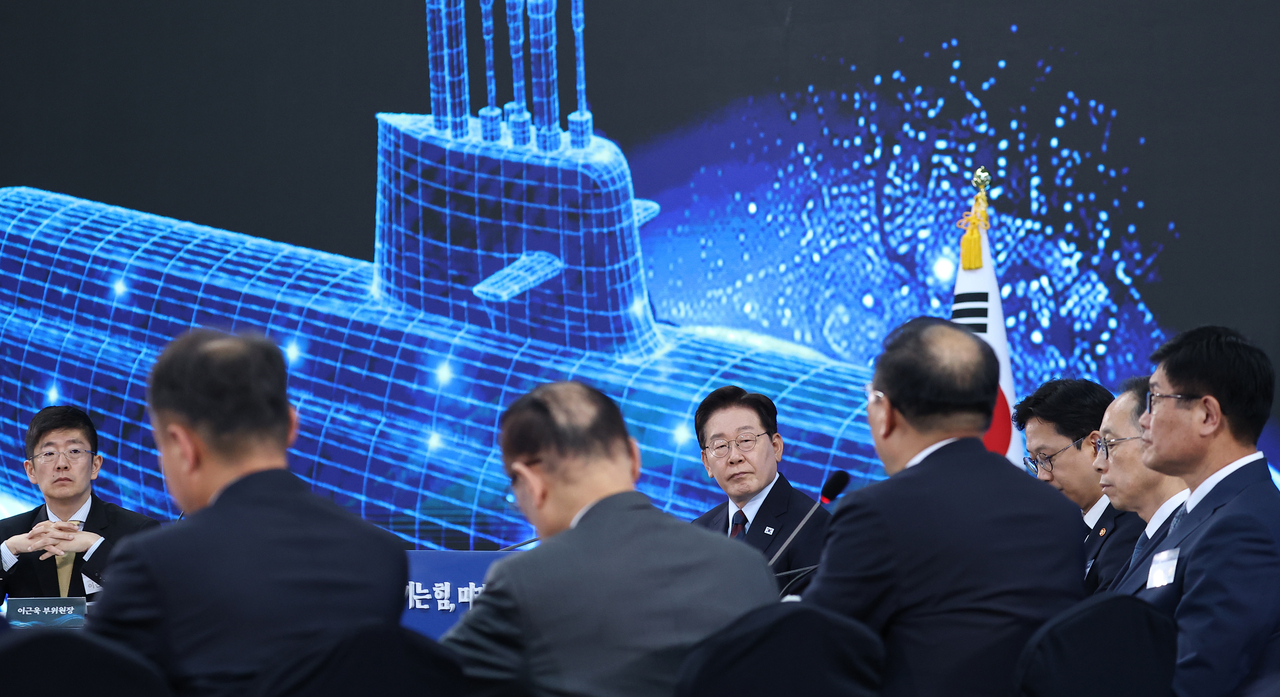
The budget also includes nearly 100 billion won for South Korea's nuclear-powered submarine program for the first time.
Washington formally approved Seoul's plan to build nuclear-powered attack submarines in a joint fact sheet released last November following Lee's summit with US President Donald Trump in October 2025. The US also agreed to work with South Korea on ways to source nuclear fuel for the submarines.
Officials said next year's funding would cover initial design work, related facilities and nuclear-related reviews. But the program remains in an early stage, with its total cost and detailed development schedule yet to be determined.
Still short 3.5 percent
The budget increase also comes after Lee told Trump that South Korea planned to raise defense spending to 3.5 percent of gross domestic spending as soon as possible, as Washington pressed Seoul to shoulder a greater share of the defense burden.
The commitment was later included in the November 2025 joint fact sheet, with Trump welcoming Seoul's plan to increase defense spending.
Even with the sharp increase proposed Tuesday, however, defense spending would account for an estimated 2.33 percent of GDP next year, up slightly from 2.28 percent this year.
The ratio reflects government projections for nominal economic growth, meaning the defense budget's share of GDP rises only modestly despite the 8.2 percent spending increase.
Ministry officials said the broader calculation of defense spending was not adopted to help meet the 3.5 percent target, noting that military manpower administration accounts for only about 525 billion won and has little impact on the GDP ratio.
They also did not specify when South Korea would reach the 3.5 percent level, saying the timetable could change with economic growth and future defense spending plans.
The proposal also addresses South Korea's shrinking pool of military-age personnel by nearly doubling full-time reservists from 3,700 to 7,000 and testing civilian outsourcing of some noncombat duties.
Defense AI funding would more than double to 361 billion won, alongside investments in drone swarms, attack and exploding drones, and counter-drone systems.
Diplomacy budget rises but ODA falls again
Among other ministry budgets unveiled Tuesday, the Foreign Ministry's spending plan is set to rise 2.4 percent next year to 3.7 trillion won, while its official development assistance budget will fall for a second consecutive year.
ODA spending under the ministry would decline 1 percent to 2.16 trillion won from 2.19 trillion won this year, following a cut of more than 600 billion won. Government-wide ODA spending would also fall 2.1 percent to 5.24 trillion won.
The government plans to focus the smaller aid budget on areas tied to national interests, including artificial intelligence, culture, technology, summit diplomacy and supply chain security.
Meanwhile, the Foreign Ministry's cybersecurity budget would more than quadruple to 15.5 billion won from 3.8 billion won following a cyberattack on the Korea National Diplomatic Academy's online education system that is believed to have exposed up to 10,000 records.
Funding will also increase for overseas diplomatic facilities, while new budgets have been set aside for preparations to chair the Group of 20 summit in 2028 and for AI diplomacy.
flylikekite@heraldcorp.com