MANILA — Hours before a group of South Korean reporters was due to visit the Korean Help Desk on Aug. 10, a typhoon swept through the Philippine capital, prompting authorities to order government employees to work from home.
By the time the scheduled visit began, the downpour had eased. In Malate, one of Manila's busiest commercial and nightlife districts, Philippine police maintain a visible presence around the neighborhood frequented by hundreds of Koreans each day.
The patrols are part of broader efforts to protect Korean nationals in a country where safety has drawn growing attention over the past decade, particularly following a series of high-profile crimes.
In one of the most notorious cases, Philippine police officers kidnapped and killed a South Korean businessman in 2016, shocking both countries and intensifying calls for stronger protections for Korean nationals.
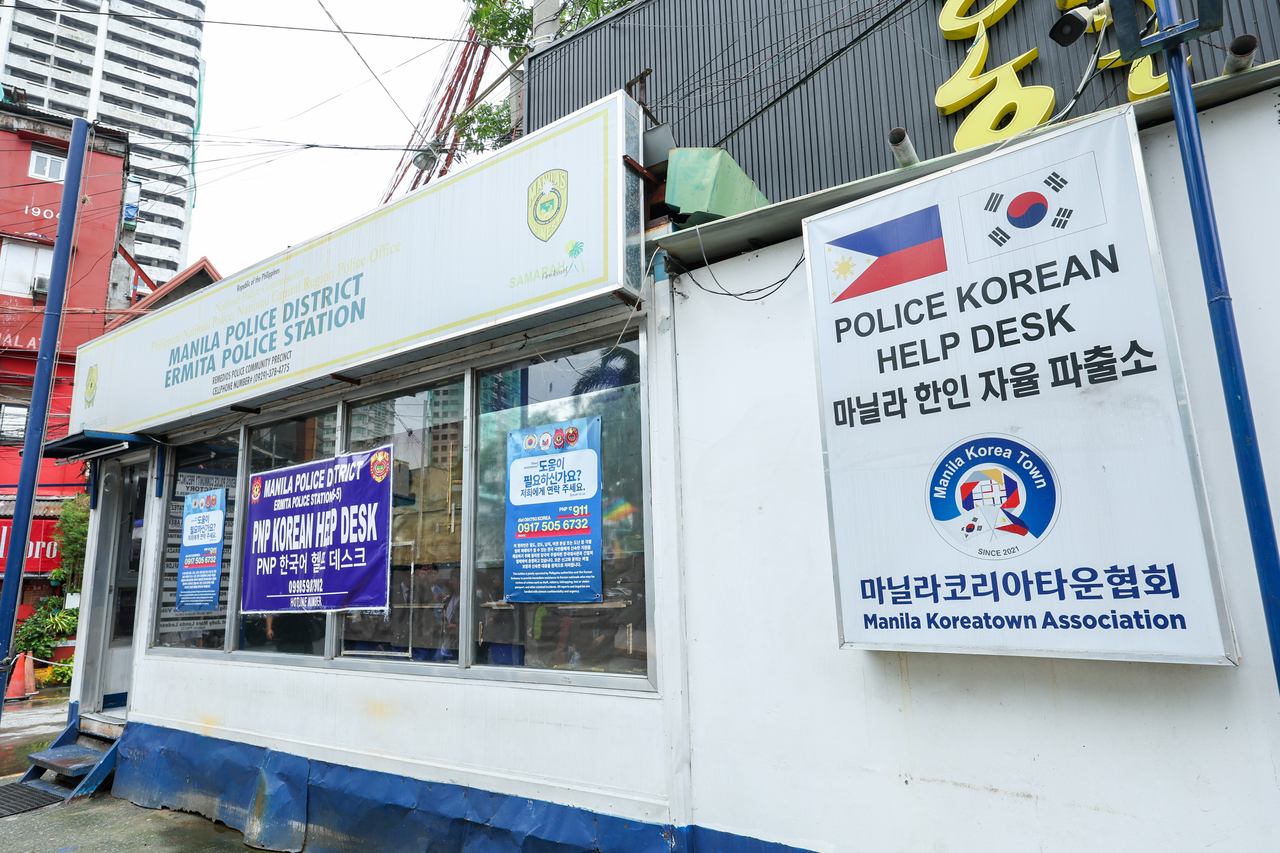
A decade later, police patrol Malate's streets while surveillance cameras and emergency communication networks operate alongside the Korean Help Desk. The 24-hour service is part of a Philippine police effort to provide Korean nationals with direct access to law enforcement in areas heavily frequented by Korean residents and tourists.
Malate's Koreatown covers 37,160 square meters and is home to approximately 500 Korean nationals and around 100 Korean-owned businesses, according to data presented by the Manila Police District.
Restaurants, bars, shops and other businesses crowd the neighborhood, making it one of Manila's busiest commercial and nightlife areas. About 700 Koreans visit the area each day, adding to the heavy pedestrian and vehicle traffic.
Philippine police have assigned 48 officers to the Korean Help Desk in two shifts, for around-the-clock assistance.
Their work extends beyond simply taking reports: Officers conduct foot and mobile patrols in areas with large Korean populations and major tourist destinations, investigate reported crimes, and coordinate responses with other agencies.
When an incident occurs, local officers, the Korean Help Desk and the South Korean Embassy in the Philippines can quickly exchange information and coordinate follow-up action.
Police also work with local barangays — the Philippines' smallest administrative units — businesses and other community stakeholders.
On the streets of Koreatown, signs of the system were easy to spot.
Surveillance cameras watch busy intersections, and crime-prevention notices are posted outside Korean-owned establishments. Police officers patrol the area on foot and on motorcycles, maintaining a presence intended both to deter crime and to respond quickly when it occurs.
With support from the South Korean government, 36 CCTV cameras have been installed across the neighborhood, along with emergency call buttons on major streets.
Police also carry out checkpoint operations and regularly distribute crime-prevention information through posters, leaflets and social media.
Language is another part of the equation. Korean-language assistance and interpretation services are available to reduce one of the most immediate obstacles Korean victims can face when seeking help from local authorities.
The system in Malate is part of a broader effort launched last year.
In August 2025, Philippine police established eight Korean Help Desks across Manila, Angeles and Cebu — three destinations frequented by Korean residents and travelers — to strengthen responses to crimes involving Koreans. The National Capital Region Police Office provided an additional 180 personnel to reinforce security operations.
Police say the stepped-up presence is producing results.
According to Manila Police District data presented to a group of Korean reporters, 16 cases involving Korean victims were recorded in Koreatown between Aug. 1, 2025, and July 31 this year. They comprised seven serious crimes, seven minor offenses and two traffic-related cases.
Eight cases involving Korean suspects were recorded over the same period, including two serious crimes and six minor offenses.
Police claimed the crime clearance rate reached 100 percent in both halves of the year, with no cases left unresolved. Crime solution efficiency rose from 40 percent to 66 percent, while the crime rate, taking into account the area's population and foot traffic, declined from 0.87 to 0.52, according to the police presentation.
A killing that changed the conversation
Behind today's heightened focus on Korean safety in the Philippines lies a far darker episode in the two countries' recent history.
In October 2016, South Korean businessman Jee Ick-joo was abducted from his home in Angeles City by Philippine police officers posing as members of an anti-drug operation.
He was taken to the headquarters of the Philippine National Police, where he was killed — a crime that shocked South Korea not only because of its brutality, but because police officers themselves had been implicated.
The case remained a sensitive issue between Seoul and Manila for years.
Rafael Dumlao, a former officer with the Philippine National Police's Anti-Illegal Drugs Group and a key suspect in the case, was acquitted at trial in 2023. An appeals court overturned that decision in 2024 and sentenced him to life imprisonment, but he fled before the sentence could be enforced.
It eventually reached the highest levels of diplomacy.
During their summit in October 2024, then-President Yoon Suk Yeol and Philippine President Ferdinand Marcos Jr. discussed the need to resolve the case and apprehend the fugitive.
President Lee Jae Myung again raised the issue with Marcos during their summit in March this year.
Dumlao remained at large for nearly two years before Philippine police arrested him in Quezon City on June 9, following close coordination between authorities in Seoul and Manila.
The case underscored a fundamental challenge facing both governments: how to ensure that the large numbers of Koreans who live, work and travel in the Philippines can turn to local authorities when they need help.
At a briefing for South Korean journalists participating in an ASEAN-Korea Center journalist exchange program, Manila Police District acting district director Arnold C. Santiago described cooperation over Korean safety as part of the broader relationship between Seoul and Manila.
Santiago said the journalists' visit offered an opportunity to reaffirm the countries' "strong partnership" based on mutual respect, trust, peace and regional cooperation, while pledging continued efforts to protect Korean nationals.
However, despite ongoing efforts, there is also a need for Seoul and Manila to strengthen their broader criminal justice cooperation, observers say, particularly in tracking fugitives and ensuring that convicted offenders do not slip through gaps between the two countries’ legal and law enforcement systems.
South Korea and the Philippines already cooperate under bilateral arrangements covering extradition and mutual legal assistance in criminal cases. But the Jee case — in which a key suspect was able to remain at large after his acquittal was overturned — underscored the importance of faster information-sharing and closer coordination among police, judicial and immigration authorities.
mkjung@heraldcorp.com