Mayor-elect says Suncheon, Muan and Gwangju complexes to all act as 'main headquarters,' despite legal address being based in Suncheon
A regional standoff over where to locate the main city hall of the Jeonnam-Gwangju Special City is intensifying ahead of the municipality’s launch Wednesday.
Gwangju and South Jeolla Province sealed a merger deal on Jan. 27 to create South Korea’s third-largest jurisdiction outside the greater Seoul area. But the western and eastern regions of the new municipality remain at odds over where to locate the city’s headquarters.
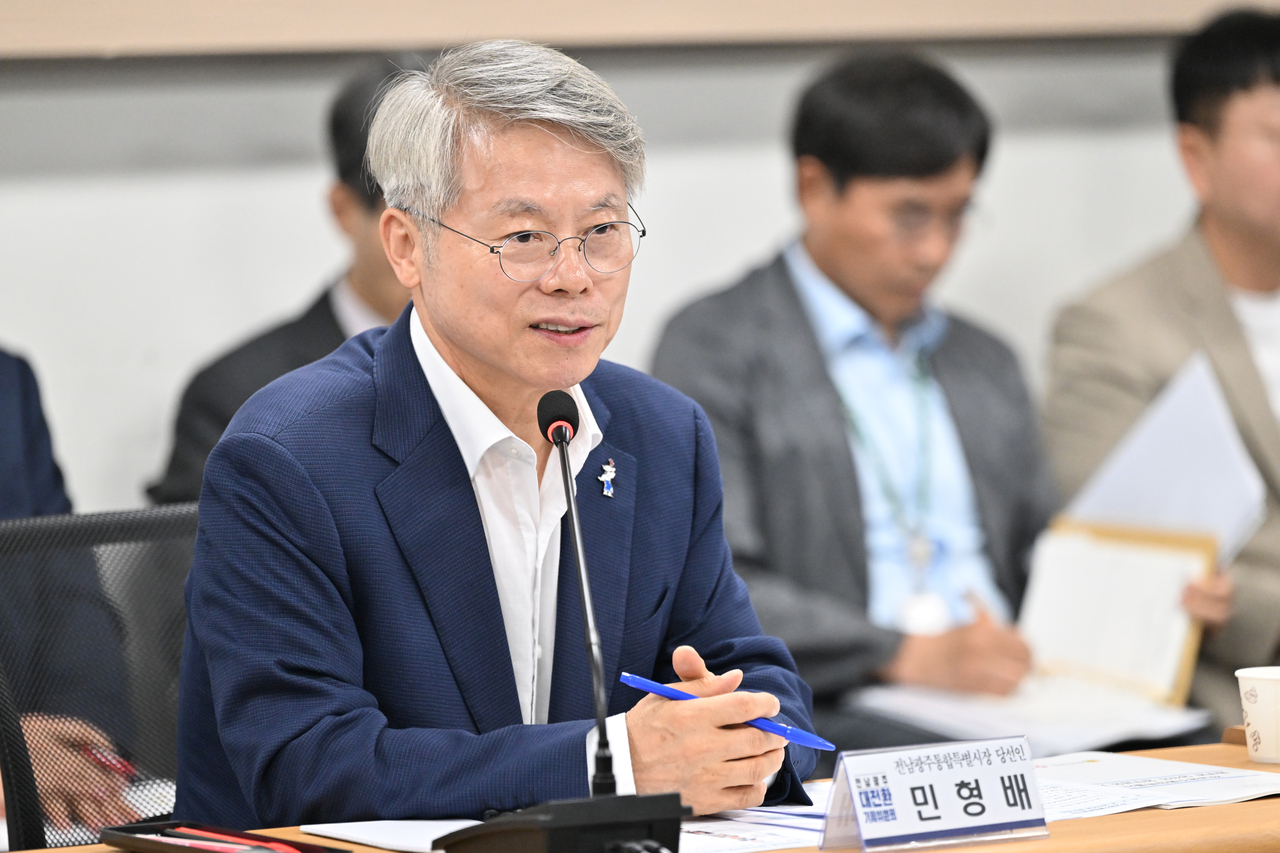
Mayor-elect Min Hyung-bae said he plans to designate the current Jeonnam Eastern Provincial Government Complex in Suncheon as the legal address of the new city hall, sparking opposition from residents and officials in Gwangju and Muan, the current seat of the South Jeolla Provincial Government.
“The complexes in Gwangju and Muan are large, while the eastern complex in Suncheon is somewhat smaller,” Min said in a televised interview.
“I think the address should be at the complex with the smallest size,” he added, stressing the need for balanced growth.
Municipality's western region cries foul
Local mayors and council members in the western part of the new municipality expressed opposition.
“The main headquarters should be located in Muan for balanced growth,” elected officials from seven western regions of the city said in a statement. “The western region has suffered from population decline, a weakening industrial foundation and an outflow of young adults.”
“It doesn’t make sense to send the headquarters to the smallest complex,” Mokpo Mayor-elect Kang Seong-hwi said.
Democratic Party of Korea lawmaker Seo Mi-hwa on Friday also called on Min to designate the Muan complex as the new municipality's headquarters.
"Regional conflicts are arising because only the size of the complexes was mechanically taken into account," Seo said, adding that the conflict of where to locate the headquarters' main address could act as a risk factor hindering future investments and industry relocations.
"Failing to name the Muan complex as the city's main headquarters could result in a great waste of taxpayer money," she added.
Although a proportional representative, Seo is a longtime resident of Mokpo, the largest city on the western coast of the South Jeolla Province.
'All three are main headquarters,' says mayor-elect
As the controversy intensified, Min’s transition committee sought to quell dissent by saying all three regions would be considered “main headquarters.”
“The mayor-elect’s principle is clear,” said Yang Eun-sook, the mayor-elect’s spokesperson. “The Suncheon, Muan and Gwangju complexes will all be operated in balance. All three are the main headquarters.”
“Unbiased balance is the absolute principle of the integrated special city,” Yang added. “Creating a single pole within the integrated special city, which was created for region-driven growth, runs directly counter to the spirit of integration.”
Yang said the current complex in Suncheon would hold the headquarters’ legal address and serve as the center of the provincial government’s industrial and economic functions. She added that the complex would be expanded.
Meanwhile, two vice mayors would work from the Muan office, which the committee described as the “citizen sovereignty” headquarters. The Gwangju complex would serve as the center for political affairs and administrative maintenance.
Min will work out of all three headquarters on a rotating basis.
“This vision of the mayor-elect will be sufficiently reviewed by the transition committee before being officially announced,” Yang said. “Throughout this process, we will hear opinions from a wide range of citizens and experts and communicate closely with the city council.”
Critics, however, say the transition committee’s vague plan is creating confusion among citizens and officials.
“It is questionable whether there was sufficient communication between the mayor-elect and the transition committee,” a South Jeolla Province official working in Muan told local media Weekly Chosun. “Many public officials and citizens are asking, ‘So what are they saying they are going to do?’”
“Looking at the transition committee’s announcement, it seems like not much has been decided.”
Eastern region also remains skeptical
Officials in the eastern region, where the headquarters’ legal address will be based, are also skeptical of Min’s plan.
“What’s important is not where the main headquarters is located, but whether administrators follow through with their plans,” said Han Moon-sun, head of the Yeosu Chamber of Commerce.
“The Suncheon complex should not remain merely a symbolic address for the headquarters, but must become the real city center, leading the integrated special city’s planning, budget and human resources,” said Joo Cheol-hyun, a city council member representing Yeosu’s A constituency.
The integrated city will reunite Gwangju and South Jeolla Province 40 years after the two separated in 1986. The new special city will encompass 3.2 million people and 159 trillion won ($104 billion) in gross regional domestic product.
The municipality will become the country’s third-largest regional economy, trailing only Seoul and Gyeonggi Province.
The Lee Jae Myung administration has also pledged to inject 5 trillion won annually into the city for four years.
seungku99@heraldcorp.com