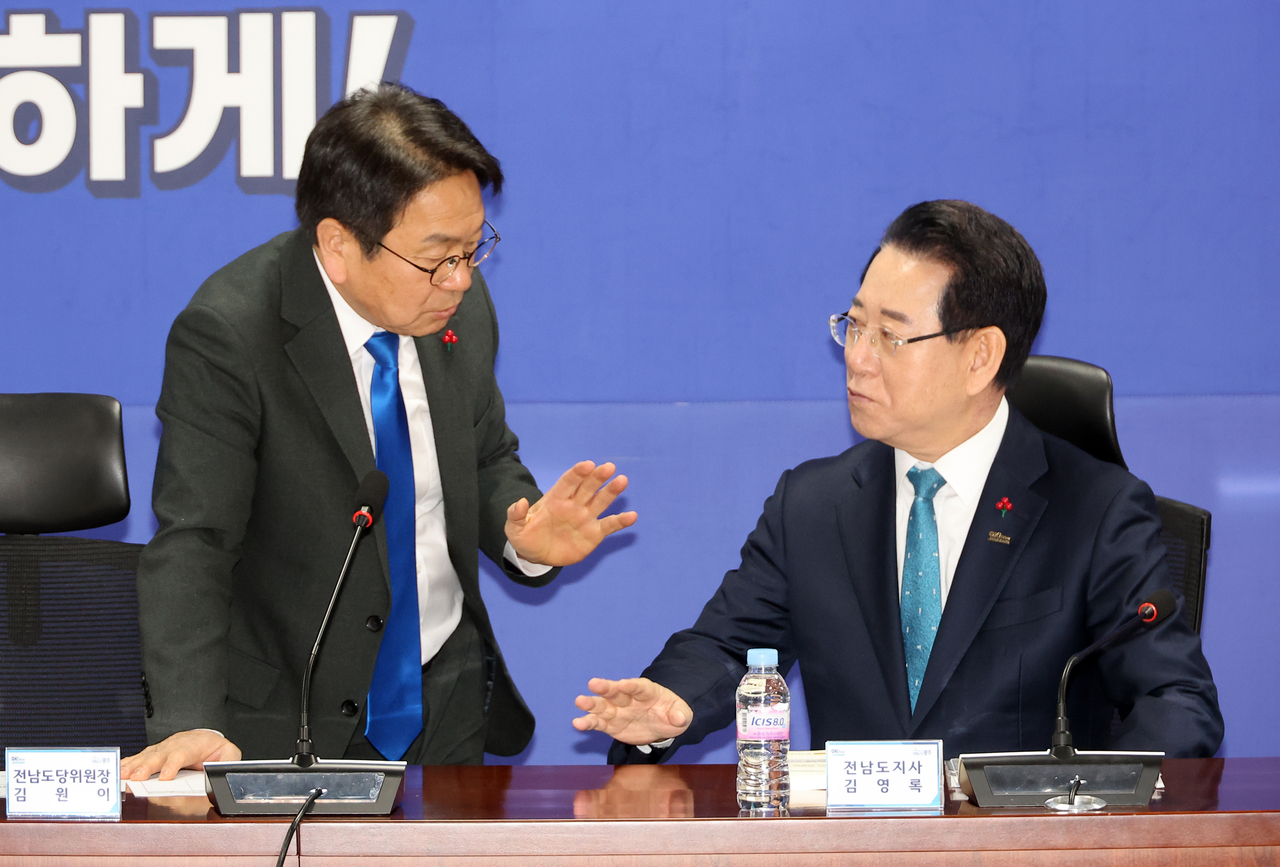
Gwangju and South Jeolla leaders reached an agreement Tuesday on the name and administrative framework of their proposed merged municipality, clearing a key step toward advancing a special bill that would authorize the integration.
The unified region would have about 3.2 million residents, making it Korea’s third-largest jurisdiction outside greater Seoul.
Gwangju Mayor Kang Gi-jung, South Jeolla Gov. Kim Yung-rok and senior ruling Democratic Party lawmakers said the merged entity would be called Jeonnam-Gwangju Special City, a name tentatively translated into English, with Gwangju Special City as its short form.
Officials expect that the Lee Jae Myung administration intends to grant the unified municipality a status comparable to Seoul, elevating it to a coequal administrative tier with expanded autonomy.
Under the agreement, government functions would be distributed across three locations — eastern South Jeolla, Muan and Gwangju — with the final headquarters location left to the first special-city mayor, who will be elected on June 3.
Kang said naming a headquarters now risked hindering progress.
“We agreed that deciding it now would hinder integration, so the matter will be left to the first mayor,” he said after the meeting at the National Assembly. Gov. Kim called the arrangement a step toward balanced regional administration.
Lawmakers plan to submit the special integration bill on Wednesday.
If passed, preparations for launching Jeonnam-Gwangju Special City will begin in March, followed by the mayoral election in June and the official launch on July 1, marking the first reunified administration since Gwangju and South Jeolla were separated four decades ago.
Prime Minister Kim Min-seok has pledged major fiscal incentives, priority relocation of public institutions and expanded administrative authority for the new entity, including the ability to appoint multiple vice–minister-level officials.
The push comes as administrative-integration efforts gain momentum nationwide, driven by concerns over regional population decline, the need to build competitive megacities and the benefits of establishing new administrative units ahead of the 2026 local elections.
After Daejeon–South Chungcheong advanced their integration plan, Gwangju–South Jeolla has moved quickly, with Daegu–North Gyeongsang and Busan–South Gyeongsang also joining the debate.
hnpark@heraldcorp.com











