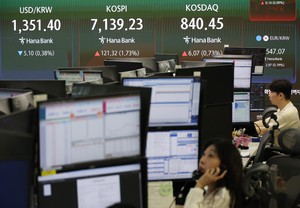
We never had it so good. The S&P 500 and Nikkei 225 just hit record highs. SpaceX had its spectacular initial public offering, raising an eye-popping $75 billion (the largest IPO in history) with a sharp rise in share price to a mind-blowing valuation of $2.5 trillion. The possibility of a US-Iran deal to reopen the Strait of Hormuz has caused gasoline prices to drop back to below $4 per gallon, or about $1 per liter. Global stock markets are creating wealth for portfolio investors that seems unstoppable.
Bull investor Ed Yardeni is calling the S&P 500 Index at 8,250, meaning a year-on-year return of 33 percent after three consecutive years of double-digit returns. US companies are still recording bumper profits, driven by artificial intelligence, financial firms and consumer giants. Let's connect some dots of boom-or-bust noise that cloud underlying investment signals.
Firstly, the doomsters are also flagging warning signals. The World Bank's latest global projections think that global gross domestic product growth will slow to 2.5 percent in 2026, down from 2.9 percent last year, mainly due to greater tensions in the Middle East and higher oil prices. Veteran monetarist Steve Hanke thinks a financial crash is inevitable based on advanced country debt levels and monetary stance, but he doesn't know when it will happen.
On June 10, the US Fed Open Market Committee under new Chairman Kevin Warsh held Fed Funds rates at the current 3.5-3.75 percent range, but took what appeared to be a hawkish stance on keeping price stability amid strong productivity growth. With 30-year US Treasurys yield hovering around 5 percent per annum, even as consumer prices spiked to 4.2 percent in May, the average interest costs of US sovereign debt of $39 trillion are roughly 3.4 percent per annum and scheduled to be over $1 trillion, or just under 19 percent of federal government revenue.
US Fed monetary policy is not independent of monetary policy in two of the largest surplus economies, Europe and Japan. The European Central Bank just hiked interest rates by 0.25 percent on June 11 given higher inflation rates. The Bank of Japan hiked interest rates to 1 percent, the highest since 1995, with concerns over inflation and yen weakness. Japanese intervention to defend yen devaluation beyond 160 to $1 inevitably means selling US Treasurys, which will keep long-term Treasury yields high. Japan's holdings of US securities fell $73 billion in May, even as Japanese 30-year Japanese Government Bond yields hit a record 4.16 percent per annum in May, meaning that the differential between US and Japanese sovereign debt 30-year yields is narrowing to around 1 percent, compared to 3 percent as late as October 2023.
The narrowing gap suggests that long-term investors such as Japanese insurers and pension funds would prefer to go back to yen holdings to avoid foreign exchange risks. This has augured well for the Japanese stock market, but the convergence of global interest rates will force a rerating of holdings in US dollar assets. As investors worry over US fiscal debt sustainability, global asset rebalancing occurs and global interest rates normalize because there is a credit risk premium now attached to US government debt, which used to be zero.
Secondly, unlike the bond market, the US stock market is compensating in terms of return for holding US dollar assets, with US stock market capitalization at $62.2 trillion, just under half of global stock market capitalization, but its spectacular growth is more recently narrowly focused on 10 AI-related stocks. The combined valuation of SpaceX and Anthropic+OpenAI (waiting for IPOs) is an estimated $4.5 trillion, lower than Nvidia's market valuation of $5 trillion. Putting things into perspective, Nvidia has a larger market cap than the London Stock Exchange ($4.4 trillion).
How the market is valuing these high-tech companies is nothing short of amazing. In its prospectus document, the estimated net revenue of SpaceX in the year to March 2026 is negative to the tune of $4.9 billion. Investors are valuing Anthropic using its annualized run revenue based on revenue estimated at $47 billion for 2026. This allowed Anthropic to raise $65 billion to achieve a post valuation of $965 billion in May. Using the same logic, OpenAI raised $122 billion to reach a market valuation of $852 billion in March.
The market is betting that these three companies will deliver superior future net profits to justify their valuations, but in essence they are betting on the ability of Elon Musk and key entrepreneurs of Anthropic and OpenAI to deliver such promises. The mission statement of SpaceX is breathtaking in its ambition: "to build the systems and technologies necessary to make life multiplanetary, to understand the true nature of the universe and to extend the light of consciousness to the stars."
For such audacity, the market believes their starry dreams. But the secret sauce of all financial bubbles is excess market liquidity, because if liquidity is scarce and the price of money high, bubbles based on high leverage cannot form. Financial bubbles are Ponzi schemes whereby one borrows from Peter to pay Paul at promised higher returns (or interest rates) until the music stops. What goes up cannot defy gravity forever. The gap between promised expectations and reality cannot be infinity. As inventor Thomas Edison once said, "Genius is 1 percent inspiration and 99 percent perspiration," commonly translated as "vision without execution is hallucination."
We all know that, technically, AI models can hallucinate because if the data is wrong or incomplete, the results are garbage. Financial hallucination floats on current excess government spending and deficits based on excess debt, enabled by loose monetary policy. As long as money is made available cheaply through fiat monetary printing, financial engineering genius comes from promising the stars.
Shrewd investors understand from bitter experience that you can never buy at exactly the bottom nor sell at the top. When greed overcomes fear, hallucination happens. We know AI hallucinates. Will you join the crowd?
- - -
Andrew Sheng
Andrew Sheng is a distinguished fellow at the Asia Global Institute, University of Hong Kong, and chair of the George Town Institute of Open and Advanced Studies, Wawasan Open University. The views expressed here are the writer’s own. — Ed.
(Asia News Network)
khnews@heraldcorp.com