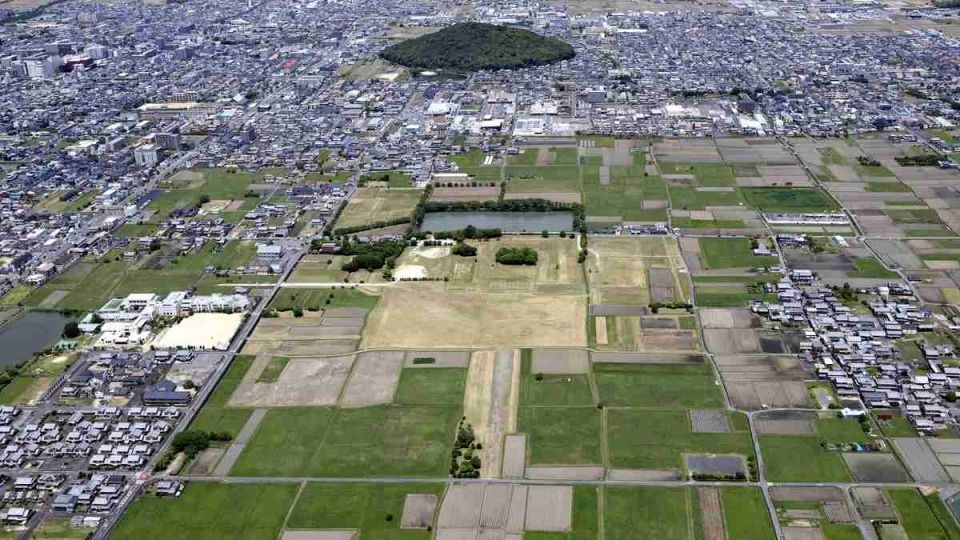
NARA, Japan (Japan News/ANN) -- Two decades after local governments in Nara Prefecture answered a call for nominations from Japan's Cultural Affairs Agency, the International Council on Monuments and Sites (ICOMOS), an advisory body to UNESCO, has recommended that archaeological sites located across Kashihara, Sakurai and Asuka in the prefecture be registered as a World Heritage Site.
With the realization of this dream now just one step away, the local community of the "Ancient Capitals of Asuka and Fujiwara" is filled with happiness and expectations.
Efforts to secure World Heritage status began around 2003, with a proposal from the village of Asuka. In 2006, relevant local governments applied in response to the Cultural Affairs Agency's call for nominations and the site was placed on UNESCO's tentative list the following year.
However, progress stalled because relevant areas must be protected under domestic law as constituent assets, and many of those in Nara Prefecture had not been designated as historic sites under Japan's Law for the Protection of Cultural Properties. As a result, officials had to submit draft nomination documents four times.
While seeking the understanding of landowners, officials steadily expanded the areas designated as historic sites. In September 2024, the site was finally selected as Japan's nomination candidate. The Kashihara city government put undesignated areas under legal protection through a World Heritage ordinance it enacted.
But there were concerns that the archaeological sites' value is difficult to grasp, because many of the ruins are buried underground. To address this, the Nara National Research Institute for Cultural Properties and an affiliated facility of the Archaeological Institute of Kashihara, Nara Prefecture, displayed excavated artifacts and created public dioramas and virtual reality apps, making repeated efforts to make the sites "visible."
A major concern was the evaluation of the richly colored murals at the Takamatsuzuka Tumulus and Kitora Tumulus. The murals depict mythical beasts influenced by China and the Korean Peninsula, as well as a group of female figures known as the Asuka Beauties.
In the 2000s, they were found to have deteriorated due to mold.
The stone chamber in Takamatsuzuka Tumulus that houses the Asuka Beauties was dismantled, and the murals in Kitora Tumulus were also removed, both for restoration purposes. Archaeological remains, in principle, need to be preserved in situ, but due to the risk that mold would grow again if the murals were returned to the burial mounds, they are currently being stored at a nearby facility.
The Cultural Affairs Agency and others said that the murals would be returned to the stone chambers in the future. Yet, no technology has been established to prevent mold. In its recommendations, ICOMOS called for continued scientific research aimed at preserving the murals and returning them to the burial mounds, as well as dealing with the few areas that remain undesignated as historic sites within the Fujiwara Palace ruins.
These are issues that need to be resolved in the future.
"The sites received a very high evaluation, nearly a perfect score, but we must take the points raised seriously and steadily move forward to make responses," said a Cultural Affairs Agency official.
A sense of joy spread throughout the local community in response to the ICOMOS recommendation.
A press conference was held at the prefectural office by Nara Prefecture Gov. Makoto Yamashita, who serves as chair of the Asuka-Fujiwara World Heritage Inscription Promotion Council, along with the mayors of the municipalities of Kashihara, Sakurai, and Asuka.
Yamashita presented plans to focus on providing multilingual tourist information and developing tours of World Heritage sites within the prefecture. "This will serve as a major opportunity for people to rediscover the charm of Nara," he said.
Many people immediately visited the Ishibutai Tumulus in Asuka. "I heard it was going to become a World Heritage site, so I thought I should take this opportunity to stop by," said a 27-year-old office worker from Kyoto with a smile. "Nara's appeal lies in the fact that it's packed with Japan's mystical appeal. The scenery surrounded by mountains is beautiful, too."
The cafe at Branchera Ishibutai Terrace, an accommodation facility near the burial mound, had about 50 percent more tourists than a typical Saturday.
"Since the news about the World Heritage designation broke, we've received nearly 10 hotel reservations," said the hotel's manager. "Visitors can enjoy the scenery throughout the four seasons here. So, we want to convey the area's appeal to make people want to come back here multiple times."
khnews@heraldcorp.com