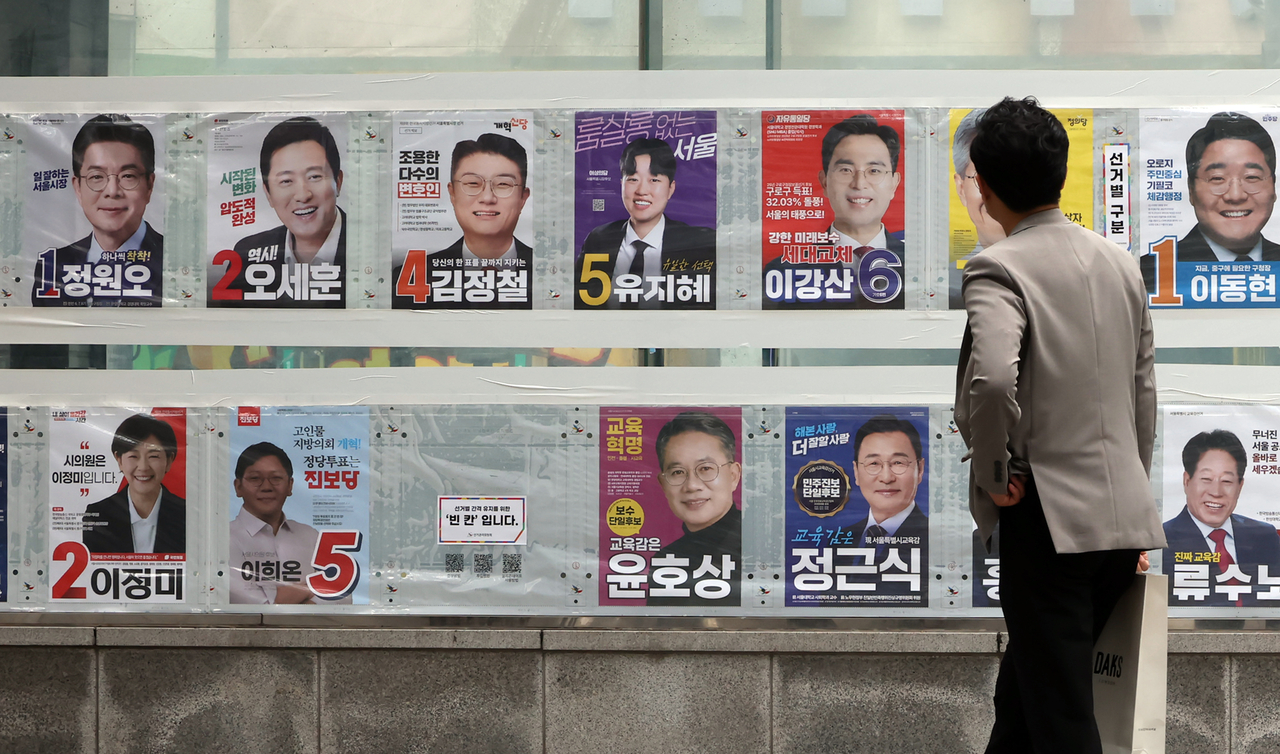
As South Korea heads into its June 3 local elections, rival parties are entering the race with sharply different expectations.
The ruling Democratic Party of Korea believes it is leading in most races and remains competitive in nearly all of the rest. The main opposition People Power Party, meanwhile, is focused on holding its traditional strongholds while remaining within striking distance in several key battlegrounds.
The contrasting outlooks reflect different readings of recent political history.
The Democratic Party's optimism stems from the 2018 local elections, when it won 14 of the nation's 17 mayoral and gubernatorial races a year after former President Park Geun-hye's impeachment and the inauguration of liberal President Moon Jae-in.
Many in the Democratic Party believe this year's elections could unfold similarly. The vote is once again taking place roughly a year after a presidential impeachment and a change in government, following former President Yoon Suk Yeol's removal from office and President Lee Jae Myung's inauguration.
Conservatives, meanwhile, point to the 2022 local elections, which were held less than a month after Yoon took office.
While the People Power Party won 12 of the nation's 17 mayoral and gubernatorial races that year, the Democratic Party retained its traditional strongholds in the southwest and held onto the closely watched Gyeonggi governorship.
The opposition believes it can avoid a Democratic Party landslide by holding conservative strongholds and remaining competitive in major battlegrounds, even if the broader political environment favors the ruling party.
Until recently, polling appeared to support the Democratic Party's expectations. Some political observers projected that the party could win as many as 15 of the nation's 16 mayoral and gubernatorial races, a forecast driven by President Lee's popularity and the People Power Party's struggles following Yoon's impeachment.
More recent surveys, however, suggest the race may be more competitive than those projections indicated.
An analysis of 382 public opinion polls conducted by a research team led by Seoul National University professor Han Kyu-sup estimated that the Democratic Party could win between nine and 14 of the 16 races.
The People Power Party was projected to secure between two and seven races, while an independent candidate was favored in one contest.
Different choices at ballot box
Several recent surveys suggest voters may be making different choices depending on the race.
One of the clearest examples comes from North Jeolla Province, one of the Democratic Party's strongest traditional strongholds.
A Korea Society Opinion Institute poll conducted May 23-24, before the polling blackout period began, found independent incumbent Gov. Kim Kwan-young leading the gubernatorial race with 44.1 percent support, ahead of Democratic Party nominee Lee Won-taek at 40 percent.
Kim, formerly a Democratic Party member, was expelled from the party following allegations that he distributed cash to young party members and local councilors. Lee, a lawmaker representing a North Jeolla constituency, secured the party's nomination after Kim's expulsion.
The same survey, however, showed support for the Democratic Party at 68.3 percent.
A similar pattern emerged in Busan's Buk-A constituency, where a parliamentary by-election is being held alongside the local elections.
A Gallup Korea survey conducted May 21-22 found independent candidate Han Dong-hoon leading with 36 percent support, narrowly ahead of Democratic Party candidate Ha Jung-woo at 35 percent. Yet in the same survey, Democratic Party mayoral candidate Chun Jae-soo held a commanding lead over incumbent conservative Mayor Park Heong-joon, 55 percent to 34 percent.
To some analysts, such results suggest voters are becoming more willing to distinguish between party preference and candidate preference.
Yoon Tae-gon, head of political consulting firm The Moa, said local politics has become increasingly candidate-centered.
"As district chiefs have become more visible and their roles have grown, more voters are choosing candidates from parties different from those of mayoral candidates," Yoon said. "There is also a tendency for voters to directly assess the performance of incumbent district chiefs seeking reelection."
Political commentator Park Sang-byeong offered a similar assessment, saying, "Voters may support a political camp overall while expressing dissatisfaction with a particular party nomination or candidate."
"Such voting patterns tend to emerge when voters seek to send a message to political parties without abandoning their broader ideological preferences," he added.
The phenomenon is not entirely new. In Seoul's 2022 local elections, then-People Power Party mayoral candidate Oh Se-hoon won all 25 districts, but Democratic Party candidates captured district chief races in eight of them, producing different outcomes on the same ballot.
Democratic Party lawmakers caution against reading too much into the surveys.
Rep. Park Sang-hyuk argued that many voters ultimately return to party loyalties once they enter the voting booth.
"In actual voting, people who support the Democratic Party are likely to end up supporting Democratic Party candidates across the ballot," Park said. "The level of support independent candidates are receiving in surveys may not fully materialize on election day."
Rep. Kim Hyun made a similar argument.
"Nationwide elections are fundamentally contests between parties," Kim said. "In the final stage of the campaign, party affiliation tends to matter more than personal popularity."
Whether this year's elections resemble the Democratic Party's hoped-for replay of 2018, the more competitive outcome envisioned by conservatives, or something in between, will become clear when ballots are counted on June 3.
flylikekite@heraldcorp.com