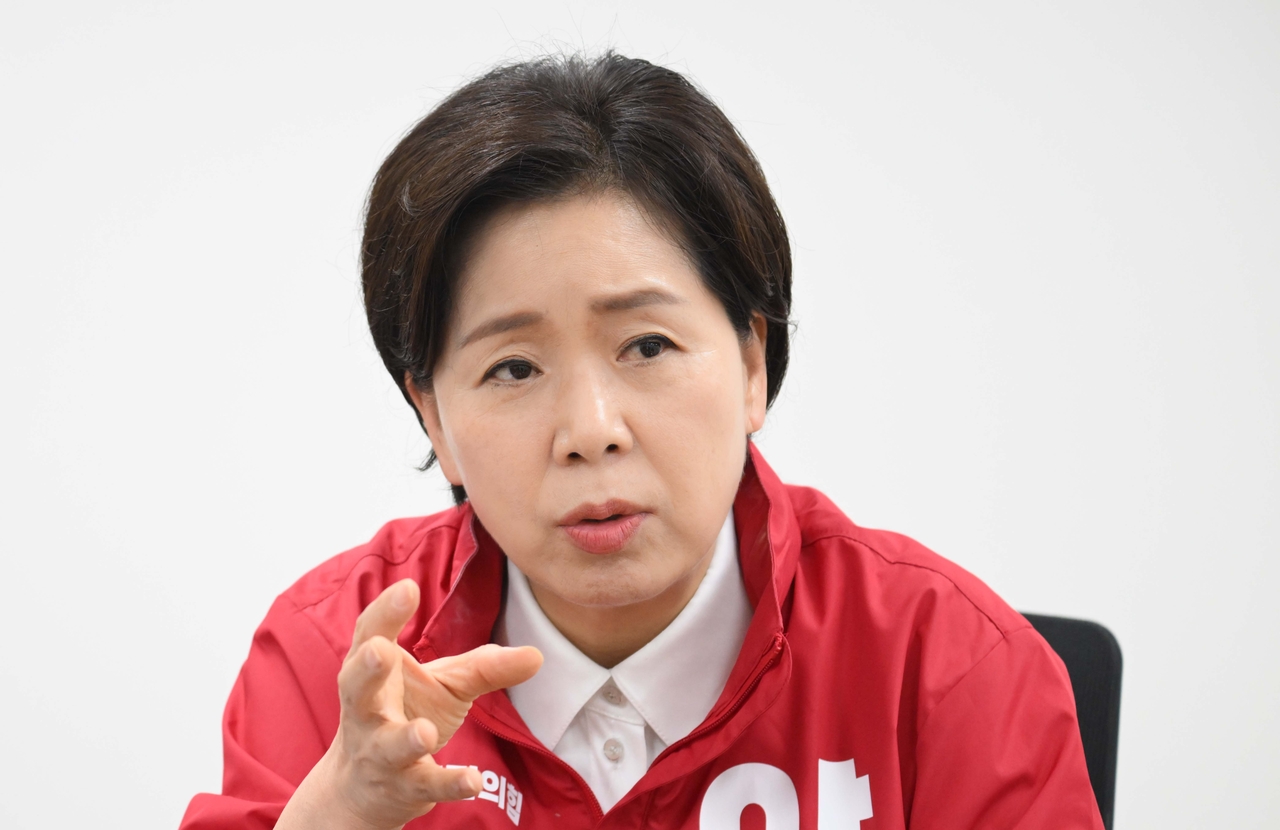
An imminent strike threat is the latest illustration of how Samsung Electronics' decadeslong "no-union" policy left the tech giant vulnerable, according to the main opposition People Power Party's candidate for Gyeonggi Province governor, Yang Hyang-ja.
Samsung Electronics — which runs chip manufacturing bases in Gyeonggi Province cities like Giheung, Yongin and Pyeongtaek — has missed the opportunity to build a culture that embraces unions. This, in turn, has exposed the company to a strike at a critical time, the Samsung Electronics executive-turned-politician said.
"If Samsung is an international company, it should have established a labor-management culture on par with global standards early on," Yang told The Korea Herald in a recent interview at the National Assembly in Seoul.
Samsung Electronics Chair Lee Jae-yong officially ditched the "no-union" policy in 2020, after its executives were convicted of union-busting schemes.
"Samsung had long been running its business in an environment where no union existed. That is why Samsung’s management ended up lacking experience (in dealing with its union)," she said.
"The situation is becoming much worse as (Samsung's management) keeps taking wrong steps."
In return for its "no-union" policy, Samsung offered employees a merit-based pay system. Now, amid an artificial intelligence boom in which Samsung has been reaping enormous profits, Samsung has been at odds with its labor union for months over how to calculate bonuses.
The deadlock persisted as management rejected the union's call to lift the bonus ceiling, set at 50 percent of annual salary, and reset the basis for calculating bonuses.
Given that semiconductors are categorized as national strategic assets, the internal rules on how to distribute what Samsung defines as “excess corporate profit" to its workers "need to be fixed," she said.
Global supply chain disruption is imminent. Yang said the impact would also spill over to small- and mid-sized companies within the semiconductor ecosystem, as they will be forced to adjust their investment plan in ongoing projects.
Urging the government to "minimize damage to affected SMEs," Yang said the public sector's responsibility to mediate in the dispute was growing.
"How can a person without an understanding of the global supply chain assume the role of Gyeonggi Province governor?" Yang said.
"If the deadlock persists, the public sector has to step in," added Yang, who had 28 years of experience as a semiconductor worker in Samsung. "But who in the government has an understanding of what it is like to work at Samsung?"
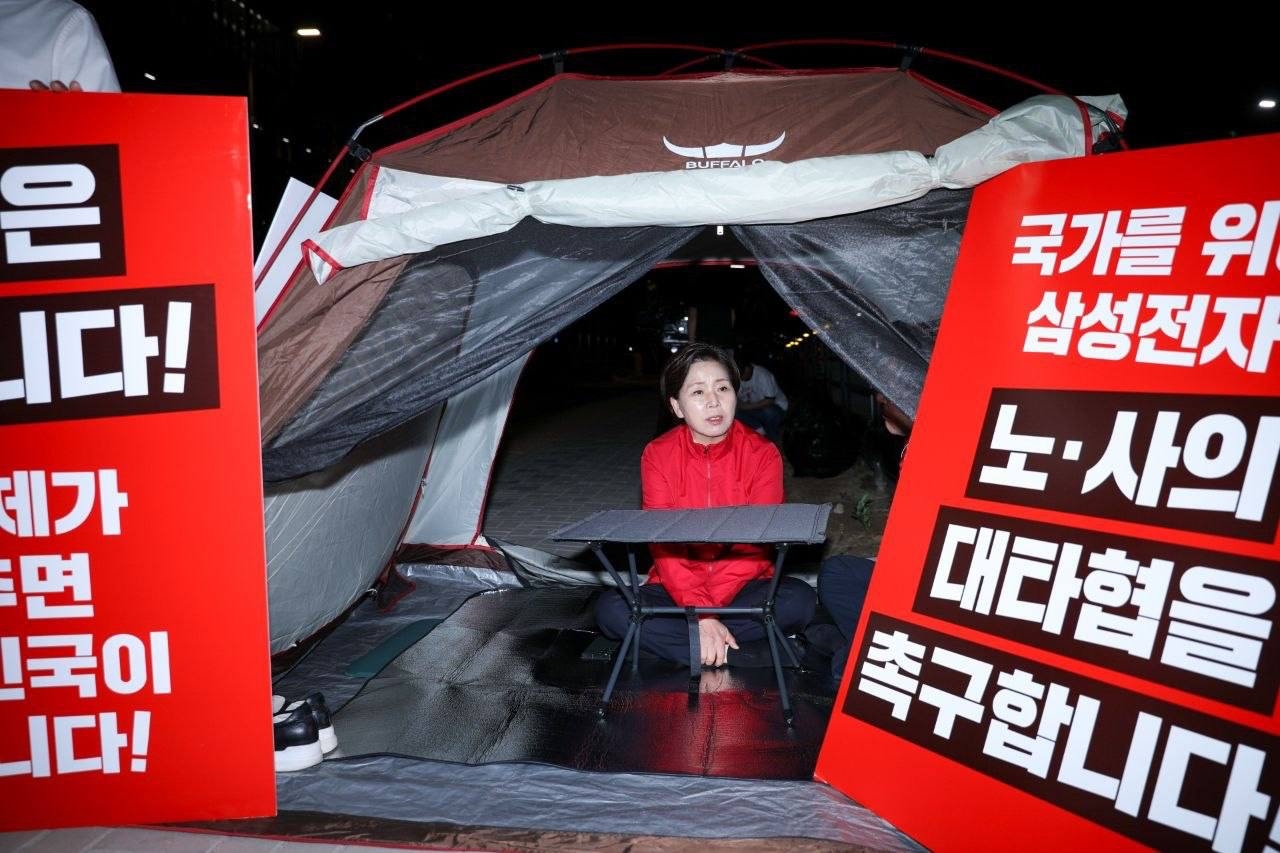
The interview was held a few days before Yang began a hunger strike Monday evening to call for a resolution to the pay dispute.
Having joined Samsung Electronics as a worker shortly after graduating from high school in 1986, Yang rose to assume an executive position in 2014 and entered politics in 2016.
During her time as a lawmaker from 2020 to 2024, Yang led a move to legally define "national strategic industries" and their incentives for investment.
She floated a bill to allow the country to designate them as national high-tech strategic industries for greater protection. Another bill Yang proposed allowed such designated industries to receive increased tax incentives for facility investments.
Stressing the importance of preventing supply chain disruptions in key industries like semiconductors, Yang said workers in strategic industries, as defined under the Act on the National High-Tech Strategic Industries, should be subject to "a separate labor rule" from the Trade Union Act.
"Labor laws should not be uniformly applied (to chip workers)," Yang said.
Yang has moved through political parties during her career, beginning with the Democratic Party of Korea in 2016. She left the party in 2021 and was nonaffiliated through 2023. She then joined the minor Reform Party in 2024, which she left in 2025 to join the People Power Party.
A member of the People Power Party's supreme council, Yang was selected in early May as the party's candidate for Gyeonggi Province governor.
Yang will be contending with the Democratic Party's Choo Mi-ae, a six-term lawmaker who beat the incumbent Kim Dong-yeon in a party contest and stepped down as a lawmaker to run for the election, and Cho Eung-cheon of the Reform Party.
consnow@heraldcorp.com