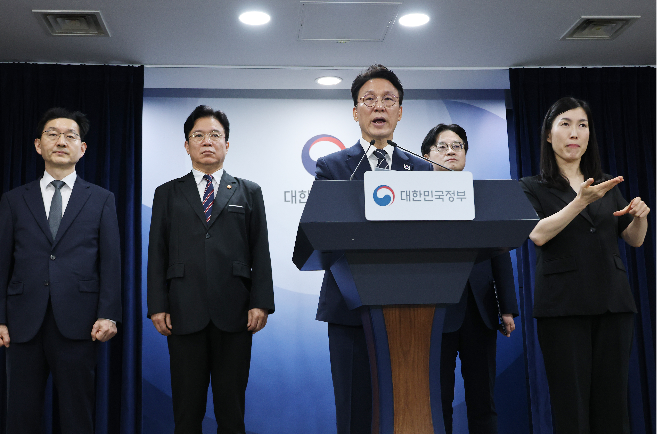
The government will be pushed to invoke "all available measures including emergency adjustment" if Samsung Electronics' wage negotiations fall through and its labor union stages a walkout as planned, Prime Minister Kim Min-seok said Sunday.
"If a concerning situation occurs in which the national economy could be greatly damaged due to a strike, the government will have no choice but to come up with all available response measures including emergency adjustment to protect the national economy," Kim said in an address at the Government Complex Seoul.
Kim's remarks echoed Industry Minister Kim Jung-kwan's hint at exercising emergency mediation on Thursday as the labor-management dispute lingered on with the deadline for Samsung union's strike to begin on May 21 drawing near.
Samsung Electronics' labor union and management are scheduled to sit down for what would likely be the final round of talks Monday.
"I earnestly request that the labor union and the management (of Samsung Electronics) achieve an outcome in a mediation, which is virtually the last opportunity," the prime minister said.
When an emergency adjustment is invoked, the government intervenes in labor disputes to impose a forced suspension on the labor union's activities, including a 30-day suspension of strike action.
If activated, it would be the first time the government has done so in more than two decades.
Under the Trade Union and Labor Relations Adjustment Act, the labor minister is able to take emergency measures if a union's activity is "likely to impair the national economy or endanger citizens' daily lives because of its large scale and specific nature."
The emergency mediation was activated four times since its introduction in 1963. The most recent instance was in December 2005 under the center-left Roh Moo-hyun administration, four days after a Korean Air Lines' pilots' union launched a strike.
Major umbrella unions have called on Lee Jae Myung's center-left administration to exercise prudence.
The prime minister said a strike would cause irreversible damage — estimated to reach 100 trillion won ($66.67 billion) and months of production line normalization process — to South Korea's industry dedicated to the national strategic assets.
The international credibility of South Korea's semiconductor industry, which was recently enriched from the global artificial intelligence boom, will be greatly marred by the strike, he added.
Kim said the strike would ultimately "lead to a drawdown of the domestic semiconductor industry."
Kim added that Samsung could see decades of hard-earned accomplishments and confidence from clients vanish if unionized Samsung workers pushed ahead with its plans to go on strike.
"The most concerning aspect is that South Korea will completely give up the strategic advantage it painstakingly earned in the global AI semiconductor race to its competitors," he said.
Kim's warning was met with criticism from the umbrella union.
On Sunday, the Federation of Korean Trade Unions urged the government to encourage a resolution through dialogue between the labor union and the management, rather forcing an intervention in the dispute.
It said that the government was exaggerating its estimate for the losses in case of a strike, which "does not help resolve the situation."
Another umbrella union, the Korean Confederation of Trade Unions, said in a statement Thursday the emergency adjustment could set an undesirable precedent, in which the basic labor rights protected under the Constitution are easily neglected, especially for the workers dedicated to the national strategic industries.
Meanwhile, Samsung Electronics Executive Chair Lee Jae-yong called for unity of all parties concerned in Samsung's ongoing labor-management dispute, in his early return from his overseas trip Saturday.
consnow@heraldcorp.com