SACHEON, South Gyeongsang Province — A sudden alert broke the calm inside a missile defense battery under the Air Force Missile Defense Command on Wednesday.
“Enemy ballistic missile launch confirmed,” came the warning in Korean through the control center.
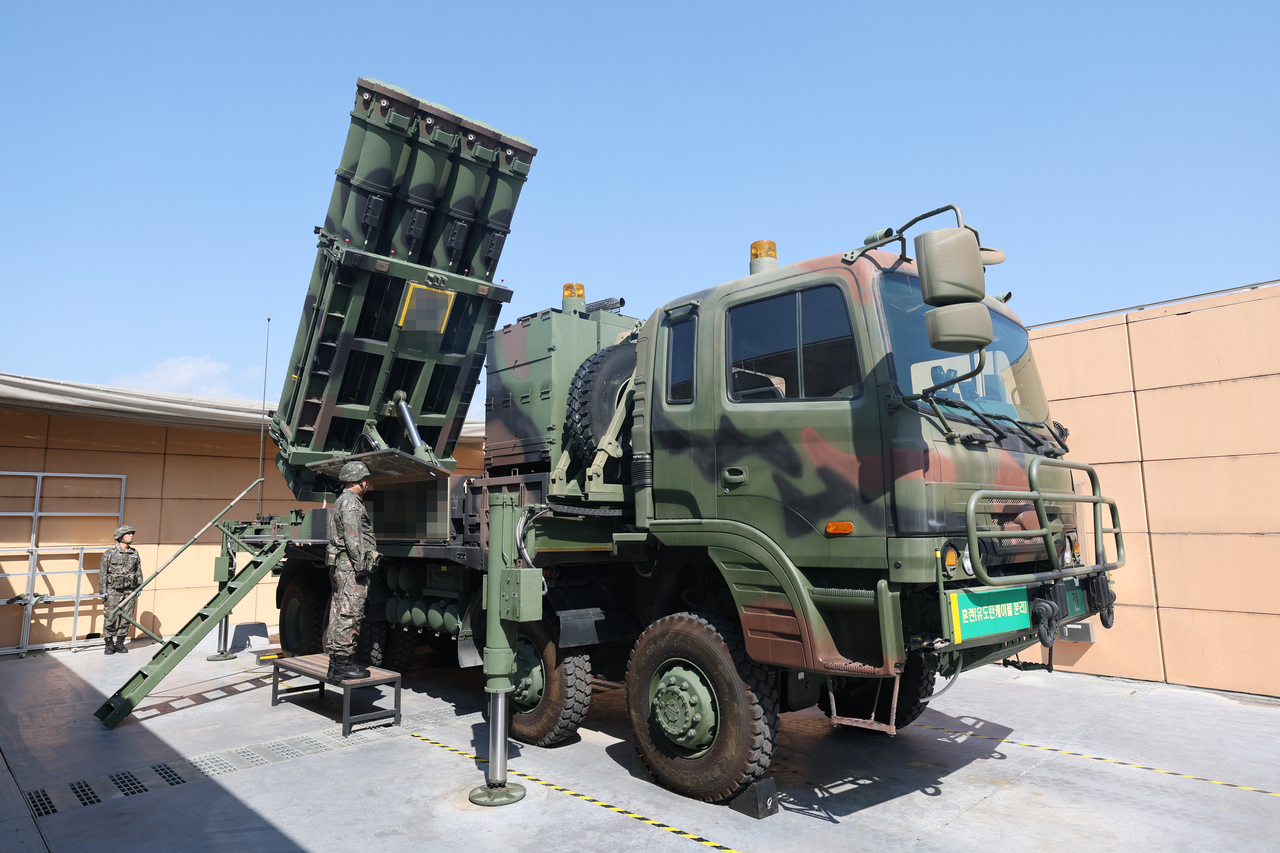
Operators checked the target information and projected impact point. Sirens sounded across the battery as launch crew members moved toward a Cheongung-II launcher.
After power supply checks, circuit inspections and final confirmation of the system’s status, the simulated enemy missile entered the interceptor’s engagement range.
“Engage.”
With a simulated launch command, the virtual ballistic missile was destroyed. The entire procedure took less than 10 minutes.
“We repeat mission procedures every day so that we can launch interceptors immediately once an engagement order is issued,” said Maj. Kim Seung-tae, the battery commander who supervised the drill.
The routine drill reflected South Korea’s missile defense posture at a time of growing concern over North Korea’s increasingly diversified weapons tests, ranging from ballistic missiles to cruise missiles, drones and artillery rockets. Some worry that Pyongyang could use such weapons together or in sequence in so-called “mixed attacks,” complicating detection, tracking and interception.
But the Air Force’s assessment is more measured.
“The issue is not simply whether North Korea fires different weapons at the same time,” a ranking Air Force official said. “A ballistic missile, a cruise missile, a drone and an artillery rocket are not the same target. They move at different speeds, fly at different altitudes and require different responses.”
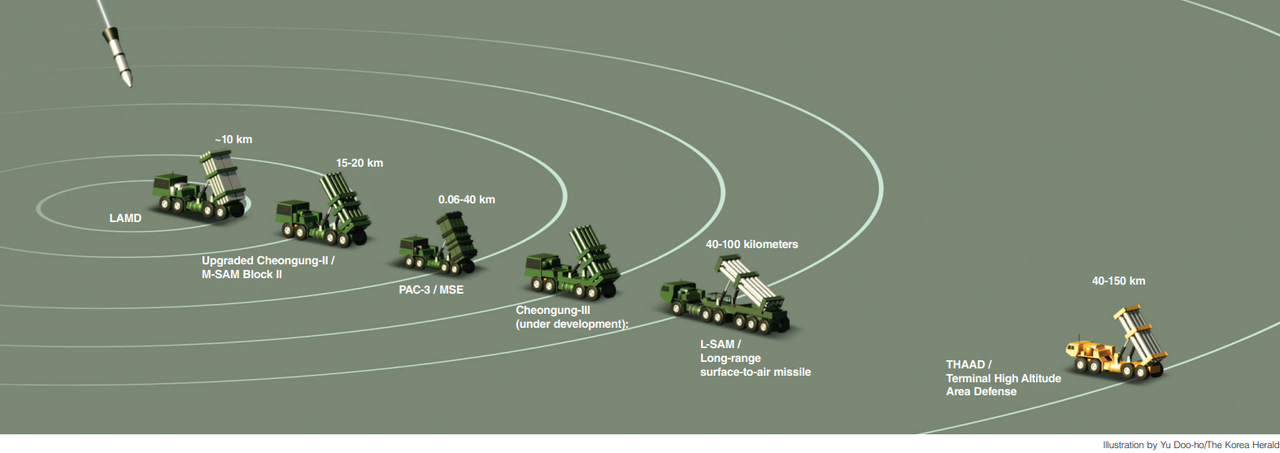
The official said ballistic missiles are treated as high-end strategic threats because of their speed, destructive power and limited response time. Such threats require missile defense interceptors such as Cheongung-II or Patriot.
Cruise missiles and drones pose a different challenge. They fly at low altitudes and can be harder to detect, but they are much slower than ballistic missiles and can be handled by short-range air defense systems, anti-aircraft guns and point-defense assets once detected, according to Air Force officials.
“The key is to quickly identify the type of threat and determine which asset should respond to it,” the official added.
Officials said cruise missiles would have difficulty penetrating deep inland because low-altitude routes would eventually expose them to South Korea’s dense air defense network. Drones could attempt to infiltrate in larger numbers, but the Air Force said it has response measures in place and is strengthening related drills.
The officials also noted that South Korea has maintained a large number of short-range air defense systems due to its continued exposure to North Korean air and artillery threats, unlike many Western militaries that reduced anti-aircraft gun capabilities after the Cold War.
Systems such as Cheonho, Biho, Vulcan and Shingung remain deployed around air bases, radar sites and other key facilities, they said.
Can drones blunt missile defense system?
The recent conflict in the Middle East has raised a separate question as to whether the growing use of low-cost drones could blunt conventional missile defense by forcing militaries to spend expensive interceptors such as Patriot missiles on cheap, slow-moving targets.
Air Force officials said that concern is often misunderstood.
“There is a misunderstanding that expensive interceptors would automatically be used against low-cost drones,” the official said. “Slow-moving drones are not normally targets for Patriot missiles. They would be handled first by more suitable short-range air defense systems or point-defense assets.”
The official said the lesson from recent drone warfare is not that missile defense systems have become useless, but that exposed fixed facilities have become more vulnerable once their coordinates are known.
Drones and cruise missiles may not be high-end weapons, but they can still damage radar sites, aircraft facilities or other key infrastructure if those sites are not protected by shelters or local air defense systems, the official added.
For that reason, officials said, the Air Force is looking beyond missile interceptors and examining how shelters, anti-aircraft guns and short-range air defense systems can be combined to protect critical assets against low-altitude threats.
Air Force-led KAMD
For ballistic missile threats, South Korea’s response is built around KAMD, or the Korea Air and Missile Defense system.
Since the 2000s, South Korea has developed KAMD as one pillar of its three-axis defense system, alongside the Kill Chain preemptive strike platform and the Korea Massive Punishment and Retaliation plan.
The main operator is the Air Force Missile Defense Command, which consists of the KAMD Operations Center, Missile and Space Surveillance Squadron and three missile defense brigades. Its key assets include Green Pine radars and interceptor systems such as Cheongung, Cheongung-II and Patriot.
When an enemy missile is launched, ground-based surveillance radars, Aegis destroyers and early warning assets detect the launch. The KAMD Operations Center then analyzes the missile’s speed, altitude, flight direction, launch origin and expected impact point before transmitting the information to missile defense units.
Still, officials were careful not to present the Air Force’s assessment as a claim that every missile, drone or artillery rocket can be intercepted under all circumstances.
Rather, they said the military is continuing to adapt to changing threats by matching each threat with the appropriate layer of defense and verifying those responses through further tests.
The Air Force is also preparing a test next month to assess how effectively anti-aircraft guns can respond to swarm drone threats, as missiles, drones and artillery rockets are increasingly used together on modern battlefields.
flylikekite@heraldcorp.com