
South Korea aims to strengthen the cultural capabilities of the recipients of Seoul's foreign aid, leveraging its status as a global cultural powerhouse, the government announced Monday.
The country seeks projects that will allow recipients to expand their cultural and arts education, build cultural complexes, train content artists, support creative industries and digitize cultural heritage.
This is part of South Korea's plan to select the cultural sector as one of the two new priorities in the area of focus in the country's future policy concerning official development assistance, or ODA, according to South Korea's Committee for International Development Cooperation under Prime Minister Kim Min-seok.
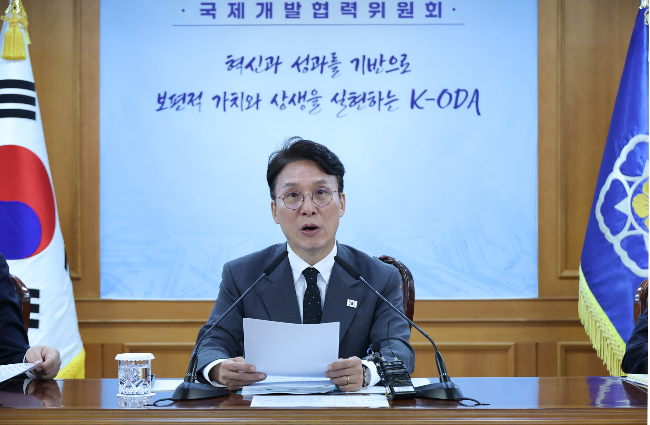
"Culture is perceived as an important driver (for a country) to achieve economic and social development and to improve (its people's) quality of life," Kim said during a meeting of the Committee for International Development Cooperation at the Government Complex Seoul.
"If South Korea capitalizes on its experience of success and capabilities, we can create a mutually beneficial partnership with our ODA partner countries in contributing to their cultural ecosystem and cultural welfare."
Under the new plan, South Korea aims to take advantage of its "cultural soft power" and the capabilities in artificial intelligence to contribute to the recipients' growth in its creative industry and tourism business, the office said in a release.
The cultural aid projects targeting creative industries will mostly go to middle-income countries with adequate demand, according to the government.
Seoul added these projects will be aimed at respecting the partner countries' unique cultures and local demand for the new projects.
Through this, South Korea's foreign aid in the cultural sector will go beyond more conventional sectors, such as preserving the cultural heritage of the recipients.
South Korea's plan was inspired by those of France and Japan, according to the government, which it said uses aid projects as an opportunity to give recipients greater access to learn their languages, cultural content and sports.
For this year's budget, South Korea's ODA spending in the cultural sector accounts for 0.67 percent of the total, and its 40 cultural aid projects are mostly concentrated in Asia.
Along with the cultural sector, the health care sector will also emerge as another priority in South Korea's focus.
South Korea's new health care ODA projects will similarly be tailored to the recipients. They will range from projects to establish a basic health care system, create a response system to fight infectious diseases and provide digital health infrastructure, to curbing the spread of tuberculosis and malaria in developing countries.
South Korea will also increase its contribution to global initiatives to nonprofit organizations dedicated to such as Gavi, the Vaccine Alliance, the Global Fund to fight AIDS, Tuberculosis and Malaria, and the Coalition for Epidemic Preparedness Innovations.
Meanwhile, South Korea has decided not to disclose a change in ODA priority partner countries.
Local media reports have suspected that the number of priority partner countries was to be reduced from 27 to 25, with the exclusion of Colombia, Myanmar and Ukraine and hte addition of Kenya.
The committee cited a need for strategic flexibility as the reason behind the decision to keep the list of priority partner countries private.
consnow@heraldcorp.com