Policy surrender payouts rise as savings-bank deposits hit 4-year low
South Koreans are cashing out of insurance policies and savings deposits, chasing higher returns by piling into local stocks' breakneck rally.
Policy surrender payouts at the country's three largest life insurers, Samsung Life Insurance, Hanwha Life Insurance and Kyobo Life Insurance, reached 4.9 trillion won ($3.3 billion) in the first quarter, up 16.3 percent from a year earlier, according to industry data on Monday.
The increase suggests more policyholders are willing to terminate insurance contracts early, even at a loss, in search of higher returns in the stock market. Policy surrender value refers to the amount returned when a contract is canceled before maturity, typically less than the total premiums paid.
The rise was sharper in savings-type insurance policies, where surrender payouts jumped 23.2 percent on-year to 2.29 trillion won. Savings-type products are designed to return premiums and interest at maturity, either as a lump sum or annuity. The pickup in cancellations signals households are moving away from stable savings products and toward riskier assets.
"There is clearly money moving as consumers surrender policies despite losses to seek higher returns in securities," an industry official said. "Similar moves have occurred during past stock-market rallies, though the current increase is still seen as temporary and unlikely to have a major impact on insurers’ profitability."
The shift is also showing up in financial groups' earnings. Shinhan Life Insurance's first-quarter profit fell nearly 40 percent from a year earlier, while KB Life Insurance's profit declined 8 percent. By contrast, Shinhan Securities' earnings more than doubled and KB Securities' profit surged 93 percent.
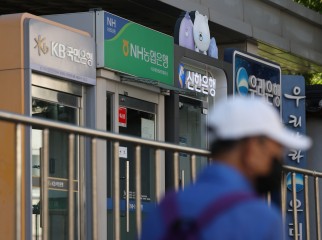
Deposit outflows are widening as savings banks raise rates to defend their funding base.
Savings-bank deposits fell to 97.93 trillion won, the lowest in four years and four months, according to the latest Bank of Korea data. The balance has declined since October, after reaching about 105 trillion won in September.
The drop came even as the average rate on one-year time deposits at the nation's 79 savings banks rose to 3.24 percent as of last week, the highest since January last year, according to the Korea Federation of Savings Banks.
Savings banks typically lure depositors with higher rates than commercial banks, but the latest decline shows even elevated yields are struggling to compete with the equity market's momentum.
The outflow has begun to spread to major commercial banks. The combined outstanding balance of time deposits at KB Kookmin, Shinhan, Hana, Woori and NH NongHyup reportedly fell from 947 trillion won at the end of February to 935 trillion won in early May, a drop of around 12 trillion won in just over two months.
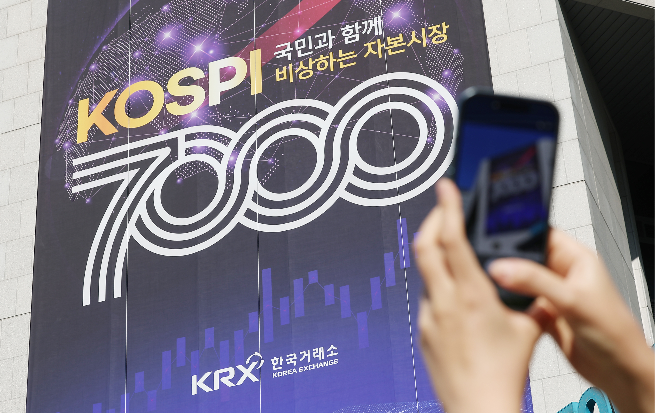
The decline coincided with the Kospi's rebound from its March pullback and its surge to fresh records. After posting a world-beating 76 percent gain in 2025, the benchmark climbed as high as 6,300 in the first two months of this year, adding another 50 percent. It then slid toward 5,000 in March as Middle East tensions and rising oil prices rattled markets, before quickly recovering to cross the 7,000 mark in early May.
On Monday, the Kospi topped 7,800 for the first time intraday, extending its advance to about 190 percent from 2,700 at the end of 2024 and 85 percent so far this year.
jwc@heraldcorp.com



![[Graphic News] Nuri rocket set for fifth launch](https://wimg.heraldcorp.com/news/cms/2026/10/06/news-p.v1.20261005.74d188bdaff2417ebabf4560181741f4_T1.gif?type=h&h=800)