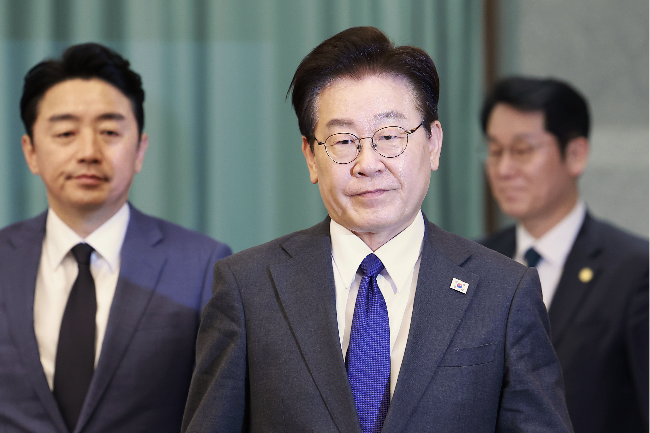
President Lee Jae Myung on Monday injected a note of caution into the ruling party’s push for a special counsel bill that could cancel charges against him, effectively tempering its momentum ahead of the June 3 local elections.
The bill seeks to investigate allegations that prosecutors under the former Yoon Suk Yeol administration fabricated investigations and indictments in cases, including some involving Lee himself.
“Uncovering the truth through a special counsel and restoring judicial justice is something that must be done,” Hong Ihk-pyo, senior presidential secretary for political affairs, said during a press briefing, delivering Lee’s remarks, at Cheong Wa Dae.
“However, regarding the specific timing and procedures, the president asked the ruling Democratic Party to make its decision through sufficient public opinion gathering and a deliberative process,” Hong added.
Lee's remarks effectively poured cold water on the drive to set up a special counsel, as they came amid growing attacks by the main opposition People Power Party and signs of concern within the ruling party that the bill could affect the June 3 local elections.
The bill was submitted by the Democratic Party of Korea's acting Floor Leader Rep. Cheon Jun-ho on April 30.
The key controversy centers on a provision that would allow the special counsel to take over cases already indicted by prosecutors and decide whether to maintain or withdraw the charges.
Critics argue the clause could effectively nullify ongoing trials, raising constitutional questions and accusations that the bill could serve as a form of presidential self-exoneration.
Of the 12 cases listed in the bill, eight involve Lee. They include development and sponsorship allegations dating to his 2010-18 tenure as mayor of Seongnam, Gyeonggi Province. Among them are the Daejang-dong, Baekhyeon-dong and Wirye development cases, as well as a Seongnam FC sponsorship case.
The list also includes the Ssangbangwool remittance case and alleged misuse of Gyeonggi Province corporate cards from his time as governor of Gyeonggi Province from 2018 to 2021. It also includes his election law and perjury inducement cases.
Former People Power Party leader Han Dong-hoon, who is running as an independent in a National Assembly by-election in Busan, said Sunday that such a move could amount to grounds for impeachment.
“If President Lee seeks a ‘prosecution-cancellation special counsel’ to block his own conviction and cancels the indictments in his own cases, that would be clear grounds for impeachment,” Han wrote on Facebook.
People Power Party Floor Leader Song Eon-seog also denounced the bill Sunday, likening it to “a thief appointing his own police.”
Song said allowing a special counsel appointed by the president to decide whether to continue the president’s own trials would violate the principle that no one should act as judge in their own case.
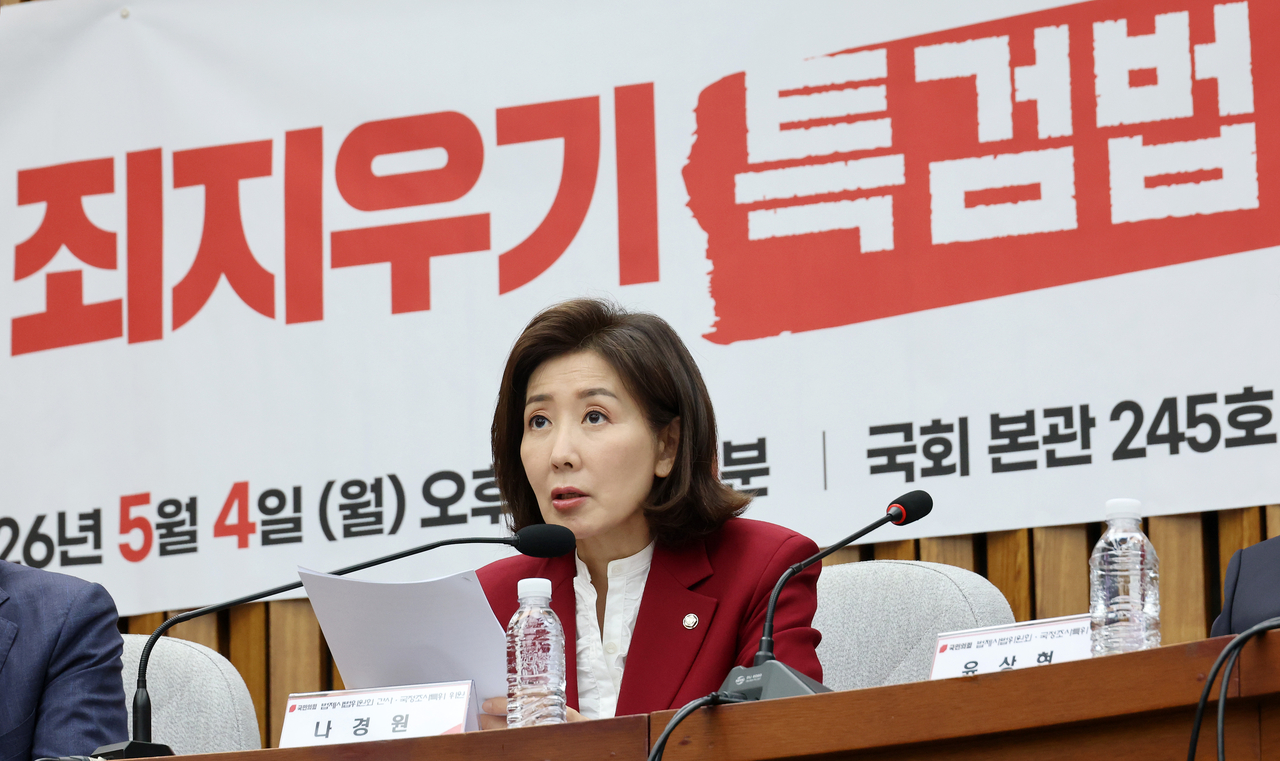
People Power Party Rep. Na Kyung-won called the bill an attempt to “erase Lee Jae Myung’s crimes” during an emergency forum on the issue held at the National Assembly in Seoul. She said the issue was not just about shielding one president from legal risks. Rather, she said, it was about weakening the judicial system by allowing a defendant to act as his own judge.
Cho Eung-cheon, the Reform Party’s candidate for Gyeonggi Province governor in the June 3 local elections, held a press conference at the National Assembly on Sunday. He proposed a meeting of opposition candidates to block the bill.
Cho called the proposal a “judicial insurrection.” He said it was designed to cover up Lee’s legal risks through what he described as a “prosecution-cancellation special counsel” and a “crime-deletion bill.”
The Democratic Party has rejected the accusations. It says the bill is meant to uncover the truth behind alleged abuses of prosecutorial power under Yoon.
Cheon has said the party launched a parliamentary inquiry because it believed the Yoon administration had engaged in forced and fabricated indictments. He said the special counsel bill was needed to confirm, through an investigation, what the inquiry had uncovered.
Democratic Party floor spokesperson Rep. Moon Geum-ju also said the bill was “not a crime eraser, but a truth magnifier.” He accused the main opposition party of distorting the purpose of the legislation.
Moon said the bill was aimed at reviewing the overall process of investigations and indictments, not shielding Lee from criminal responsibility.
Still, concerns have also surfaced inside the Democratic Party.
According to local reports, Rep. Kwon Chil-seung wrote Monday in a Telegram group chat joined by about 150 Democratic Party lawmakers that the bill could hurt the party not only in the country’s southeast, a conservative stronghold, but also in the Seoul metropolitan area.
He reportedly argued that the bill should be handled after the local elections.
Rep. Lim Mi-ae, who heads the party’s North Gyeongsang Province chapter, also reportedly urged the leadership to consider the possible electoral impact.
Reform Party leader Rep. Lee Jun-seok criticized Lee’s remarks later Monday. He called them a delaying tactic ahead of the local elections.
In a Facebook post, Lee Jun-seok said the opposition should not be swayed by what he described as the president’s vague remarks. He said it should demand a “complete declaration of abandonment” of the bill.
The controversy comes as President Lee’s approval rating has shown signs of decline.
According to a Realmeter survey conducted from April 27 to 30 among 2,006 adults nationwide, Lee’s approval rating stood at 59.5 percent. That was down 2.7 percentage points from the previous survey.
It was the first time in eight weeks that his rating had fallen below 60 percent.
In the same survey, support for the Democratic Party fell 2.7 percentage points to 48.6 percent. The People Power Party rose 0.9 percentage point to 31.6 percent.
Realmeter attributed Lee’s decline to a mix of economic burdens, including high oil prices and inflation, and political uncertainties such as labor-management disputes.
flylikekite@heraldcorp.com