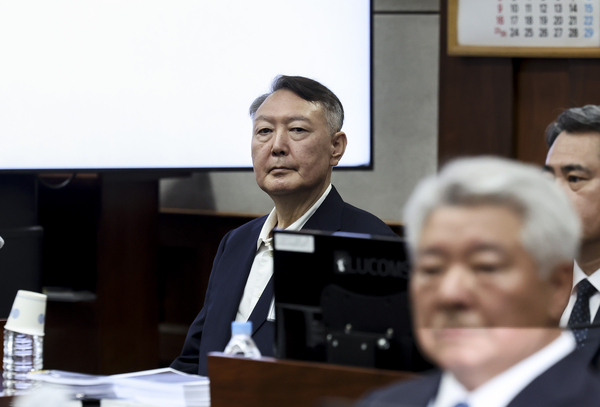
Former President Yoon Suk Yeol was sentenced to seven years in prison by the Seoul High Court on Wednesday, as the appeals court increased his punishment in a case tied to his failed 2024 martial law decree.
The ruling, two years longer than the lower court’s five-year sentence, marked the first appellate decision from a special court division handling insurrection-related cases.
The special counsel had sought a combined 10-year prison term for Yoon on charges including obstruction of the execution of an arrest warrant, allegedly creating or signing a martial law decree after the fact, infringing on Cabinet members’ deliberation rights, spreading false information to foreign media and destroying evidence.
Where ruling diverged from lower court
The appellate court agreed with the lower court that Yoon violated the legal requirement to convene a Cabinet meeting before declaring martial law.
However, unlike the lower court, which found that Yoon had violated the deliberation rights of seven Cabinet members, the Seoul High Court ruled that he had also violated the rights of former Industry Minister Ahn Duk-geun and former Agriculture Minister Kim Moon-soo.
On Dec. 3, 2024, the night martial law was declared, Yoon called six Cabinet members — Defense Minister Kim Yong-hyun, Interior Minister Lee Sang-min, Prime Minister Han Duck-soo, Foreign Minister Cho Tae-yul, Unification Minister Lee Young-ho and Justice Minister Park Seong-jae — to inform them of his plan to declare martial law.
Yoon later summoned six additional Cabinet members to secure the quorum required to open a Cabinet meeting. He began the meeting after four of them arrived at the presidential office, while Ahn and Kim had failed to arrive in time.
Yoon did not notify the remaining seven Cabinet members.
The lower court found that only the rights of the seven Cabinet members who were not notified had been violated.
The appellate court, however, found that Ahn and Kim were also notified at a time when it was realistically impossible for them to arrive in time for the meeting, effectively infringing on their right to participate in deliberations.
The Seoul High Court also diverged from the lower court by finding Yoon guilty of abuse of power in connection with instructions given to presidential aides.
Prosecutors alleged that Yoon ordered the presidential international press secretary to draft press guidance asserting the legality of his martial law decree. The guidance claimed there had been an immediate threat to Korea’s democracy and that Yoon had allowed lawmakers to vote to lift martial law.
Although the lower court found that the guidance contained false information, it acquitted Yoon on that charge, ruling that presidential secretaries were not legally exempt from carrying out their duties even if a presidential instruction was based on false information.
The appellate court took a different view, saying public officials have a legal duty to act lawfully and in the public interest, meaning they are not required to follow unlawful or unjust instructions.
Court upholds other findings
The Seoul High Court upheld most of the lower court’s findings on the remaining charges.
After Yoon’s martial law decree, officials from the Corruption Investigation Office for High-ranking Officials attempted to arrest him in January 2025. Yoon mobilized the Presidential Security Service and police to block access to his residence.
The court upheld the lower court’s finding that the CIO acted under valid arrest and search warrants. Yoon had claimed that the CIO lacked jurisdiction to investigate insurrection charges.
The court accepted the legal reasoning that the CIO’s insurrection probe was part of its investigation into Yoon’s abuse of power charge, which falls within the agency’s jurisdiction.
It also echoed the lower court’s rejection of Yoon’s argument that the CIO improperly sought an arrest warrant from the Seoul Western District Court rather than the Seoul Central District Court.
Yoon also signed a martial law decree on Dec. 7, 2024, four days after declaring martial law and three days after the National Assembly voted to lift it. The document, created on Dec. 6, had been signed by Defense Minister Kim and Prime Minister Han before being handed to Yoon.
The high court agreed with the lower court that Yoon signed the document to fabricate evidence suggesting that the martial law declaration had followed due process.
Like the lower court, it acquitted Yoon of using a forged official document, noting that the document was never made public and was destroyed shortly afterward.
However, the lower court had ruled that the document became a presidential record once signed by Yoon, and that his decision to destroy it constituted destruction of presidential records. The appellate court upheld that finding.
The court also ruled that Yoon’s instruction to delete records from secure phones and block investigators from accessing them was intended to protect his personal interests as a defendant charged with insurrection. It found him guilty of obstructing official duties and ordering subordinates to perform acts beyond their legal obligations.
After the ruling, Yoon’s lawyers said they would appeal.
“Of course we do not understand the legal logic, and we will appeal,” said Song Jin-ho, one of Yoon’s attorneys. “We will go to the Supreme Court to debate the logic.”
seungku99@heraldcorp.com


![[Legal updates in Korea] New insurance mandate protects firefighters on the job](https://wimg.heraldcorp.com/news/cms/2026/10/01/news-p.v1.20261001.76835f19eb424f18814ac3bb65d896a9_T1.jpg?type=h&h=800)