Judge Ji Gwi-yeon rejected notes prosecution put forward as evidence that Yoon declared martial law as part of plot to establish dictatorship
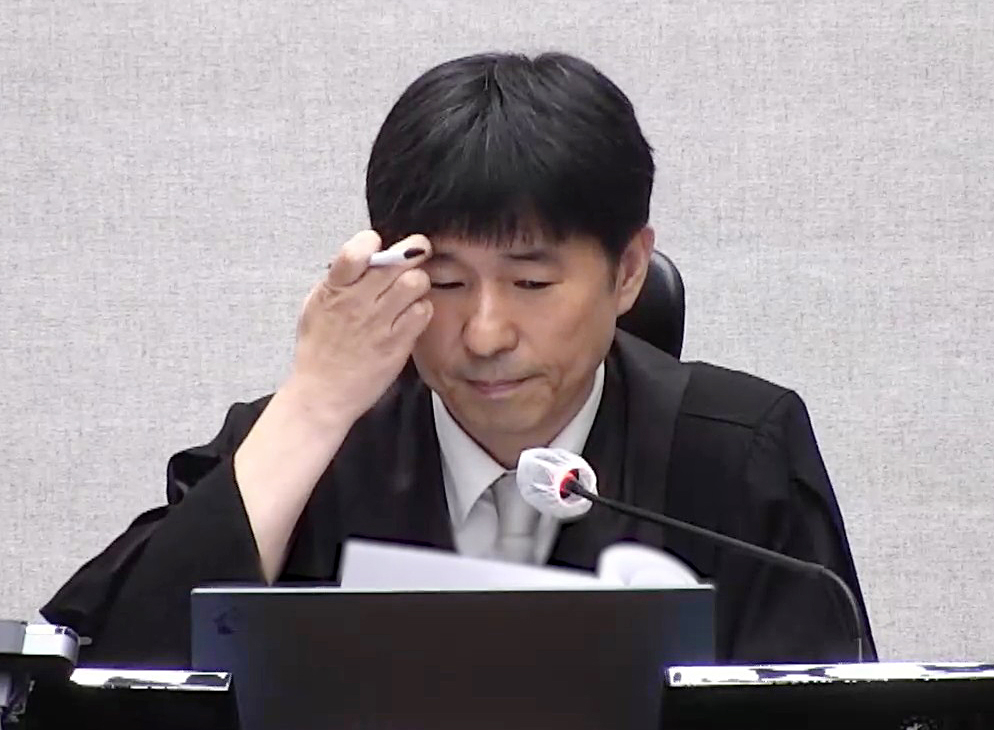
Legal experts reacted with surprise to parts of Thursday's verdict on former President Yoon Suk Yeol, which that rejected key pieces of evidence and cited the lack of planning and limited use of force as reasons for refusing the death penalty.
Presiding Judge Ji Gwi-yeon found Yoon of guilty of leading an insurrection but denied the prosecution's claim that he planned to establish a long-term dictatorship. He said Yoon declared martial law on Dec. 3, 2024, because of an obsessive belief that the opposition was interfering with state affairs, and that he needed to "overpower the National Assembly."
"(Yoon's) preparations are too lax to think that he had planned for a long time to declare martial law and root out the political opposition. There isn't particular evidence about the follow-up actions, such as after neutralizing the National Assembly," Ji said in his ruling.
Special counsel Cho Eun-suk's team had claimed that Yoon and his followers had plotted the insurrection for at least a year, citing details in the confiscated pocketbook of former Defense Intelligence Command chief Noh Sang-won. But the the full transcript of the ruling revealed Sunday showed that the so-called "Noh Sang-won notes" were deemed inadmissable.
Notes disregarded
The court said that it cannot definitively be said that the notes were written in preparation for martial law, and it could not be determined when the notes were made.
The court also pointed out that the notes were collected from a table during a search and seizure operation at the residence of Noh's mother.
"If Noh had planned the martial law before October, 2023 and delivered the plans to (former Defense Minister) Kim Yong-hyun, and Kim to Yoon, the notes would be critical evidence that the planning took place a year before the martial law declaration. He (Noh) would not have just left it on the table of his mother's home, for the investigators to easily find," the court said.
Noh, a close confidant of Yoon and Kim, held no official military post since after discharged from the Army after being convicted for sexual harassment against a female subordinate in 2018. He played a key role in the insurrection, and was sentenced to 18 years in prison by the same court on Thursday.
Noh's notes were a key justification for the prosecution's argument that Kim and Yoon convened military commanders multiple times between December 2023 and August 2024, supposedly to discuss the details of the martial law. The notes even specified "collecting and disposing" of the hundreds of Yoon's political rivals.
Ji did say that Noh appeared to have played a crucial part in the martial law bid, but doubts over the authenticity of the notes ultimately invalidated the prosecution's claim that Yoon and his followers had carefully planned the martial law for a long time.
Disputable ruling
Ji said that Yoon appeared to have restricted the use of force in the martial law, and granted relative leniency based partly on the failure of most of his plans — including soldiers' failure to arrest members of the National Assembly.
This was in contrast with the Jan. 21 ruling by the same court against former Prime Minister Han Duck-soo, who was sentenced to 23 years in prison for his part in the insurrection. Then-presiding Judge Lee Jin-kwan claimed the lack of deaths in the insurrection and swift lifting of the martial law was "due to the courage of the people who protected the National Assembly, and not due to (restraint by) those taking part in the insurrection."
"The fact that there were minimal damage and it (martial law) went on for a short period of time cannot be considered when deciding on a punishment for those responsible for the Dec. 3 insurrection," Lee said in his ruling.
Lee sentenced Han to a stronger punishment then the 15 years requested by the prosecution. Ji, on the other hand, sentenced Yoon to life in prison, while the special counsel requested the death penalty.
Lawyer Lee Go-eun, formerly a prosecutor, said while she and many other legal experts expected a life sentence, mentioning the failure of the martial law as a reason for leniency was baffling.
"This part directly contradicts (ruling) of Judge Lee Jin-kwan. The martial law's failure was due to resistance of the people and the police and military passively following such orders. Lee pointed out that such failure should not benefit those responsible for martial law, and I think it is very reasonable," she said in an interview with local JTBC.
minsikyoon@heraldcorp.com

![[Legal updates in Korea] New insurance mandate protects firefighters on the job](https://wimg.heraldcorp.com/news/cms/2026/10/01/news-p.v1.20261001.76835f19eb424f18814ac3bb65d896a9_T1.jpg?type=h&h=800)