Hiring of people with disabilities rose 4.3% in 2025, alongside gains in regional recruitment and the share of women and STEM talent in management
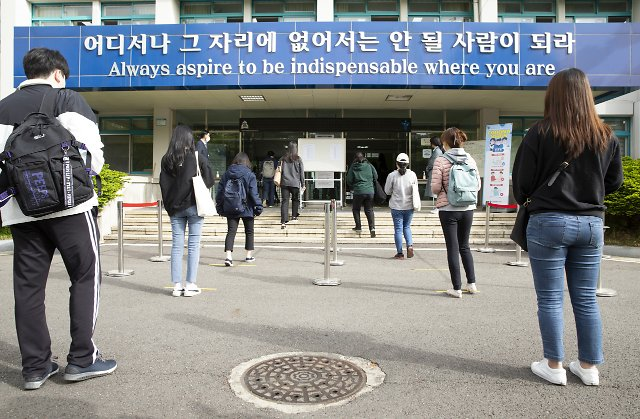
South Korea’s central and local governments hired more people with disabilities last year, while people with severe disabilities made up a larger share of employees with disabilities across the public sector, according to a government report released Wednesday.
The number of new hires with disabilities at central government ministries and local governments rose 4.3 percent on-year to 1,024 in 2025, up from 982 a year earlier, according to the 2026 Annual Report on Balanced Personnel Management released by the Ministry of Personnel Management.
The report tracks the representation of groups including people with disabilities, regional talent, graduates of technical high schools, women and officials with science and engineering backgrounds across the central government, local governments and public institutions.
Among public employees with disabilities, the proportion of people with severe disabilities increased across all three sectors.
At central government ministries, people with severe disabilities accounted for 20.6 percent of employees with disabilities, up 0.6 percentage point from a year earlier. The corresponding share was 19.3 percent at local governments, up 0.1 percentage point, and 23.2 percent at public institutions, an increase of 2.1 percentage points.
The share of women among employees with disabilities also increased in each sector, reaching 20.3 percent at central government ministries, 24.7 percent at local governments and 26.3 percent at public institutions.
The government said it has expanded hiring through separate recruitment tracks for applicants with disabilities and career-based recruitment specifically targeting people with severe disabilities.
Regional recruitment exceeds 30% target
Beyond disability inclusion, the report showed gains in the recruitment of people educated outside Seoul, another component of the government’s efforts to make the public workforce more representative.
For the first time, the share of regional talent selected through the Grade 7 open competitive recruitment process for the central government exceeded the government’s 30 percent target.
Applicants who graduated from schools outside Seoul accounted for 31.1 percent of those selected in 2025, up 2.1 percentage points from 29 percent a year earlier.
Under the regional talent recruitment system, additional candidates can be selected within a designated score range when the share of successful applicants from schools outside Seoul falls below a target level in the Grade 5 and Grade 7 civil service examinations.
A separate recommendation-based recruitment program, under which graduates or prospective graduates recommended by schools are selected as trainees before being appointed as regular civil servants, brought in 416 people last year.
South Korea’s civil service sector is generally divided into nine grades, with Grade 1 the highest and Grade 9 the lowest. Grades 7 and 9 are common entry points through civil service recruitment exams, while Grade 5 recruits generally enter a managerial career track.
Regional hiring by relocated public institutions also increased.
Such institutions hired 1,527 regional candidates, accounting for 40.8 percent of recruits. The number was up by 233 from the previous year. Public institutions also hired 442 more high school graduates than a year earlier.
STEM talent, women gain ground in management
The share of officials with backgrounds in science, technology, engineering and mathematics, or so-called STEM fields, continued to rise as well.
Among senior civil servants at central government ministries, those with science and engineering backgrounds accounted for 28.3 percent in 2025, up from 27.2 percent a year earlier. Their share among officials at Grade 4 or above rose from 37 percent to 38.7 percent.
At local governments, officials with science and engineering backgrounds accounted for 47.6 percent of those at Grade 5 or above, up 1.4 percentage points. The figure has remained above the government’s 40 percent target every year since 2016.
Women’s representation in management positions also continued to rise.
Central government ministries and local governments met their targets for female managers for the seventh consecutive year.
Women accounted for 14.3 percent of senior civil servants at central government ministries, or 210 officials, up from 201 a year earlier. The proportion of women among headquarters-level division chiefs rose 1.5 percentage points to 32.3 percent.
At local governments, women accounted for 38.8 percent of officials at Grade 5 or above, up 4.1 percentage points from the previous year.
“Bringing in talent with diverse backgrounds and expertise is a driving force for solving complex and rapidly changing social problems and improving the quality of public services,” said Park Sung-hee, director general for personnel innovation.
seungku99@heraldcorp.com