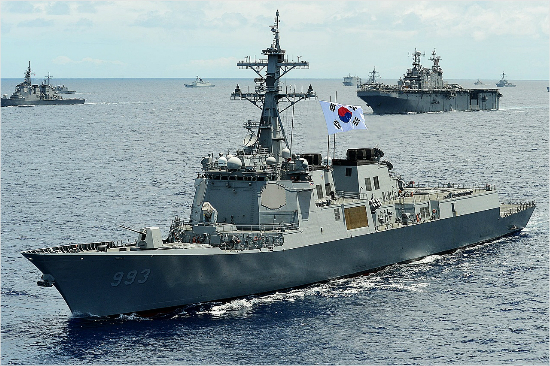
South Korea’s destroyer ROKS Wang Geon is reinforcing its defensive systems ahead of deployment, sources said, in a move seen as preparation for a possible mission in the Strait of Hormuz.
According to military officials on Monday, the 4,400-ton Chungmugong Yi Sun-sin-class destroyer has been enhancing its counter-drone capabilities using so-called “soft-kill” measures, including electronic jamming and cyber-based disruption.
The vessel is set to depart the Navy’s Jinhae base in early May and arrive in the Gulf of Aden in early June, where it will replace ROKS Dae Jo-yeong as part of South Korea’s Cheonghae Unit, the Navy’s anti-piracy mission operating off Somalia.
Seoul has faced pressure to contribute to maritime security in the Strait of Hormuz, amid growing calls for international coordination to safeguard commercial shipping routes.
President Lee Jae Myung on April 17 signaled South Korea’s willingness to play a role during a virtual summit on freedom of navigation in the Strait of Hormuz. The summit was led by France and the United Kingdom and joined by around 50 countries and international organizations.
“Blockage of the Strait of Hormuz — a public asset and a key artery supporting global supply chains — is shaking energy, finance, industry and food security worldwide,” Lee said, adding that South Korea would “make a substantive contribution” to ensuring freedom of navigation.
Defense Minister Ahn Gyu-back also indicated that Seoul is considering joining a multinational maritime force expected to be formed after the end of hostilities between the United States, Israel and Iran, noting that the country is preparing a phased response to protect its commercial vessels.
The Wang Geon is a leading candidate for such a mission. The Cheonghae Unit’s current operational area — the Gulf of Aden, near Yemen and Somalia — lies a few days’ sailing distance of the Strait of Hormuz, making it a flexible asset for relatively quick redeployment.
South Korea previously expanded the unit’s operational scope to the Strait of Hormuz and the Persian Gulf in 2020, opting for an independent deployment instead of joining a US-led coalition at the time.
Officials said options under review include dispatching naval assets, sharing intelligence or sending liaison officers, with the focus likely to be placed on support roles such as logistics and coordination rather than direct combat operations.
“Given the possibility of a multinational force being formed, the military is reviewing a range of cooperation measures, including intelligence sharing and the dispatch of liaison officers,” a military official said on condition of anonymity.
“Any deployment of military assets will be considered with the safety of our personnel as the top priority, while closely monitoring developments in the Middle East and among European partners,” the official added.
flylikekite@heraldcorp.com