In era of uncertainty, Koreans increasingly seek out lucky spots for good fortune

If you spot someone taking a photo on a mountaintop or lingering over coffee at a luxury hotel in Seoul, they may be doing more than sightseeing.
They may just be trying to improve their luck.
A growing number of South Koreans are seeking out their "lucky spots" — places believed to bring good fortune across arenas ranging from one's career and finances to health and relationships.
Park Jeong-ho, a 38-year-old office worker who got married in early April, is among them. He hiked Gwanaksan, a mountain in southern Seoul, with his wife last month, hoping to begin their new chapter on a positive note.
"I saw a post on Instagram saying that several spots on the mountain are believed to hold spiritual energy, including Yeonjudae near the summit," Park told The Korea Herald. "It also said that making the same wish three times at Eungjinjeon Hall would make it come true."
Interest in Gwanaksan surged in late January after feng shui expert Park Sung-joon mentioned the mountain on the popular TV talk show "You Quiz on the Block," suggesting it as a simple way to reset one's fortunes.
"The mountain is known for its strong energy," he explained. "There's even a saying that if you make the same wish three times here, it will come true."
Gwanaksan has long been regarded as a mountain with strong geomantic energy. Its jagged ridgelines, said to resemble rising flames, embody the "fire" element. In feng shui, the mountain's fire shape is associated with change and decisiveness. Folklore links it to career success, with its ridgeline also said to resemble a traditional official's hat.
According to Google Trends, searches for "Gwanaksan" in March rose to around 80,000, up about 60 percent from 50,000 during the same period last year.
But the search for good fortune is no longer limited to mountain trails. In Seoul, luxury hotels and major landmarks have also become destinations for those hoping to tap into positive energy.
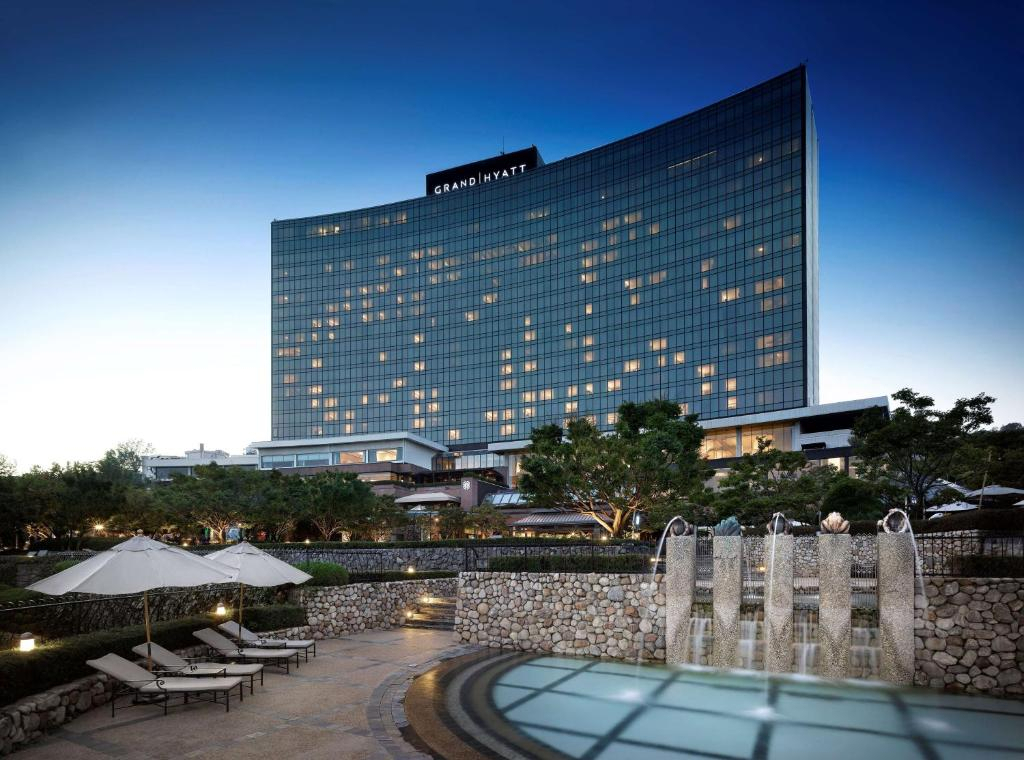
Hotels such as the Grand Hyatt Seoul have gained attention for their perceived geomantic advantages. Overlooking both Namsan and the Han River, the hotel is considered by some to occupy a favorable position. In feng shui, the "fire" energy associated with Namsan is believed to enhance status and financial prospects.
Other landmarks have drawn similar interest.
Lotte World Tower in Jamsil is often interpreted as resembling a vessel in motion, which could be understood as a symbol of overcoming stagnation and advancing toward success.
The trend has grown alongside a boom in readings of saju, a traditional Korean practice that interprets a person's fate based on the date and time of their birth. It is rooted in the concept of "ohaeng," or the five elements: wood, symbolizing growth and vitality; fire, symbolizing passion and intensity; earth, symbolizing stability and balance; metal, symbolizing strength and structure; and water, symbolizing intelligence and fluidity.
Rather than relying solely on fortunetelling, some people are now turning to physical places believed to radiate positive energy, hoping to compensate for elements they feel are lacking.
Experts say the phenomenon has less to do with belief in energy and more to do with how people cope with uncertainty.
Lim Myung-ho, a professor of psychology and psychotherapy at Dankuk University, pointed to economic and social pressures people face today.
"Many people, especially the younger generation, are struggling both economically and socially, which has added to a growing sense of anxiety. From a psychological perspective, turning to so-called lucky spots can be a way of coping with that uncertainty to make them feel better," the professor explained.
"There is a positive side. Believing in it can boost confidence and shape how people think, which is what psychologists call a 'self-fulfilling prophecy,' or a placebo effect."
junheee@heraldcorp.com