Imports jump 84% to $71.8m as Chinese beauty industry follows Korean playbook

It might take nerve for an overseas brand to press its case on the Korean beauty industry's home turf, more so for Chinese players still dogged by doubts over quality.
Yet for the moment, Chinese beauty brands, or "C-beauty," are the challengers du jour.
Imports of Chinese cosmetics into Korea climbed to a record $71.76 million last year, up 84 percent from a year earlier, according to the Korea Customs Service.
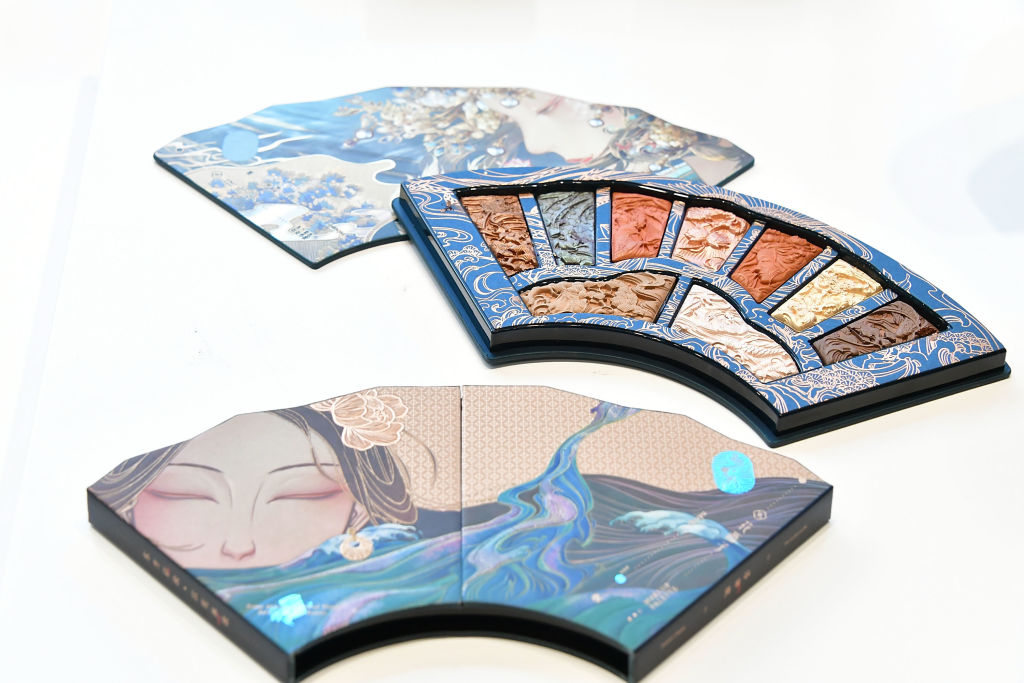
A telling vignette came last October, when Chinese color cosmetics brand Flower Knows, known for its Rococo flourishes and fairy tale aesthetic, held a two-week pop-up in Seongsu-dong, drawing 27,000 visitors and selling out multiple product lines.
That debut may not yet amount to a threat, but it could be a warning signal, officials say, as the Chinese beauty industry’s momentum within China has begun to spill into neighboring markets.
Chinese firms edge their way in
As for what underpins the rising demand, a more theatrical visual language sets Chinese beauty firms apart from Korean beauty firms’ understated sensibility, according to industry insiders, with trends such as “wanghong” makeup gaining traction on social media.
“C-beauty is striking a chord with Korean consumers on its own terms through bold patterns and pearlescent finishes that contrast with K-beauty’s signature toned-down aesthetic,” one official said.
Taking note of the trend, Korean platforms are warming to Chinese brands.
Since February, Flower Knows turned its pop-up momentum into a listing on Korea’s leading fashion platform, Musinsa, topping the eye makeup category on day one.
“This is our first time carrying a Chinese beauty brand,” a Musinsa official said. “Starting with Flower Knows, we intend to bring in more C-beauty labels that have built loyal followings.”
The brand has also made its way into Chicor, operated by Shinsegae, which said it had spotted rising demand among younger consumers.
Among well-known Chinese brands such as Judydoll, Florasis and Perfect Diary, Judydoll has been making its own moves recently, launching a dedicated Korean Instagram account and reportedly eyeing an official listing on Coupang.
Improved product quality has also contributed to their rise, much of it, ironically, owing to Korea.
Chinese brands are increasingly tapping Korean contract manufacturers, closing the gap with their Korean peers. For example, Flower Knows works with Kolmar Korea and Cosmax, alongside Chinese producers.
For Cosmax, a Seoul-based analyst at Daol Investment & Securities projects 13 percent and 15 percent revenue growth this year for its Shanghai and Guangzhou units, respectively.
“The overseas expansion of C-beauty color brands is expected to support growth in Cosmax’s China operations,” they said.
Korean beauty holds the line
While Chinese brands make inroads, Korean brands are increasingly outward-looking, even as they pivot away from China.
According to the Ministry of Food and Drug Safety, Korean cosmetics exports rose to a record $3.1 billion in the first quarter, up 19 percent from a year earlier, as shipments to the US surged 40.9 percent to $620 million, offsetting a 9.6 percent decline in exports to China to $470 million.
Shipments of cosmetics to China, in fact, have nearly halved in recent years, falling from $3 billion in 2022 to $1.6 billion in 2025. Even so, that figure is still 23 times the $71.76 million in Chinese imports, pointing to more robust demand among Chinese consumers for Korean products than vice versa.
Korean brands' staying power runs deeper than market share, industry insiders remarked, given its rise has moved in lockstep with Korean culture that competitors would struggle to replicate.
"For C-beauty to challenge K-beauty on the global stage, it would first need a comparable fandom for Chinese culture," one industry official said.
With Chinese products heavily concentrated in color cosmetics, another moat for the Korean beauty industry is skincare, which generated $2.43 billion in the first quarter, versus $330 million for color cosmetics. Its reliance on years of formulation depth makes it harder for rivals to close the gap quickly.
Some see the risk from China less in competition and more in gray market activity.
“The real issue is the spread of counterfeit K-beauty products, which, when mistaken for genuine items, can harm individual brands and erode trust in the category as a whole," said Kim Byung-hoon, CEO of APR, at a beauty event last September.
The Korea Customs Service said that in 2025, cosmetics accounted for 37 percent of the 117,000 counterfeit Korean-branded goods seized, with nearly 98 percent originating from China.
minmin@heraldcorp.com