South Korea’s military is facing scrutiny over its handling of North Korea’s recent missile launches, with critics saying it failed to promptly detect and assess the tests, raising doubts over the effectiveness of the country's missile defense system.
The lapse has drawn political backlash, with opposition figures questioning Seoul’s readiness to assume wartime operational control, which has remained under US authority since the 1950-53 Korean War and which the Lee Jae Myung administration aims to reclaim by 2030.
Earlier this week, North Korea conducted a series of missile tests, including a launch on Tuesday that is believed to have failed mid-flight, followed by two separate short-range ballistic missile launches on Wednesday.
According to South Korea’s Joint Chiefs of Staff, the Wednesday launches were detected at around 8:50 a.m. and 2:20 p.m., with the missiles flying approximately 240 kilometers and over 700 kilometers, respectively.
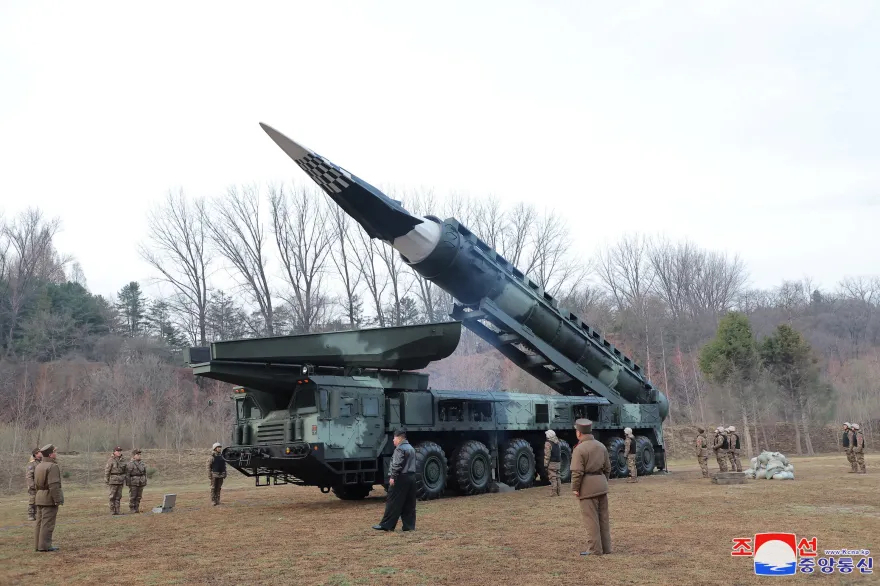
Further details emerged a day later through North Korea’s state media, the Korean Central News Agency, which reported on Thursday that the tests involved the Hwasong-11 (KN-23) short-range ballistic missile equipped with a cluster munition warhead to assess its combat effectiveness.
Controversy centered on the Tuesday launch, which was not immediately identified by South Korean authorities and was later confirmed based on US intelligence.
Rep. Sung Il-jong, chair of the National Assembly’s Defense Committee and a member of the main opposition People Power Party, said, “It is regrettable that our military failed to detect the missile and only learned of it later through US information.”
“This case clearly shows how dangerous it would be to push ahead with wartime operational control transfer without sufficient capabilities,” he added, warning of potential security gaps.
The incident has also raised questions over the effectiveness of South Korea’s “Kill Chain” system, a key component of its missile defense architecture designed to detect and neutralize imminent missile threats before launch.
Military officials said the difficulty in promptly identifying the launch reflects inherent technical limitations in missile detection.
A Joint Chiefs of Staff official, speaking on condition of anonymity, said South Korea continuously monitors North Korea using its own military satellites and ground-based radars, including Green Pine systems, in coordination with US assets.
“Because the Earth is curved, radar systems inevitably have blind spots,” the official said. “Even when a launch is detected, calculating its trajectory requires tracking the missile throughout its flight. If it disappears midair or breaks up early, that becomes significantly more difficult.”
“Whether a missile uses solid or liquid fuel also matters,” the official added. “Liquid-fuel missiles require fueling in advance, which allows us to detect signs beforehand, but solid-fuel missiles can be launched almost immediately, making advance detection much harder.”
Yoo In-seok, a professor at Yeungnam University and a retired Army colonel who previously led the Joint Chiefs of Staff’s nuclear and weapons of mass destruction response planning division, said the Kill Chain system is designed to operate only under highly specific conditions.
“Preemptive strike options like Kill Chain are not meant to be applied in every situation, but only when there is a high degree of certainty that a launch is imminent,” Yoo said.
“Because such decisions could effectively trigger a military conflict, the threshold for action is extremely high.”
He added that in many real-world scenarios, where clear prelaunch indicators are difficult to obtain, the focus shifts to post-launch detection and tracking rather than preemption.
“This gap between expectation and reality can create the perception that the system is not functioning,” he said.
“But in operational terms, missile defense — including detection after launch and trajectory tracking — is still functioning as intended.”
The Joint Chiefs of Staff added that South Korea, the United States and Japan share tracking data in real time to improve accuracy, noting that some launches — particularly those that fail shortly after liftoff — may be harder to detect and assess in their early stages.
flylikekite@heraldcorp.com