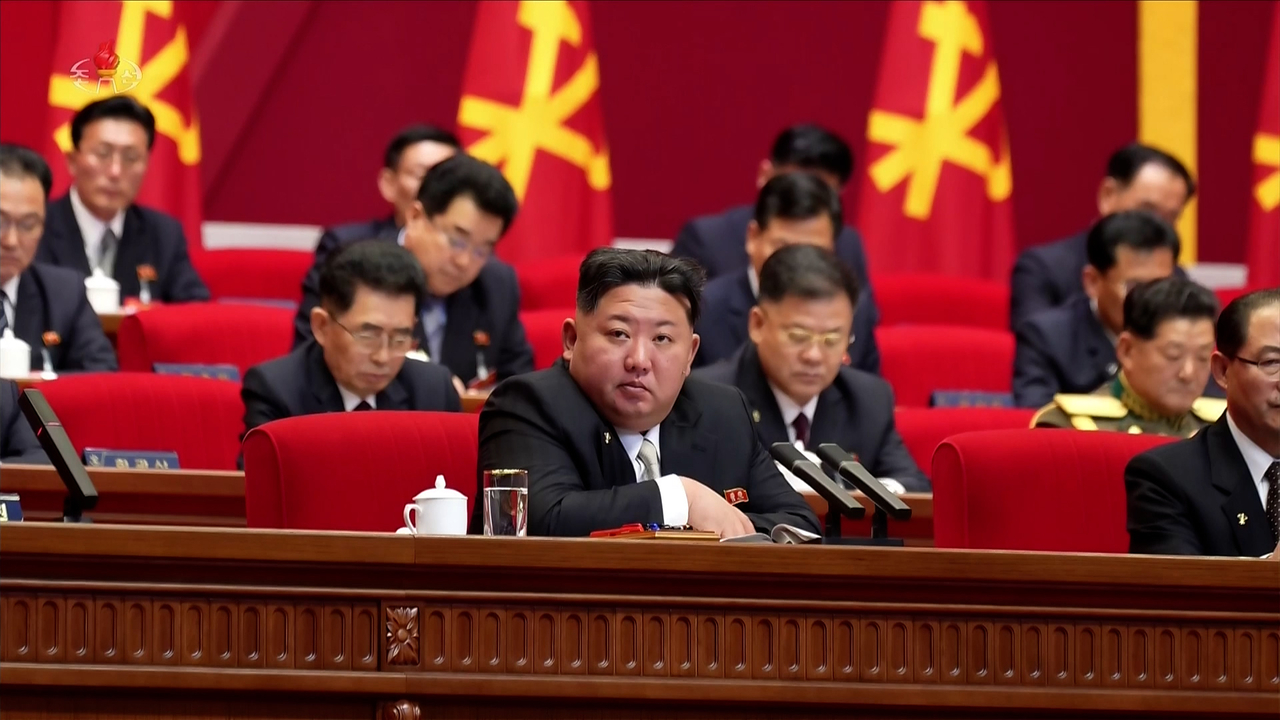
North Korea has reelected Kim Jong-un as general secretary of the ruling Workers’ Party at its ongoing party congress, its state media said Monday, as the regime highlighted progress in nuclear deterrence while refraining from direct messages toward South Korea and the United States.
“The Ninth Congress of the Workers' Party of Korea decides to elect Kim Jong-un as general secretary of the WPK ... for the development of the WPK and the prosperity of the state,” the Korean Central News Agency said, citing the “unshakable” will of party members, the people and soldiers.
The decision was made Sunday, the fourth day of the congress that typically concludes with policy directions covering the economy, defense and diplomacy for the next five years. Under party regulations, the general secretary must be elected at a party congress.
State media framed the reelection as validation of Kim’s leadership, particularly in strengthening the country’s military and nuclear capabilities.
The congress praised Kim for building “the revolutionary armed forces capable of coping with any threat of aggression on their own initiative and fully prepared for any form of war.”
“The war deterrence of the country with the nuclear forces as its pivot has been radically improved and our state has dynamically advanced in the orbit of prosperity ... despite the stern challenges of history,” KCNA said, quoting the congress decision.
In remarks to the congress, party secretary Ri Il-hwan credited Kim with guiding national development and shaping a long-sought vision of prosperity.
The leader “made it possible to design and create to the full the dream and ideal for prosperity, which had been desired for a long time, even in the middle of this confused planet shaking with wars and tyranny,” Ri was quoted in English as saying.
“Only Kim Jong-un can guide the trend of gigantic transformation of our cause put on an orbit of leap forward to a steady upturn without halt,” the quote continued. He added that the country had overcome sanctions and emerged as a “formidable” force recognized by its adversaries.
Despite the heavy emphasis on internal consolidation and nuclear deterrence, Pyongyang has not issued any message aimed directly at Washington or Seoul during the congress so far.
South Korea’s Unification Ministry assessed that the event appears focused on reinforcing Kim’s leadership and domestic messaging.
“Looking at the main characteristics of the congress so far, external messages have been minimized, while the content of the meeting was being disclosed at the most minimal level,” ministry spokesperson Yoon Min-ho said at a press briefing Monday.
Neither Kim’s opening speech, the decision announcing his reelection nor Ri’s proposal mentioned the US or South Korea by name. KCNA also reported that revised party rules were adopted, but did not disclose details, including whether Pyongyang formally codified its stance defining the two Koreas as “hostile countries,” as some observers had speculated.
South Korea or the US were described broadly as hostile forces, while nuclear capability was framed in words such as “war deterrence,” according to Yang Moo-jin, a professor at the University of North Korean Studies in Seoul.
"The restraint may indicate room for the North's future diplomacy with the US and South Korea," though confirmation would depend on the final decision document adopted at the end of the congress, he explained.
Lim Eul-chul, a professor at Kyungnam University’s Institute for Far Eastern Studies, said the developments indicated that Kim’s authority was being elevated to a near-absolute level. Phrases emphasizing “raising dignity and authority to extraordinary heights” and portraying him as “irreplaceable” suggest he is being positioned not only as the successor to past leaders but as a figure ushering in a “new era,” Lim said.
Lim added that Pyongyang appears to be reframing nuclear capabilities not just as a means of survival but as a foundation for national prosperity and economic focus.
Meanwhile, Chinese President Xi Jinping sent a message of congratulations Monday to Kim following his reelection as general secretary of the ruling party, pledging to deepen strategic cooperation between the two countries, according to China's state-run Xinhua News Agency. Xi's message was delivered after Kim was returned to the top post of the Workers’ Party of Korea during the ongoing party congress, the news report said.
In the message, Xi praised Kim for "achieving new results in building a Korean socialist country" and said his reelection reflects "the high trust and heartfelt support" of the party, the government and the people.
Xi also referred to China and North Korea as "friendly socialist neighbors," reaffirming his party and government’s "unwavering policy" to sustain and further strengthen bilateral relations.
The Chinese leader additionally referenced his recent meetings with Kim and proposed that both sides carry out key agreements reached at those talks in order to "open a new chapter" in ties.
Leadership reshuffles announced during the meeting also pointed to internal restructuring. KCNA reported the election of new members of the party’s Central Committee, with more than half replaced compared with the previous congress. Notably absent from the list was Choe Ryong-hae, president of the Presidium of the Supreme People’s Assembly and a longtime senior figure, along with several other veteran officials.
The changes suggest a generational shift within the leadership and the rise of younger technocrats, observers say.
North Korea opened the Ninth Party Congress last Thursday — its first since 2021 — and the gathering is expected to conclude with a decision outlining policy priorities for the next five years.
Whether Pyongyang will eventually issue messages in response to Seoul and Washington’s overtures for dialogue remains a key point of attention as the congress continues.
mkjung@heraldcorp.com

![[Survive&Thrive] Tips for getting around Seoul by subway (2)](https://wimg.heraldcorp.com/news/cms/2026/10/08/news-p.v1.20261006.1e7dee51d7f64cdba1a20b897d88cee6_T1.jpg?type=h&h=800)