Chief technical officer says next-gen HBM4 exceeds expectations, as tech giant moves to restore AI memory leadership
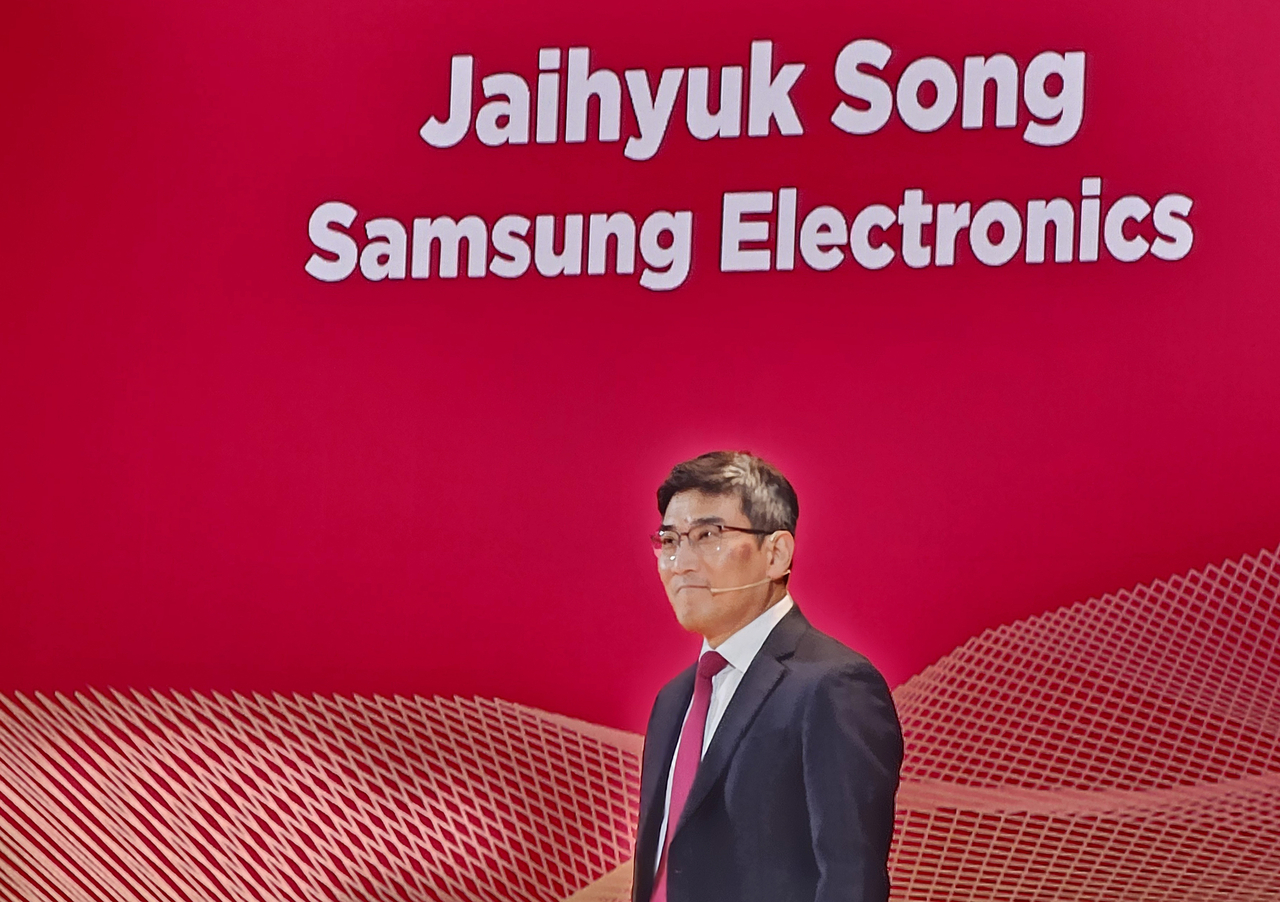
Samsung Electronics used Semicon Korea 2026 to underscore its push into next-generation artificial intelligence memory, highlighting strong customer response to its sixth-generation high bandwidth memory, or HBM4, and unveiling an expanded road map for advanced packaging.
Song Jai-hyuk, chief technology officer of Samsung’s device solutions division, said feedback on HBM4 has been “very satisfactory,” adding that the company is preparing for mass production shipments this month.
Samsung and SK hynix are expected to begin supplying HBM4 for Nvidia’s upcoming AI accelerator platform, Vera Rubin. The new memory chips achieve data transfer speeds of 11.7 gigabits per second, exceeding Nvidia’s 11 Gbps requirement and marking a new industry benchmark.
Song said Samsung’s integrated structure — combining memory, foundry and advanced packaging — positions the company to respond quickly to AI market demands. He added that next-generation products, including HBM4E and HBM5, are already in development.
At his keynote address, Song outlined Samsung’s broader memory strategy, centered on custom HBM, vertically integrated zHBM and Hybrid Copper Bonding technology.
Custom HBM is designed to move certain processing functions from the graphics processing unit to the base die within the HBM stack, improving performance efficiency. Meanwhile, zHBM vertically integrates memory with compute chips such as central processing units and GPUs through 3D stacking, aiming to enhance bandwidth and reduce power consumption.
To enable these architectures, Samsung plans to deploy Hybrid Copper Bonding, which directly bonds chips without microbumps. The technology allows thinner dies, shorter interconnect distances and faster data transfer speeds, reflecting the growing importance of advanced packaging in AI chip performance.
Samsung’s presentation came as industry analysts emphasized that AI infrastructure growth increasingly depends on memory and packaging rather than wafer capacity alone.
Clark Tseng, senior director of market intelligence at Semi, said during a briefing that record capital expenditure in AI does not automatically translate into usable supply.
“We are seeing record levels of capital investment, but spending alone does not resolve bottlenecks,” Tseng said. “The real constraint is shifting from wafer starts to yield, advanced packaging and qualification timelines.”
According to Semi, Korea’s chip exports reached $173.4 billion in 2025, up 22.2 percent from a year earlier, with December marking a monthly high of $20.7 billion. Exports to Taiwan surged 64.8 percent, reflecting deeper integration into the AI accelerator supply chain.
Global semiconductor revenue and AI-related capital expenditure are both expected to exceed $1 trillion by 2027, Tseng said. Fab capacity is projected to expand from 25 million wafers per month to about 45 million by 2030, while Korea’s annual fab investment is forecast to reach around $40 billion between 2026 and 2028.
Tseng noted that memory and advanced packaging have become system-level constraints in AI infrastructure.
“Memory and packaging are no longer supporting roles,” he said. “They are now critical to how fast AI infrastructure can scale.”
Lee Sei-cheol, head of Citi Korea Research, said the next wave of AI demand could shift gradually from centralized cloud systems to more distributed, on-device AI applications. He added that back-end process technologies such as hybrid bonding are becoming strategically important alongside front-end wafer fabrication.
Semicon Korea 2026 opened in Seoul with a record number of preregistered participants. More than 75,000 visitors are expected to attend the three-day event, which features 550 exhibitors and over 200 speakers across 30 conferences.
herim@heraldcorp.com
![[Survive&Thrive] Tips for getting around Seoul by subway (2)](https://wimg.heraldcorp.com/news/cms/2026/10/08/news-p.v1.20261006.1e7dee51d7f64cdba1a20b897d88cee6_T1.jpg?type=h&h=800)