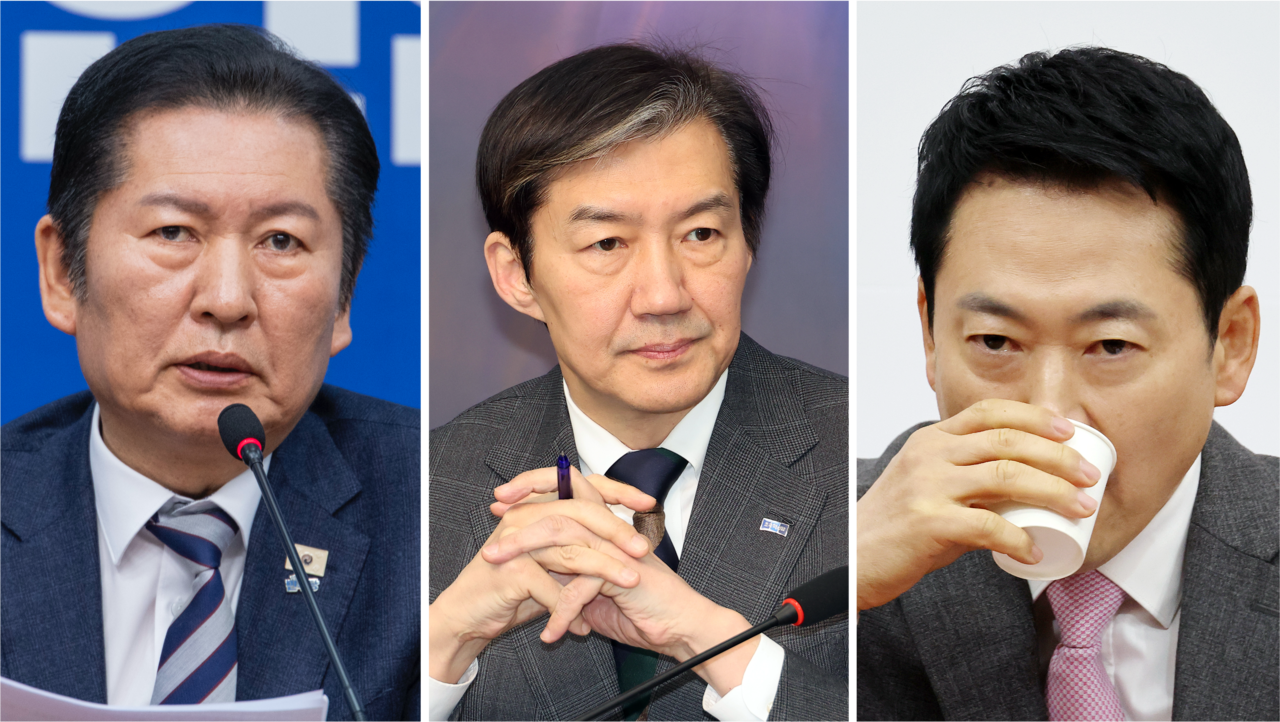
New fault lines appeared within South Korea’s two major political parties, as internal controversies spread to the ruling party's abortive choice of a special prosecutor and disciplinary committees within the main opposition party turning their sights to more members.
The leaderships' failure to unify the parties has raised concerns that internal fragmentation could weigh on their electoral footing ahead of the June local elections.
Within the Democratic Party, tensions have escalated beyond an ongoing dispute over a proposed merger with the left-leaning Rebuilding Korea Party, into a fresh controversy over the party’s recommendation of attorney Jeon Jun-cheol as a special counsel candidae.
The party had backed Jeon to lead a second round of independent investigations into allegations against former President Yoon Suk Yeol and first lady Kim Keon Hee.
The recommendation drew criticism from within the party after reports emerged that President Lee Jae Myung had expressed displeasure over the nomination, given Jeon’s history as a defense attorney for former Ssangbangwool Group Chairman Kim Sung-tae.
Kim is a central figure in the so-called Ssangbangwool remittance scandal. He is currently appealing a conviction for illegally transferring funds to North Korea, allegedly on behalf of Lee, who was the governor of Gyeonggi Province at the time.
The connection fueled internal criticism that the party leadership failed to adequately vet the candidate before making the recommendation.
Democratic Party Rep. Lee Eon-ju said the leadership had “bypassed both the Supreme Council and the National Assembly’s Legislation and Judiciary Committee” during the party’s Supreme Council meeting at the National Assembly in Seoul on Monday.
Rep. Hwang Myung-sun likewise called for a review of the party’s personnel verification system, saying the matter “cannot be brushed aside with explanations.”
Facing mounting criticism, Democratic Party leader Jung Chung-rae issued a public apology, saying he would "bear final responsibility for all decisions.”
“I sincerely apologize to the president for causing concern.”
The controversy has further strained the party’s already divisive merger talks.
The Democratic Party plans to convene a general meeting of lawmakers Tuesday to gather opinions on whether to proceed with the merger. The decision could shape the party’s preelection alignment strategy and potentially weaken Jung's authority within the party.
Rebuilding Korea Party leader Cho Kuk said Sunday that unless the Democratic Party delivered an official and public response by Friday, merger talks should be considered no longer viable.
He also accused merger opponents of spreading smear campaigns, saying false claims were being circulated to brand him as “anti-Lee Jae Myung.”
Meanwhile, the People Power Party faces a parallel escalation of internal conflict driven by disciplinary battles.
The fallout from former party leader Han Dong-hoon's expulsion has spread into a broader struggle for organizational control.
Party leadership decided to expel Han, once a Yoon ally, over allegations that he had posted messages on an internal party forum criticizing senior leadership and former President Yoon — a move that pro-Han lawmakers denounced as excessive and politically motivated.
The disciplinary fallout has since widened.
The party leadership initiated disciplinary proceedings against Rep. Bae Hyun-jin — who had publicly opposed Han’s expulsion and joined internal calls criticizing the decision — prompting backlash from senior Seoul party officials.
In a counter move, the party’s Seoul branch ethics committee, chaired by Bae, launched its own disciplinary review targeting far-right YouTuber Ko Sung-kook, who is seen as aligned with the current leadership.
The tit-for-tat measures have fueled perceptions that the party’s ethics apparatus is becoming a battleground for factional retaliation.
Adding to tensions, the party’s Supreme Council on Monday finalized the expulsion of former top council member Kim Jong-hyuk, another pro-Han figure.
Kim’s expulsion followed his social media post sharing content from Han’s political talk concert, in which he described the gathering as “the beginning of a comeback by an active majority.”
The People Power Party has also struggled to build momentum for broader conservative consolidation.
Speculation over whether the party could pursue electoral coordination with the minor conservative Reform Party ahead of the local polls persists.
However, Reform Party leader Rep. Lee Jun-seok has repeatedly ruled out cooperation with the People Power Party leadership, dimming prospects for a broader conservative alliance.
flylikekite@heraldcorp.com