Support for people with disabilities to live in community remains lackluster, despite recurring cases of abuse in residential facilities

Calls to reduce South Korea’s reliance on institutional care for people with disabilities are gaining renewed attention after a new case of sexual assault involving residents at a care facility came to light.
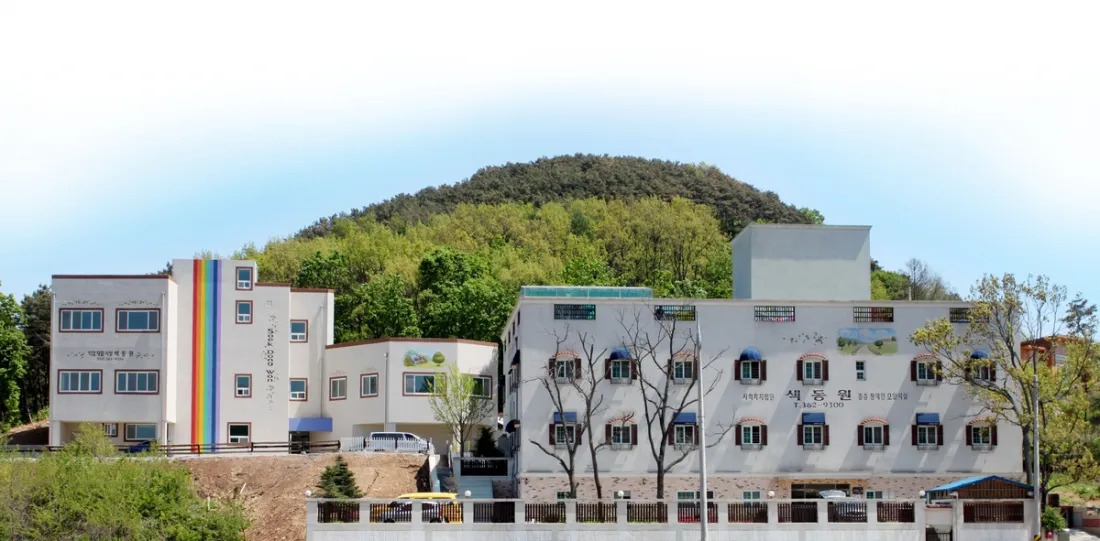
As of Monday, police are intensifying their investigation into Saekdongwon, a residential facility for people with disabilities in Incheon, where at least six female residents are suspected of having been sexually assaulted during their time there.
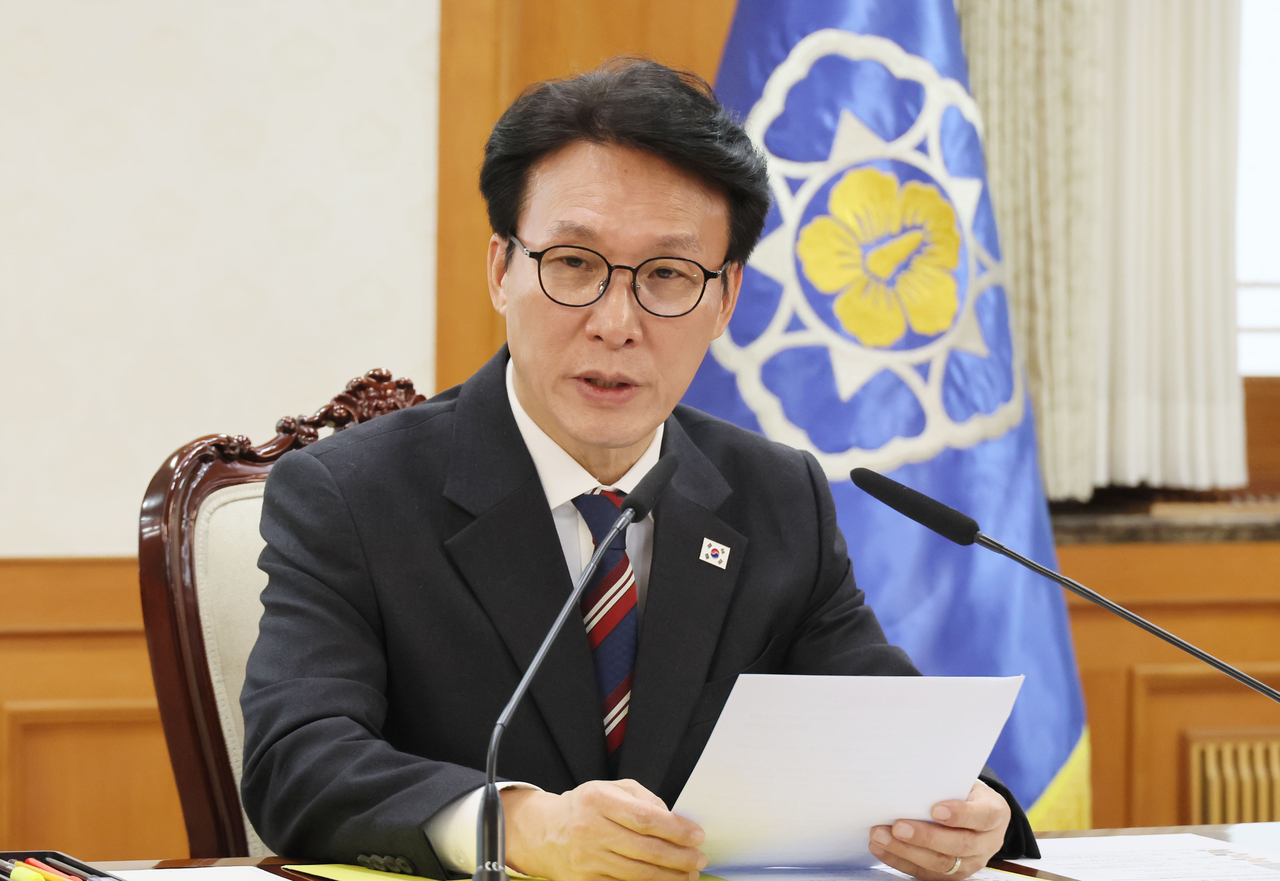
Prime Minister Kim Min-seok ordered an investigation into the case and a nationwide inspection of similar facilities.
Civic groups, meanwhile, say the incident reflects a structural problem in a care system that relies heavily on large group institutions, arguing that such settings make repeated, large scale abuse possible. They are calling once again for the closure of these facilities and a shift toward community-based, individualized support.
“Government responses have focused on punishing individual perpetrators or shutting down a single facility, even as these human rights violations keep recurring,” said Jang Jong in, an executive at a coalition of disability rights groups formed in response to the Saekdongwon case.
“This only pushes facilities to hide problems more thoroughly, while people with disabilities are left to suffer in silence for longer.”
Despite repeated pledges by the government and the president to pursue deinstitutionalization — a move away from residential institutions toward community-based living — progress has remained largely stalled, reflecting deep divisions over cost, responsibility and feasibility.
Tough transition
Deinstitutionalization has long been the trend in North America and Europe, and it is required under the United Nations Convention on the Rights of Persons with Disabilities, to which Korea is a party.
The approach centers on providing individualized support so people with varying types and degrees of disabilities can live and work in the broader community, rather than spending decades in large, segregated institutions.
In Korea, the concept has resurfaced time and again after cases of abuse at residential facilities, some of which have led to residents’ deaths.
The issue gained national attention after multiple institutional cases of sexual abuse of students at Gwangju’s Inhwa School were uncovered in 2005, later depicted in the 2011 film "Silenced."
Calls for reform grew stronger again when 20 staff members at a facility in Ulsan were found to have repeatedly assaulted nearly 30 residents, with four receiving prison sentences.
“The system itself leaves room for human rights violations,” Jang said. “No matter how well-intentioned and dedicated staff may be, control-oriented management becomes inevitable when dozens of people live together under limited staffing.”
“With repeated abuses and clear limits to rights protection, a new alternative must be pursued,” he added.
Advocates say victims often remain dependent on the facilities where the abuse occurred, while communication difficulties make investigations and prosecutions harder, increasing the risk of repeated harm. Even after the Ulsan case, many victims reportedly remain in the same institution due to a lack of alternative options.
In the Saekdongwon case, police formed a 27-member investigative team in late January and have since added dozens more officers. The probe has reportedly encountered obstacles, including challenges in obtaining testimony from residents with severe disabilities.
Government push stalled
The government has already unveiled a long-term road map to phase out residential institutions, but progress has stalled as Korea struggles to forge consensus amid deep divisions over how people with disabilities should be supported. Announced in 2021, the plan aims to reduce the number of residents in specialized facilities from 24,481 in 2020 to 2,193 by 2041.
By expanding individualized assistance, the road map envisions shifting people into personal housing or group homes, where residents are expected to have more control over their lives if adequate support is provided.
However, as of 2024 the number of people living in group homes remains far below target. Government data shows roughly 2,800 people in such settings -- nearly half the level envisioned for this stage of the transition.
Critics say the overall decline in facility residents largely reflects a long-term demographic trend rather than the impact of government policy. They also argue that the state has sent mixed signals by continuing to direct more funding to institutions than toward the community-based support envisioned in the road map.
While Lee Jae Myung described deinstitutionalization as a desirable policy during his election campaign in May, the Ministry of Health and Welfare allocated 739.6 billion won ($505 million) this year for residential facilities, around 100 times the amount designated for care in the community.
Officials have cited the substantial budget required for the transition and resistance from facility operators as major obstacles.
The Seoul Metropolitan Government, which abolished a municipal ordinance on disability deinstitutionalization in 2024, previously estimated that community-based care would cost roughly twice as much per person as facility-based care.
A 2023 estimate from the city projected that between 105 million and 141 million won per person would be needed to provide adequate support during the first four years of independent living, compared to about 65 million won per person for institutional care.
Pushback continues
Concerns remain that closing residential facilities could worsen conditions for people with severe disabilities, as institutional and financial support systems are still inadequate for independent living.
Opposition has come from facility operators, religious groups and some families of people with disabilities, reflecting differing views among families over how such policies should be implemented.
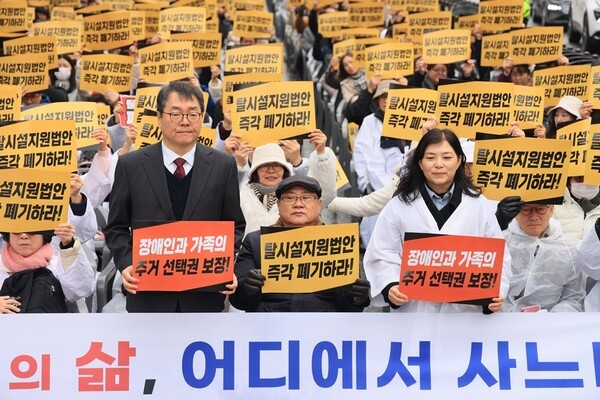
In November, protesters rallied against a bill introduced by Reps. Seo Mi-hwa of the ruling Democratic Party of Korea and Kim Sun-min of the Rebuilding Korea Party that seeks to strengthen deinstitutionalization and expand community-based living support.
“The bill violates the right of people with disabilities and their families to choose their living arrangements,” protesters said at the event held in front of the National Assembly in central Seoul.
“Without a fully established 24-hour support system for people with severe developmental disabilities and older adults, closing institutions would put their lives at risk.”
Saying that the legislation is detached from reality, they argue that residential facilities should remain an option within the disability care system. Korea’s Catholic Church, which operates more than 150 facilities nationwide, has also expressed reservations about the push to close institutions, saying people with severe disabilities should retain the right to choose facility-based care for close and specialized support.
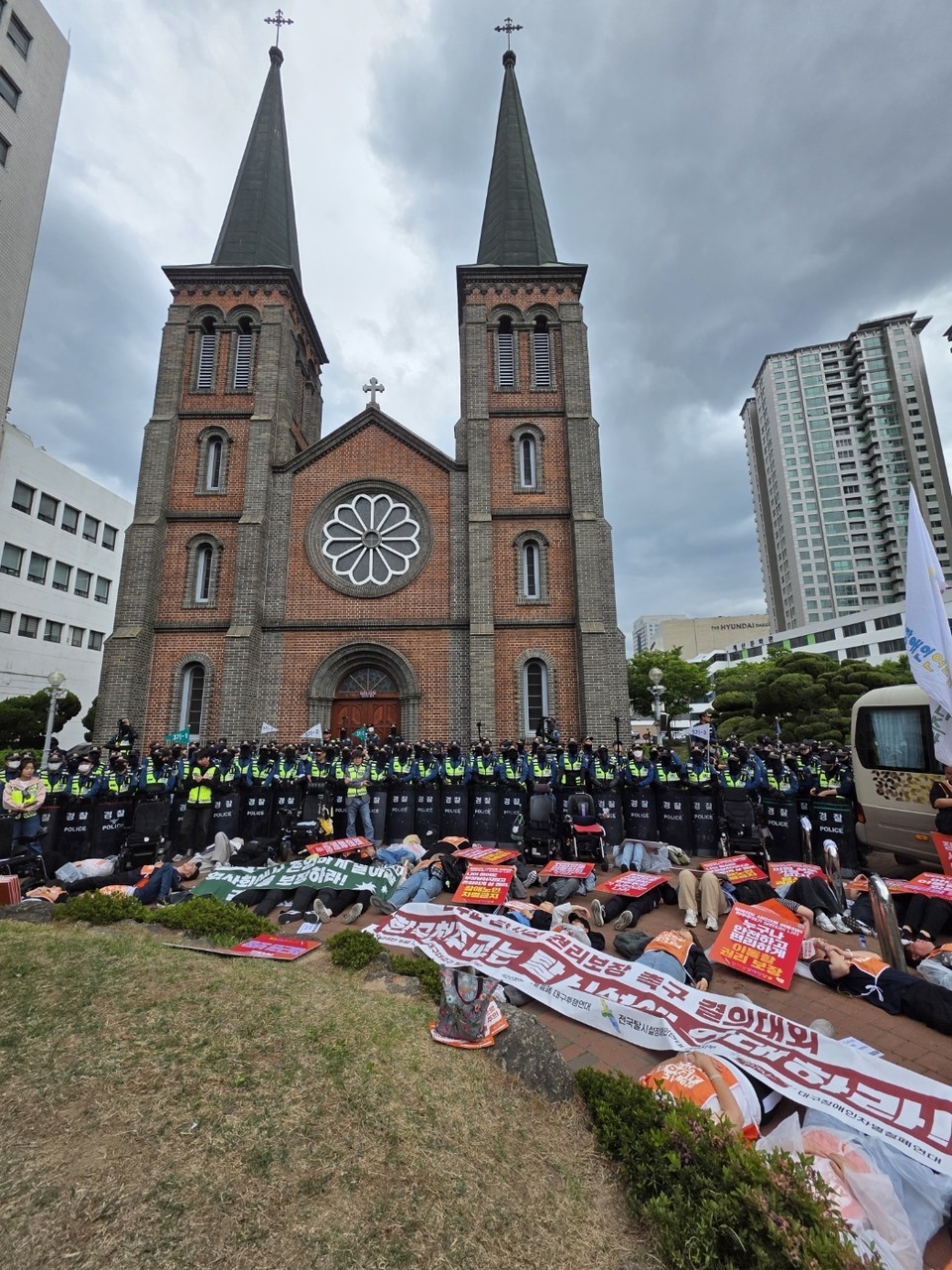
Tensions between the church and disability rights groups peaked last year, when activists staged protests outside churches across the country and held a 15-day sit-in at the bell tower of Hyehwa Catholic Church in central Seoul.
Yet signs of reconciliation have since emerged. In May, Chung Soon-taick, the archbishop of Seoul, met with disability activists to discuss deinstitutionalization policy.
“I agree with the principle that people with disabilities should live in the community and I support deinstitutionalization to enhance their rights,” Chung said. “But for people with severe disabilities who lack family support, protective measures that respect their wishes and those of their families must also remain.”
Calls grow for stronger action
Advocates of deinstitutionalization deny that they are seeking to forcibly move people with disabilities out of facilities without adequate support, arguing instead that stronger government action is necessary to ensure a smooth transition to community-based living.
“Korea’s welfare system has long been centered on residential facilities, so immediate closures or mass discharges are unrealistic, especially against the will of people with disabilities,” said an official at the Korean Parents Network for People with Disabilities.
“We urge the government to share the burden faced by families so that people with disabilities are not forced into facilities but are supported to live independently in the local community.”
Experts say the government’s lack of substantial action has contributed to families’ anxieties over deinstitutionalization.
“With few alternatives in place after people leave facilities, families naturally have concerns,” said Kim Ki-ryong, a professor of special education at Joongbu University. “The government needs a strong legal framework to implement related support measures and secure the necessary budget.”
While acknowledging that no country has completed such a transition with a fully developed system, experts stress the need for feedback mechanisms that incorporate the experiences of people who have already left facilities in order to build a more workable road map.
“Efforts are needed to establish a dedicated organization to coordinate and provide integrated counseling and support for income assistance and other public welfare services for people with disabilities,” said Hwang Jeong-ha, a professor of social welfare at Chonnam National University.
forestjs@heraldcorp.com