Self-made founder who led Jungheung’s rise, acquired Daewoo Engineering & Construction and expanded into media, aquiring Herald Media Group
Long known as a regional builder rooted in South Korea’s southwest, Jungheung Group today ranks among the country’s top 20 business groups — a transformation capped by its acquisition of Daewoo Engineering & Construction and its elevation into the top tier of the nation’s construction industry.
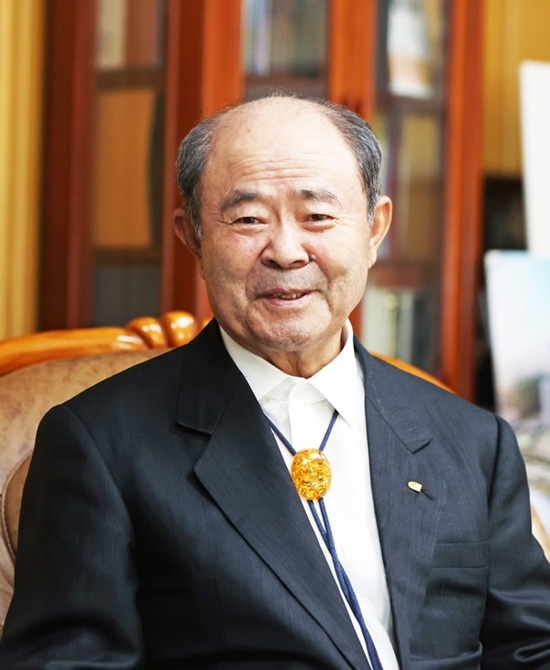
Behind that unlikely ascent was a self-made entrepreneur, Jung Chang-sun, the group’s founder and longtime chairman, who died Monday. Born in 1943 in Gwangju, Jung never lost sight of his modest beginnings, even as his company grew into a national heavyweight.
Jung entered the construction industry at just 19, working as an apprentice on building sites during a period when Korea’s postwar reconstruction was still reshaping the country. Those early years, he later said, formed not only his technical foundation but also his view of management and labor.
“Among people who took pride in mastering their craft, I learned about life,” Jung once recalled. “That is when I began dreaming of becoming the best in construction and someday founding a company of my own.”
That dream took concrete form in 1983, when he founded Geumnam Housing Construction, the predecessor of Jungheung Construction. Six years later, he formally launched Jungheung Construction, laying the groundwork for what would become Jungheung Group.
Unlike many builders that expanded aggressively during Korea’s property booms, Jung favored cautious growth, guided by strict financial discipline.
He governed the company by what he called the “three no’s”: no acquisition of assets unrelated to core businesses, no debt guarantees for affiliates and no projects lacking clear profitability. It was an approach shaped by firsthand experience of industry downturns, and one that helped Jungheung avoid the excesses that sank many rivals during housing slumps.
“The heart of sound management is strict financial control,” Jung said in a 2016 interview. “We do not plan projects first and then figure out financing. We plan finances first and shape our projects accordingly.”
The strategy paid off in the early 2000s with the launch of the Jungheung S-Class apartment brand, which brought national recognition in Korea’s fiercely competitive housing market. Momentum accelerated in Sejong, the newly designated administrative capital, where Jungheung moved in as larger builders pulled back amid uncertainty. Between 2012 and 2016, the company supplied roughly 12,000 housing units there — all of which sold — cementing its transition from a regional builder to a nationwide developer.
Yet Jung’s ambitions extended beyond residential construction. By the late 2010s, he had begun openly discussing a leap into Korea’s top corporate ranks.
“Within three years, we intend to acquire a major company and break into the nation’s top 20 business groups,” he said in 2020, signaling interest in firms with strong overseas operations.
That vision materialized in 2021, when Jungheung was named the preferred bidder for Daewoo Engineering & Construction, then the nation’s sixth-largest builder. The acquisition was completed the following year, instantly vaulting Jungheung onto a far larger stage and making it Korea’s third-largest construction group, behind Samsung C&T and Hyundai Engineering & Construction.
In what he described as the “second chapter” of his life, Jung increasingly turned his focus toward social responsibility and regional contribution. Despite his company’s national expansion, he remained closely tied to Gwangju and the broader Jeolla region, supporting local development initiatives and educational programs.
He broadened Jungheung’s footprint into media as well, acquiring regional daily The Namdo Ilbo in 2017 and later taking over Herald Media Group in 2019, the publisher of The Korea Herald and Herald Business. Jung described the move as a way to support journalism and cultural institutions while reinvesting corporate success back into society.
His philanthropy extended to education and research. In 2021, he donated about 30 billion won ($21 million) in cash and assets to KAIST to support semiconductor research, underscoring his belief that Korea’s future competitiveness depended on technology and talent.
Jung also championed environmental, social and governance initiatives within the group, emphasizing shared growth with smaller firms — which he preferred to call “cooperative companies” rather than subcontractors — reflecting his long-held view that sustainable business depended on mutual trust across the supply chain.
From a teenage apprentice to the founder of a top-tier business group, Jung Chang-sun’s life traced the arc of Korea’s own industrial rise: disciplined, regionally rooted and driven by belief in craftsmanship over spectacle. Even as his company grew to national prominence, he remained, by his own account, a builder first — one who believed that solid foundations mattered as much in business as they did in concrete.
minmin@heraldcorp.com