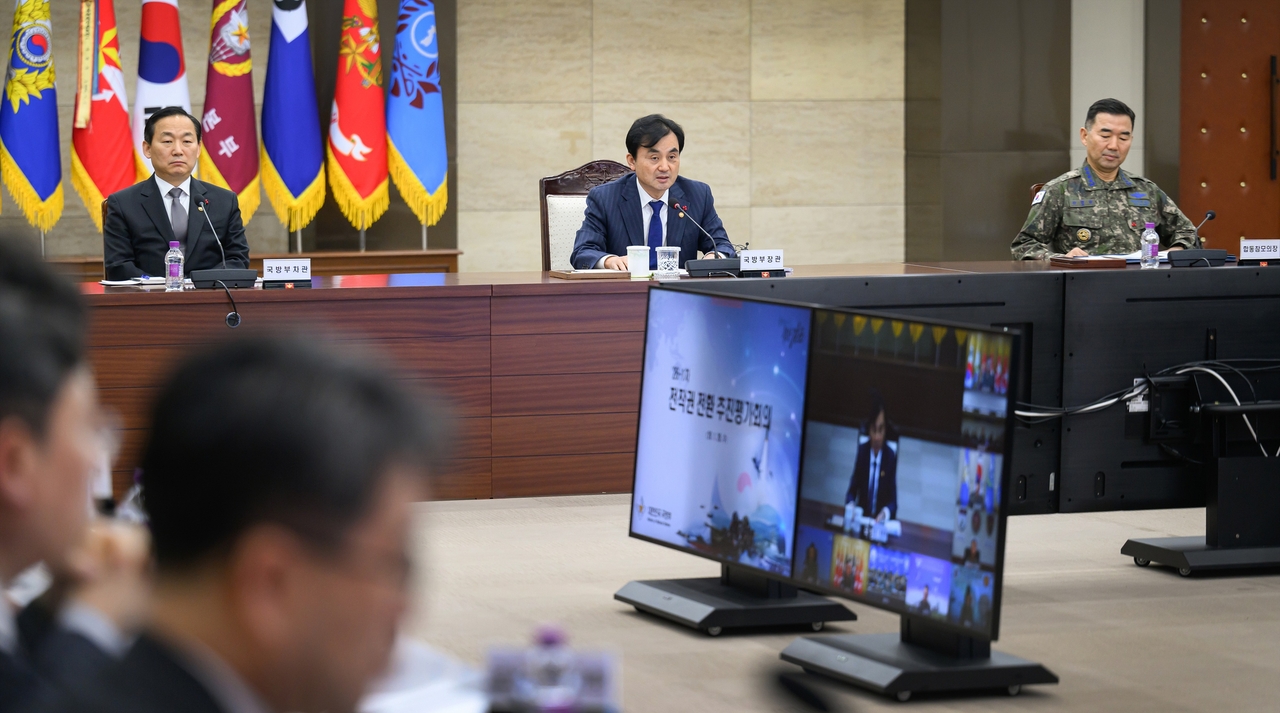
South Korea's Defense Ministry held the first evaluation meeting Wednesday to discuss the transfer of wartime operational control, part of the Lee Jae Myung administration’s push to reclaim wartime command authority within President Lee's term.
According to the ministry, the meeting was convened by Defense Minister Ahn Gyu-back at the ministry’s main conference hall in Seoul.
About 170 participants attended, including senior Defense Ministry officials, the chairman of the Joint Chiefs of Staff, the chiefs of staff of the armed services, the deputy commander of the South Korea–US Combined Forces Command and officials from agencies such as the Defense Acquisition Program Administration. No US officials were present, the ministry said.
During the meeting, Ahn reviewed progress and remaining tasks in the OPCON transition process and discussed implementation plans for 2026 with participating agencies and units.
With South Korea scheduled to undergo verification this year of the future combined command’s full operational capability, or FOC, the ministry said the evaluation meeting will be held quarterly in 2026 instead of once a year, with the defense minister directly presiding over the sessions.
During the meeting, Ahn said significant progress had been made last year, citing the expansion of a dedicated OPCON transition task force at the Defense Ministry, an agreement reached at the 57th South Korea–US Security Consultative Meeting to establish a joint roadmap to accelerate the transition, and increased budget allocations for the three-axis defense system to counter North Korea’s nuclear and missile threats.
“The year 2026 must mark the first year of reclaiming wartime operational control,” Ahn said, adding that the transition would enable the South Korean military to establish a more robust defense posture based on six combined component commands.
During presentations by individual units and agencies, the Defense Ministry, the Joint Chiefs of Staff, the service headquarters and the Defense Acquisition Program Administration outlined steps to complete the second phase of military preparations, including the FOC verification, according to the ministry.
The ministry said South Korea and the US plan to finalize a joint roadmap to accelerate the OPCON transition through high-level policy coordination, including discussions at the Korea–US Integrated Defense Dialogue scheduled for April.
Completing the FOC verification this year will be a core objective as the government pursues the OPCON transition within the current administration’s term, it added.
South Korea transferred operational control of its forces to the United Nations Command during the 1950–53 Korean War. Control was subsequently transferred to the Combined Forces Command when it was established in 1978. While Seoul regained peacetime operational control in 1994, wartime OPCON remains under US authority.
Under the conditions-based OPCON transition framework adopted by the allies in 2014, South Korea must complete three stages: Initial Operational Capability, verified in 2019; Full Operational Capability, targeted for 2026; and Full Mission Capability, the final step before the handover.
flylikekite@heraldcorp.com