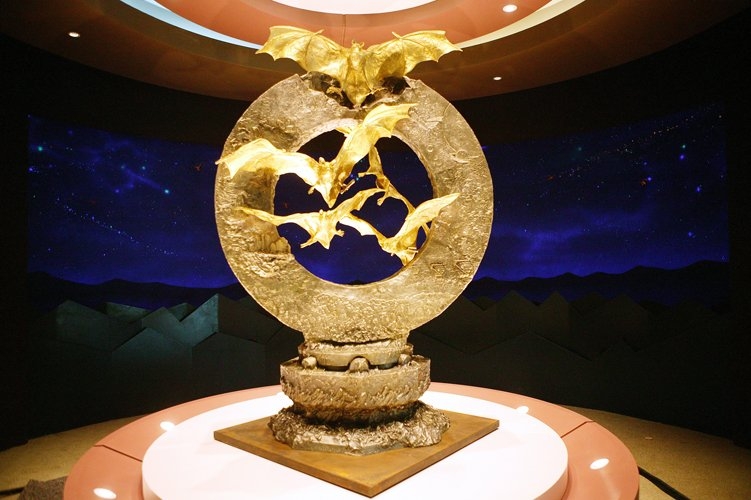
The golden bat monument in Hampyeong-gun, South Jeolla Province, was once criticized as a waste of taxpayers’ money. Now, it is drawing renewed attention as a lucrative public investment amid soaring gold prices.
The value of the gold and silver used in the monument has surged more than tenfold from about 2.6 million dollars in 2005, when the project began, to roughly $27.1 million, according to prices posted by the Korea Gold Exchange on Wednesday.
Standing at 2.1 meters tall, the monument features six bats made from 162 kilograms of pure gold combined, along with 281 kilograms of silver forming the backdrop.
The statue was completed in 2008 to commemorate the discovery of 162 orange whiskered bats, commonly known as “golden bats” in Korea, in a local cave in 1999.
The species is globally endangered and is designated as a natural monument in Korea.
At the time of construction, the county expected the monument to promote tourism by highlighting Hampyeong’s well-preserved natural environment, while also serving as a local attraction.
However, the statue failed to generate a noticeable tourism effect for more than a decade and was frequently cited as an example of wasteful public spending.

Rising gold prices have since reversed that perception.
International gold prices were below $500 per troy ounce in 2005 but continued to climb and now hover around $5,000 per ounce. Silver price also jumped more than 10-fold during the same period.
The increase in material value has also fueled public interest in the roughly 400 kilogram monument, attracting visitors from across the country.
Hampyeong-gun had previously limited public access to the statue due to security concerns, displaying it only during certain periods at an ecological exhibition hall dedicated to the orange whiskered bat. However, the county has recently made the display permanent in response to growing attention.
“The bat statue is not merely a sculpture made of gold and silver, but a core asset of Hampyeong that reflects the county’s ecological value,” a county official said.
“We are not considering creating additional bat statues, as gold prices have risen too much.”
forestjs@heraldcorp.com