From condolence money to altar etiquette, Korean funerals blend long-standing traditions, evolving social norms, with primary focus on comfort, support for bereaved
When Oh Myung-ah's maternal grandmother passed away on the last day of 2025 at the age of 93, longtime family friends traveled from Seoul to Incheon, about an hour's drive, to offer condolences to the bereaved.
"Many of them didn't even know my grandmother. But they simply came to see us and offer their condolences. After greeting us, they left the funeral hall in about 30 minutes," Oh, a 40-year-old housewife, told The Korea Herald.
The three-day funeral period also became a reunion that brought the whole family and relatives together for the first time in years, creating moments of reconnection amid loss.
"We spent much of the time catching up on one another's lives, discussing our work and how our children had grown, alongside mourning the death of our grandmother," she said.
Lee Jong-woo, a professor of embalming at Eulji University, said that Korean funerals often place a strong emphasis on comforting and supporting the bereaved family, while those in some other countries center on the deceased.
"In Korea, funerals are often centered on comforting the surviving family rather than remembering the person who died. Many people attend not because they knew the deceased well, but because they have a relationship with the family and want to show support," Lee explained.
"People are often too busy to attend funerals, especially during the holiday season, but there is a strong sense that one should still make an appearance to be seen by the family," the professor stressed. "Because of this, the act of offering condolences can become more about social obligation and courtesy toward the living than about honoring the deceased. It is something we should reflect on."
Mix of tradition, modernity
Korean funeral culture today is a mix of long-held traditions and more recent Western influences.
During the Joseon era (1392-1910), funerals extended beyond private ceremonies. They were social obligations imbued with moral significance, and the manner of mourning was seen as a reflection of one's virtue, filial duty and place within the Confucian social order.
Traditional mourning attire, known as "sangbok," followed strict designs that varied according to the mourner's relationship to the deceased, but shared a common principle of humility.
In terms of color, white was considered a base, unadorned color symbolizing grief, purity and the return of the dead to the spiritual realm.
A son, for instance, was expected to wear an undyed hemp robe for an extended mourning period, marked by loose stitching and fastened with a straw belt.
"In the past, funerals followed Confucian traditions, which involved many strict rules, rituals and formal procedures. These required a lot of time, effort and preparation, often placing a heavy burden on families," professor Lee explained.
"Instead of focusing on elaborate rituals, many of the old formalities have been removed as people now place more importance on spending time together as a family to honor the deceased," Lee noted.
In modern Korean funerals, these structures have largely faded. Black has replaced white as the standard color of mourning, reflecting the influence of Western funeral practices, in which grief is draped in somber colors.
This shift from white to black can be traced in part to Japan's colonial rule over Korea from 1910 to 1945, during which many traditional rituals and forms of dress were discouraged as part of broader cultural suppression. Japan had already adopted Western-style black mourning attire following the Meiji Restoration in the mid 19th century.
Apart from the change in color, hospital-based funeral halls became more common. Funerals moved from private homes to institutional settings as the country went through rapid industrialization and urbanization after liberation in the mid 20th century.
Modern funeral — what to wear and what to know
Upon learning of someone's death, attending a funeral can be an emotionally delicate experience if you are in the direct family circle of the person who has died, or even for those outside immediate family.
Many struggle to find the right words or response when facing grief, including what to say and how to dress.
Attire at Korean funerals is usually dark and understated. Men typically wear black suits and socks, though dark navy or gray is acceptable, paired with white or neutral-colored shirts. Similarly, women wear black or muted outfits with black shoes paired with toned-down socks and stockings, while accessories, jewelry and makeup are kept to a minimum.
Essentially, appropriate funeral attire is readily available for many office workers.
"I think almost all Koreans keep black tops, bottoms and socks in their wardrobes," said Lee Jae-hoon, a 29-year-old office worker.
"Since many of us attend funerals late at night after work, we usually stop by home to pick up a dark jacket and trousers before heading to the funeral hall."
Also, attire that exposes too much skin — including sleeveless tops or shorts — is widely viewed as inappropriate at Korean funerals, even during the summer months.
Footwear is another often-overlooked detail. Many funeral halls require visitors to remove their shoes upon entry, making socks or stockings essential. Arriving barefoot is considered improper, and some mourners find themselves unprepared for this custom.
When it comes to condolence money, it is typically handled separately at a designated desk near the entrance upon arrival, rather than given directly to the bereaved family at the altar.
In particular, the most intimidating part of a funeral for visitors is not knowing the unspoken rules — especially when standing before the altar.
Uncertainty often centers on what to do — and in what order — once a mourner approaches the portrait of the deceased.
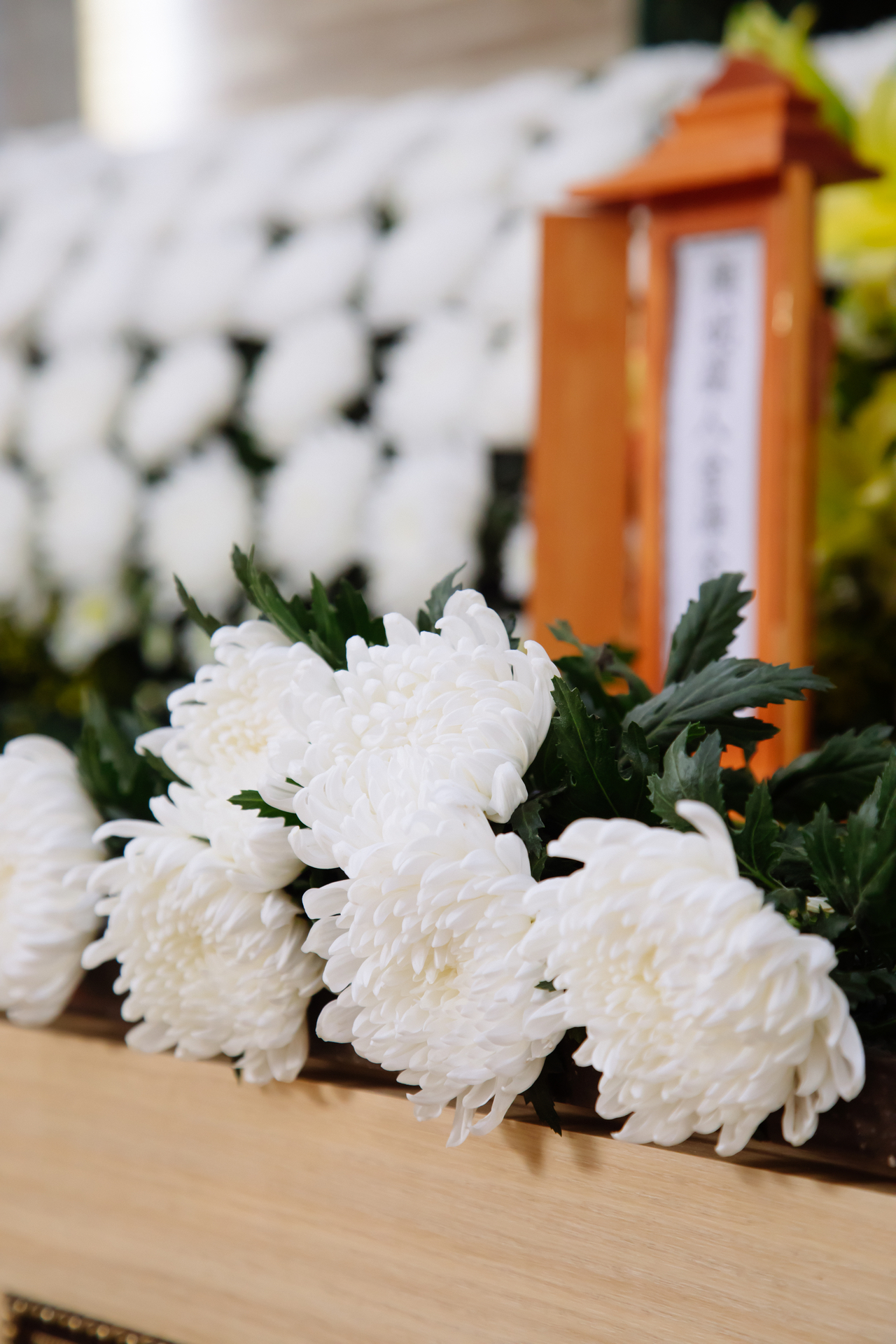
In most funeral halls, visitors begin by offering either flowers or incense, which are prepared near the altar. A chrysanthemum is placed with its blossom facing the portrait, while incense sticks are lit using the candle on the small table in front of the altar, where the incense burner is set. Following the flower or incense offering is a brief act of remembrance, either through bowing or silent reflection.
Bowing customs, once shaped by strict gender-based rules, have grown more relaxed. While traditional etiquette prescribed different bowing methods for men and women, many mourners today bow twice regardless of gender or simply stand in silent respect, both of which are now widely accepted.
After paying respects, mourners exchange a brief bow or nod with the chief mourner — typically a close family representative — before withdrawing from the altar. Some take a few steps backward before turning away, a traditional gesture of continued respect, though it is no longer strictly observed.
Beyond the altar, funeral visits often conclude with a modest meal offered by the family. A bowl of yukgaejang, a kind of beef soup, is served to ward off evil spirits with its red color and spicy heat. Modest alcohol consumption, often involving soju, is also customary, but participation is optional.


![[Survive&Thrive] Tips for getting around Seoul by subway (2)](https://wimg.heraldcorp.com/news/cms/2026/10/08/news-p.v1.20261006.1e7dee51d7f64cdba1a20b897d88cee6_T1.jpg?type=h&h=800)