Infighting is intensifying in the ruling Democratic Party of Korea ahead of a Supreme Council byelection next month, the result of which could have a significant influence on the party's positions in the months ahead.
Candidates for the election, set for Jan. 11, will be vying for three spots on the nine-seat Supreme Council. The vacancies were left by Reps. Han Jun-ho, Jeon Hyun-heui and Kim Byung-joo, who all resigned on Dec. 1 to run in the 2026 local elections.
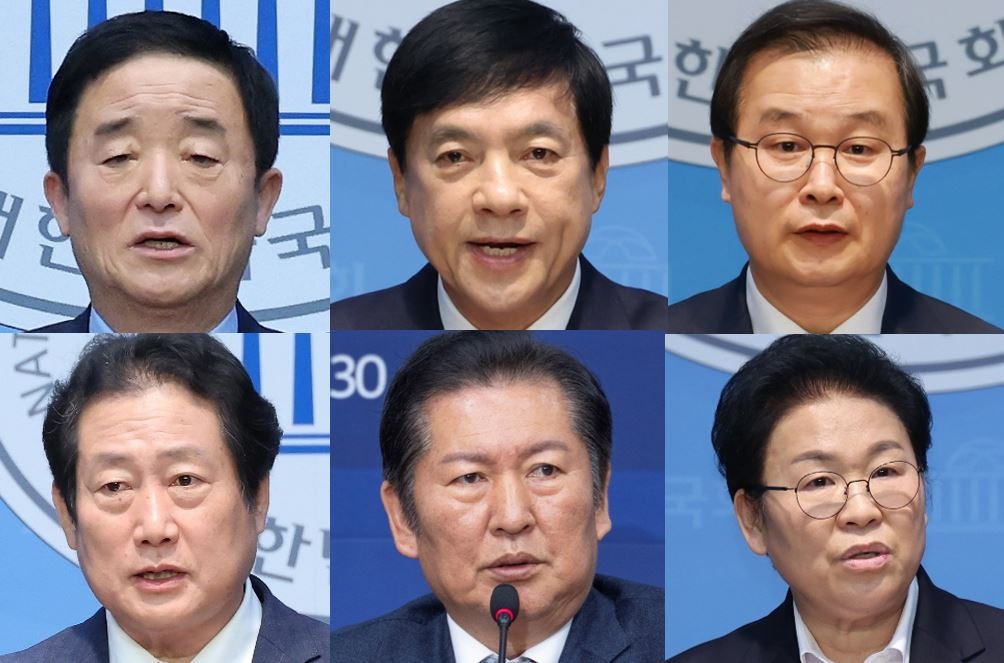
The five candidates, confirmed Wednesday, are four incumbent lawmakers — Reps. Kang Deuk-gu, Lee Geon-tae, Lee Sung-yoon and Moon Jeong-bog — and Yu Dong-chul, who was a runner-up in the 2024 general election race in Suyeong-gu, Busan.
Among them, lawmakers Lee Sung-yoon and Moon are considered Jung supporters, while the other three are believed to be aligned with President Lee Jae Myung.
Under Jung's leadership, hints of discord between the party and the presidential office have fanned speculations of a chasm forming between lawmakers aligned with Lee and Jung.
Lee Geon-tae, a former attorney who defended the president in one of his criminal cases, said in his announcement for the Supreme Council bid a week ago that the current leadership had been failing to coordinate with the presidential office in pushing ahead with its political agenda.
"There is criticism that the efficacy of the Lee administration's achievements is being marred by the lack of coordination between the ruling party and the government," said the lawmaker.
"As the government moved forward, the party moved in a different direction, being unable to keep pace with the government."
Lee Geon-tae had represented the president in a case concerning alleged wrongdoing in a large development project conducted in Seongnam, Gyeonggi Province, while the president was the city's mayor.
Kang, another pro-Lee candidate who opened up about his decadelong relationship with the president, echoed this stance.
The two-term lawmaker said Monday in his announcement to run for the election that he will remain steadfast in the party's support of the Lee administration if elected, while stressing that the entire ruling party should be "pro-Lee."
One of the key issues dividing the pro-Lee and pro-Jung factions is the move to modify the weight assigned to ordinary party members and party delegates in internal elections and primaries.
Jung, a four-term lawmaker, took the chair's post with overwhelming support from ordinary party members, while party delegates rallied behind his rival Rep. Park Chan-dae, despite delegates' votes carrying nearly 20 times the weight of the ordinary members.
In an apparent move to consolidate his power, Jung sought to give equal weighting to the votes of ordinary party members and delegates.
The plan was rejected, but the pro-Jung faction, including Moon, will likely continue to push the issue, with Moon vowing to reintroduce the agenda when announcing her bid.
Moon also declared herself "pro-Lee" and called for unity within the ruling bloc, which was quickly met by attacks from other candidates.
Yu, the only candidate who is not a lawmaker, said Moon should "feel ashamed" for her choice of words, adding that her declaration to be a pro-Lee figure "should come not only with words but with her actions, too."
Lee Sung-yoon, another pro-Jung figure, also pledged to enhance the sovereignty of the ordinary members in the party.
Conceding at least two seats out of three to pro-Lee figures could mean Jung's chances of being unable to rerun for chairship in the upcoming August party primary. Under extreme circumstances, the party could dissolve the chairship if at least five out of nine supreme council members rally to transition to the emergency committee.
consnow@heraldcorp.com