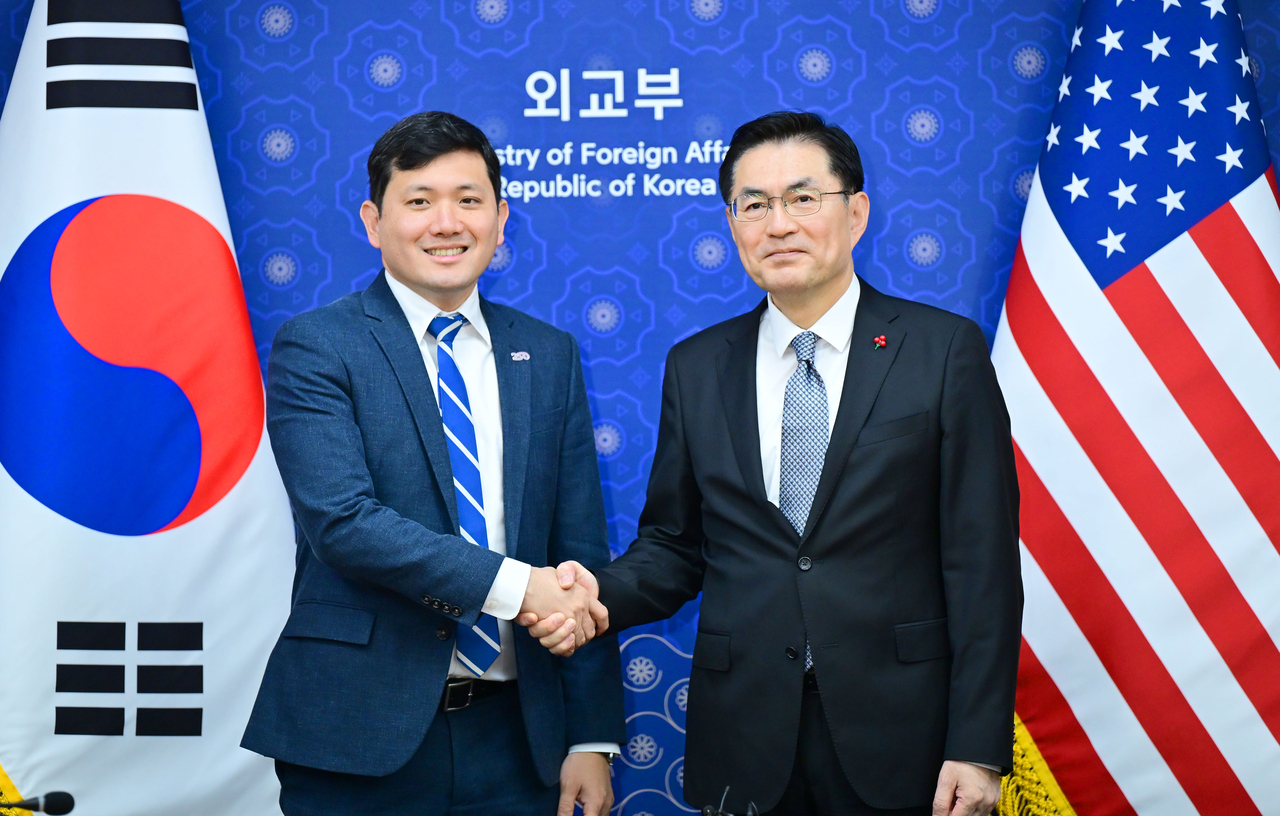
South Korea and the United States share a clear understanding that their current consultations on North Korea policy are fundamentally different from the allies’ past working group, the Foreign Ministry in Seoul said Wednesday.
Concerns and criticism have mounted over the channel’s potential trajectory, as critics argue that the earlier working group — focused on sanctions compliance — was used by Washington to put the brakes on inter-Korean cooperation projects during the first Trump administration.
“Both South Korea and the US had a clear and shared understanding that this meeting is entirely different in purpose, character and background from the past working group even during the preparatory process, and that understanding remains unchanged,” a senior Foreign Ministry official said on condition of anonymity.
The Foreign Ministry’s clarification came a day after the allies held what they agreed to label “follow-up consultations to the Korea-US summit Joint Fact Sheet,” attended by officials from South Korea’s Foreign and Defense ministries and the US State and Defense departments.
Tuesday marked the first such consultation on North Korea policy under the Lee Jae Myung administration and the second Trump administration, with the two sides agreeing to hold talks on North Korea as needed, at various levels.
However, South Korea’s Unification Ministry had decided not to join Tuesday’s consultations, largely out of concern that the talks could evolve into a South Korea-US working group arrangement similar to the one in place from 2018 to 2021.
The senior official elucidated that the consultations were pursued “to further strengthen bilateral communication between Seoul and Washington in implementing the Korean Peninsula-related commitments set out in the joint fact sheet” on Nov. 14.
“To be clear, the focus was not on how to strengthen sanctions or on reaffirming mechanisms for enforcing sanctions," the official said.
The senior official nodded in agreement when asked again by The Korea Herald whether there was no possibility that the consultations could later morph into a working group.
“We are fully mindful of those concerns, and we intend to proceed with future consultations with such concerns very much in mind.”

The South Korea-US working group was launched in November 2018 under the Moon Jae-in administration and the first Trump administration, a mechanism created mainly to coordinate denuclearization, inter-Korean cooperation and sanctions compliance.
However, the working group later drew strong criticism after the US blocked inter-Korean cooperation projects on sanctions grounds, including South Korea’s bid to provide Tamiflu to North Korea in January 2019.
The senior official underscored that the ongoing consultations have a different goal, describing them as taking place “at a critical juncture, when joint South Korea-US efforts are urgently needed to open a channel for dialogue with North Korea.”
The key aim of Tuesday’s meeting was to “have a shared understanding of the current situation” on North Korea between the allies, according to the official.
“Only then can we determine how to follow up on the ‘peace maker-pace maker’ agreed to by the leaders,” the official explained. “What we can do, at the working level of our respective government ministries, to implement that summit agreement was the main focus of the discussions.”
When repeatedly asked by reporters whether the Unification Ministry could join the consultations if they continue, the official stopped short of a direct answer.
“Whether it’s the Unification Ministry or any other ministry, if they decide this is an issue they need to be in the room for and hear directly, they can join at any time,” the official said. “It’s not for us to exclude them — and it’s not for us to tell them to come or not come.”
Amid growing concerns, the ruling Democratic Party of Korea weighed in. Party leader Rep. Jung Chung-rae on Wednesday backed the Unification Ministry’s decision not to attend Tuesday’s consultations.
“This is a warning — and an expression of concern — about the Korea-US working group under the Moon Jae-in administration. I support the Unification Ministry’s position,” Jung said.
Jung also pledged that the party will launch an internal special committee, tentatively titled the "Korean Peninsula Peace Strategy Committee" at an early date, aimed at “strengthening autonomy in South Korea–US relations and expanding room for maneuver in inter-Korean relations.”
dagyumji@heraldcorp.com