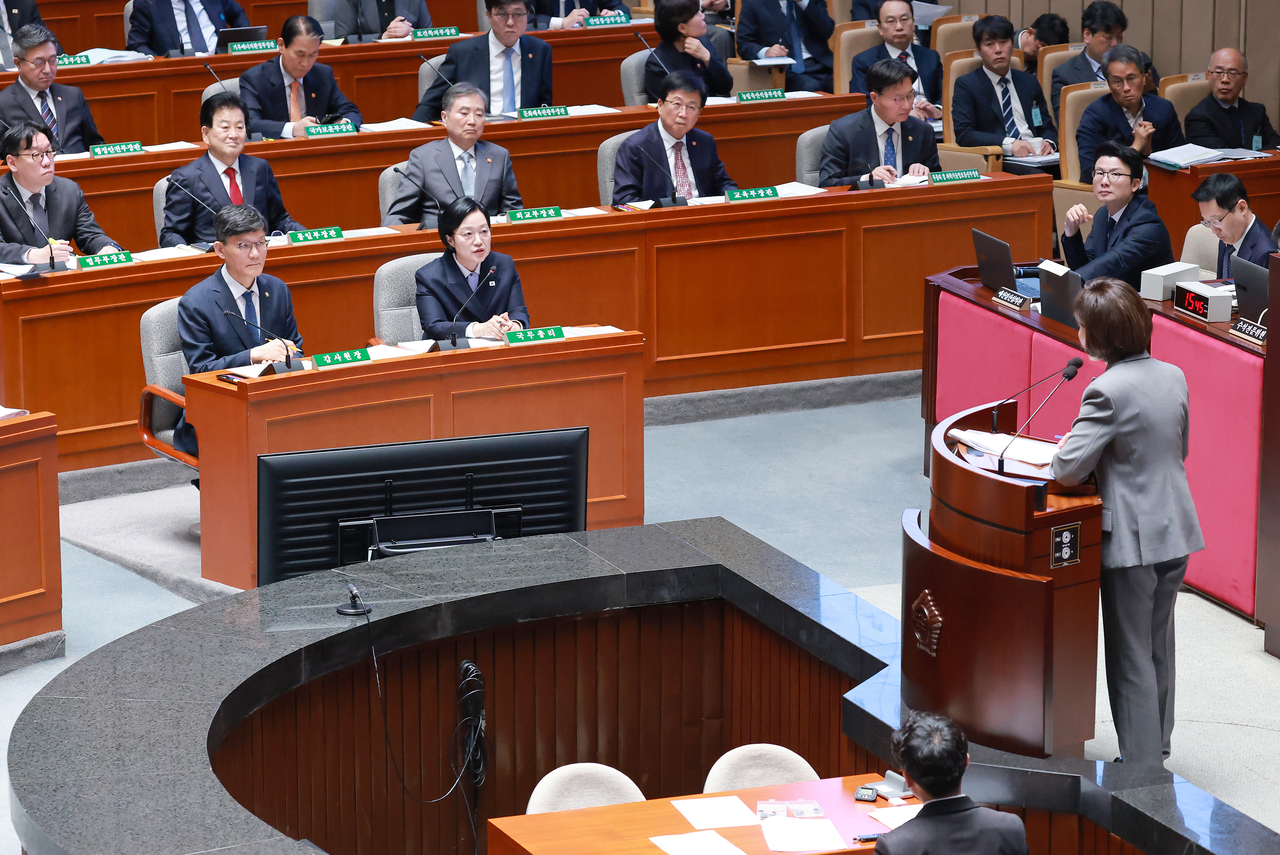
Rival parties on Wednesday clashed over the proposed 820.9 trillion won ($612.2 billion) 2027 annual budget and a 162.3 trillion won fund drawn from the tax surplus from the chip industry boom.
At the plenary session of the National Assembly's Special Committee on Budget and Accounts, the government defended the need to spur investment to keep South Korea ahead in the race for artificial intelligence supremacy, and achieve shared growth to tackle economic bipolarization.
Prime Minister Han Seong-sook defended the administration's expansionary fiscal policy, saying the country's fiscal soundness is "at a manageable level." Budget Minister Park Hong-keun said the budget will lead to "record-high government spending and enhanced sustainability."
The ruling Democratic Party of Korea backed the administration, with Rep. Ahn Do-geol saying the country was seeing a "virtuous cycle" of economic growth boosting tax revenue, and the surplus tax laying the foundations for future growth and improving fiscal stability.
The main opposition People Power Party, however, claimed the administration was leading the nation deeper into debt.
Rep. Na Kyung-won of the People Power Party said that increased fiscal spending, coupled with the chip tax windfall and the additional 106 trillion won national debt issuance, would create "debt for all." The comment contrasted President Lee's "growth for all" remarks in his budget speech Monday.
Another People Power Party Rep. Yoo Sang-bum, at a press conference Wednesday, called the budget proposal "unprecedentedly freakish." He claimed the budget plan was filled with "projects that are generally impossible to achieve."
For the "future fund" proposal powered by the chip tax windfall, the ruling bloc raised the need to provide financial support to the young generation, foster futuristic industries, promote balanced national growth and nurture expertise.
The ruling bloc also advocated for saving 104.4 trillion won for similar purposes in the near future. Some 45.4 trillion won has already been allocated, while 12.5 trillion won will be used to cancel plans to issue new national debt.
Budget Minister Park, who oversees the "future fund" management, hailed the fund as "a platform to carry out productive spending, and a tool to cushion the fiscal instability."
By contrast, the main opposition claimed that the tax windfall should have rather been used to reduce the national debt. It also pointed to the lack of clear investment criteria set for the fund, out of fears that the fund may be indiscriminately doled out to the public or buy votes ahead of the election.
Na of the People Power Party called the future fund "a private vault for President Lee's election," and said the plans for increased financial support to the young generation were meant to "appease the youth because (Lee) is seeing its approval rating falling among the young generation."
The legal deadline for the parliament to pass the government's budget proposal is Dec. 2.
consnow@heraldcorp.com