President Lee Hyang-sook says university will deepen international research and student support while turning 140 years of women’s education into a global platform
Behind each university’s global ambitions are choices about what to preserve, what to develop and where to go next. In “World Class,” The Korea Herald interviews leaders of Korean universities about the strengths they are cultivating and the futures they envision. — Ed.
For Ewha Womans University President Lee Hyang-sook, internationalization is not a new direction for a university founded by an American missionary 140 years ago.
“We sometimes joke that Ewha was a ‘born-to-be international university,’” Lee told The Korea Herald, referring to the university’s origins in 1886 under missionary Mary F. Scranton.
When Ewha was founded, its mission was clear. It gave Korean women access to education at a time when such opportunities were largely unavailable. Today, Lee argues that the mission must extend beyond access.
“If the most important role of women’s universities in the past was to open the right and opportunity to receive an education, in the 21st century that role has to expand further — to building the capabilities and networks that allow women to lead social change,” she said.
Women remain underrepresented in areas including science and technology and in many leadership and decision-making roles, she noted.
A women’s university therefore still has a role in creating an environment where women leading classrooms, laboratories, companies and institutions is unremarkable rather than exceptional.
Lee sees internationalization as a way of extending that mission beyond Korea.
“My medium- to long-term vision for Ewha’s internationalization is to develop the university into a global women’s leadership platform and a leading global university where people from around the world come together to learn and conduct research,” Lee said.
Over the next decade, Lee wants the name Ewha to become associated internationally not only with women’s education and leadership, but also with research, innovation and social responsibility.
Ewha’s scale also distinguishes it from many women’s colleges abroad. The university encompasses medicine, law, pharmacy, engineering, natural sciences, humanities, social sciences and the arts, allowing it to combine its mission in women’s education with fields including artificial intelligence, biotechnology and quantum science.
Building research capacity
Ewha’s Institute for Multiscale Materials and Systems is set to receive around 95 billion won ($70.5 million) over 10 years for research into batteries, advanced materials and future energy.
A central component is an AI-based autonomous laboratory that Ewha describes as the largest of its kind at a Korean university. Construction has begun on the facility, where AI and robots will be able to conduct experiments around the clock.
Lee said such a system can also facilitate international collaboration because experiments can continue despite time-zone differences among research teams.
For Lee, building stronger laboratories and attracting overseas researchers is also inseparable from Ewha’s traditional role in educating women.
“World-class women researchers can emerge only when there are world-class research groups,” she said.
Lee sees graduate education as the bridge between research investment and the next generation of women scientists, pointing to Ewha’s graduate-school innovation efforts.
Before becoming president, she served as Ewha’s vice president for research and as head of its industry-academic cooperation foundation. She is the university’s first president from a science and technology background.
“I think Ewha has already secured world-class competitiveness in some areas of advanced science and technology,” she said. “But in terms of scale, we still need more effort and investment.”
The next task, she said, is to translate the strength of individual research groups into the international standing of the university as a whole.
In advanced biotechnology, Ewha was selected this year for an institution-level Brain Pool+ project worth 13.5 billion won over 4 1/2 years, aimed at bringing overseas scientists into collaborative research spanning areas including pharmacy, brain and cognitive science, chemistry, nanotechnology and quantum research.
In AI, the university secured 25 billion won over five years through the G-LAMP program for mathematical and statistical AI research and interdisciplinary projects connecting AI with the humanities, social sciences and arts.
From agreements to global research
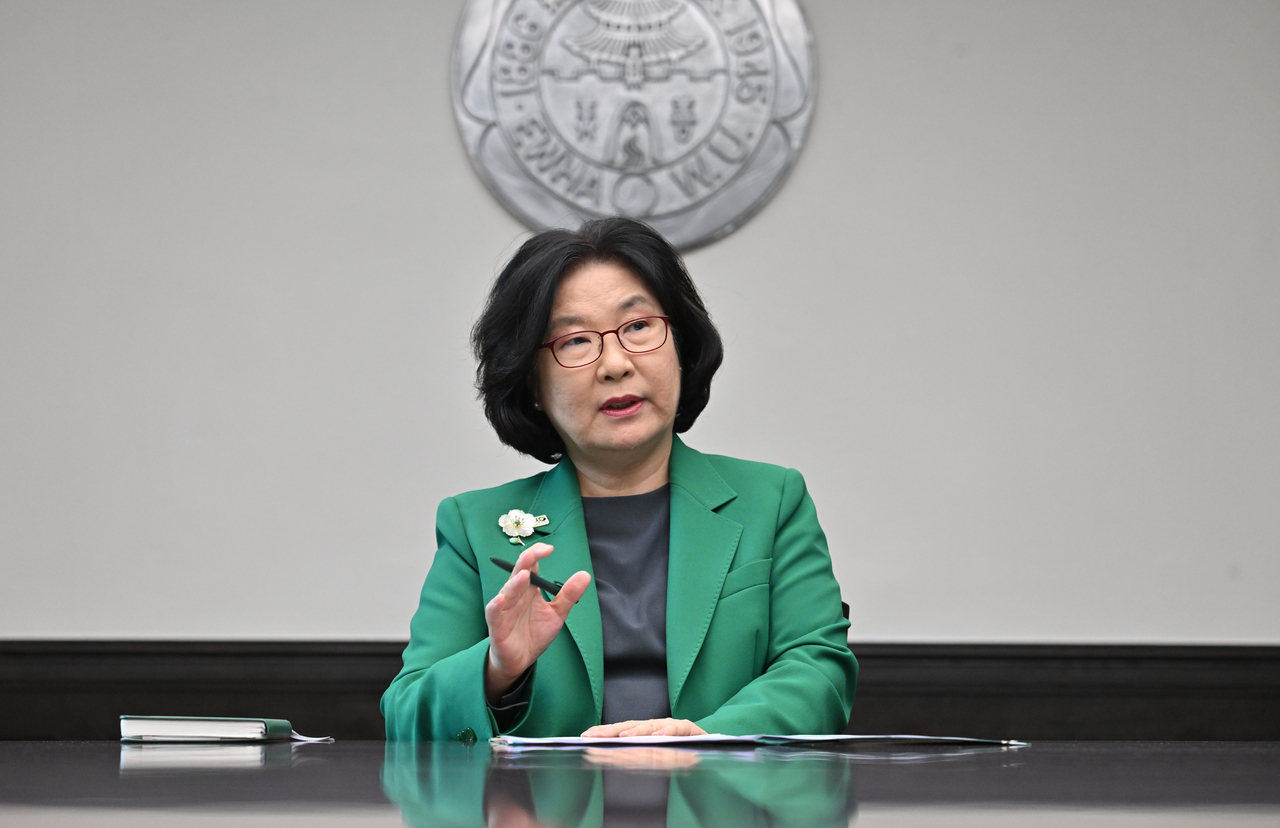
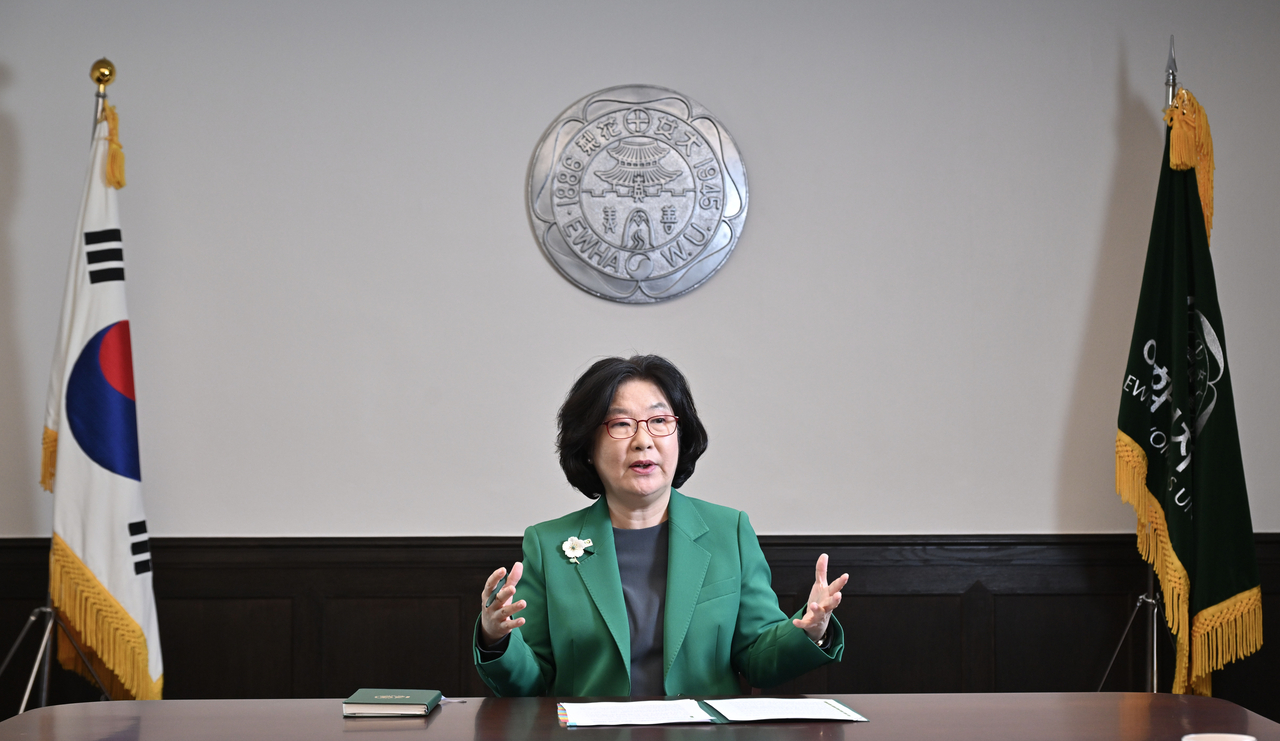
Ewha Womans University President Lee Hyang-sook speaks to The Korea Herald on Oct. 15 at the university’s campus in Seodaemun-gu, Seoul. (Im Se-jun/The Korea Herald)
The university currently maintains relationships with 1,021 universities and institutions across 74 countries. But Lee said adding more agreements is no longer the priority.
“I think the number of agreements is sufficient, considering our size and compared with other universities,” Lee said. “What we need now is for substantive cooperation to actually take place on the ground.”
That could mean joint research, jointly taught courses, student exchanges, joint supervision or joint and dual degrees. Some Ewha colleges already operate joint or dual-degree programs, and Lee said the university is looking to expand such arrangements.
The larger challenge is institutionalizing international collaborations that have often developed organically between individual professors, laboratories or departments.
Lee said Ewha needs to turn existing relationships into partnerships capable of continuing beyond individual researchers. The university should provide the administrative and financial foundation for such cooperation to become sustainable and scalable, she said.
One vehicle is the Ewha Global Excellence Program, a large internal research-support initiative that began full operation in December 2025.
Since then, 31 research groups have brought 41 researchers from 12 countries to Ewha for international collaborative and interdisciplinary research. Sixteen of the groups are in science and technology fields.
Ewha also operates the Ewha Global Fellow program, which formalizes long-standing ties between Ewha faculty members and overseas scholars.
Its current 2024-26 cohort includes 546 researchers affiliated with universities and institutions including Harvard, Oxford, the University of Tokyo, the Max Planck Society and NASA.
From recruitment to belonging
The university had around 1,500 international students in 2024. As of October this year, 2,627 international students from 96 countries were enrolled at Ewha, including 1,749 undergraduates and 878 graduate students.
“The important thing is not simply increasing the number of international students,” Lee said. “We need to select excellent students and develop them into global talent with a real sense that they are members of Ewha.”
Lee pointed to language education, academic advising, scholarships, research opportunities, internships, career support and preparation for graduate study as areas that should form a more integrated system.
Ewha already operates the Ewha Academic Assistance System for International Students. Launched in 2019, the program includes department-level projects that reflect international students' needs as well as mentoring, academic support, career lectures and meetings with graduates. EAASIS+ was introduced in 2022 to expand services including thesis guidance and student support.
Beginning with the fall 2026 semester, Ewha introduced differentiated scholarships for all international students holding levels 4 through 6 of the Test of Proficiency in Korean.
Ewha has also expanded scholarships for students who complete programs at its Language Center before entering a degree program, while increasing the number of recipients and budget for its merit-based International Students Scholarship.
Ewha recently established a Global HOKMA unit within HOKMA College of General Education, where international freshmen receive concentrated Korean-language and other forms of academic and adjustment support during their first year.
Lee said students need opportunities to form relationships with Korean classmates.
“Students who come to Korea often really want interaction with Korean students,” she said.
The objective, she said, is for international students to graduate with a lasting sense of belonging to the university community and eventually become part of a global alumni network connecting Ewha back to their countries and careers.
One example is the Ewha Global Partnership Program launched in 2006 to provide full scholarships to women from developing countries.
As of August, 273 students from 37 countries had graduated through the program, while 40 students from 13 countries were studying at Ewha.
As EGPP marks its 20th anniversary in November, Ewha plans to bring graduates back together and strengthen ties among alumni now working in academia, finance, public institutions and civil society.
Lee wants the program to develop beyond scholarships into a network through which women educated at Ewha remain connected to one another and to subsequent generations of students.
Measure what lasts
Lee is reluctant to define that ambition by a single target for foreign enrollment, rankings or agreements.
She says Ewha should eventually be judged by whether its international relationships endure.
The indicators that matter, she said, include how many leading researchers continue collaborating with Ewha, whether international research projects lead to follow-up work and what international students do after graduation.
Asked what she most hopes people will say about Ewha by the end of her term, Lee answered that she wants it to become “a university that people who have been part of it want to return to.”
That could mean a graduate returning to advise younger students, or an overseas researcher choosing Ewha again for another collaboration.
“I want to build relationships where one encounter leads to the next collaboration,” she said.
seungku99@heraldcorp.com