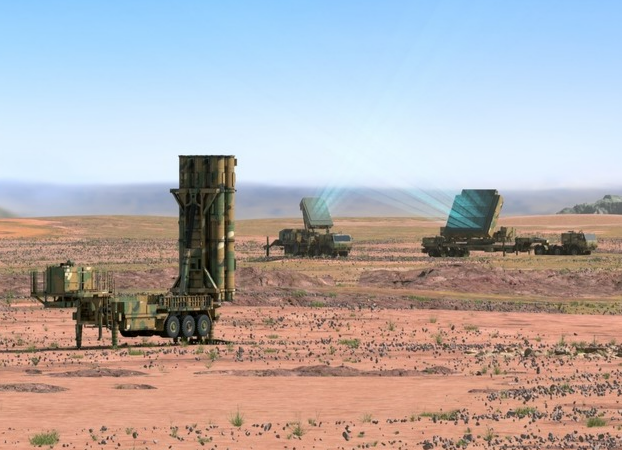
Korea’s leading defense company Hanwha Aerospace said Friday it has secured a 705.4 billion won ($481 million) contract to supply its long-range surface-to-air missile system (L-SAM) to the Korean government.
According to the company, it will deliver the anti-ballistic missiles and launch platforms to the Korean military by 2030, raising Korea’s indigenous air defense coverage to altitudes above 40 kilometers.
Together with the L-SAM multifunction radar supplied under a separate 357.3 billion won contract secured by its subsidiary Hanwha Systems, the system will become Korea’s highest-altitude homegrown air defense asset, the company said.
Currently, Korea’s air defense above 40 kilometers is provided by the Terminal High Altitude Area Defense system, or THAAD, operated by US forces stationed in the country, which covers altitudes of up to roughly 150 kilometers.
“With stable production of L-SAM, we aim to contribute to protecting Korea’s territorial airspace while pursuing export opportunities based on our accumulated technology and experience,” a Hanwha Aerospace official said.
The homegrown interceptor was developed in 2024 through joint efforts by Hanwha and the Agency for Defense Development, in response to growing North Korean missile threats.
While the company has not disclosed detailed performance metrics, analysts estimate the interceptor can engage targets at altitudes of 50 to 60 kilometers.
Hanwha Aerospace said the L-SAM incorporates a divert and attitude control system and a dual-pulse propulsion system, enabling precise targeting and maneuverability to intercept ballistic missiles in low-density air environments. Only a handful of countries possess these technologies, the company added.
The multifunction radar from Hanwha Systems will serve as the “eyes” of the system, capable of detecting, tracking and identifying multiple aerial objects simultaneously.
As part of the Korea Air and Missile Defense program to build a multilayered national air defense system, Hanwha Aerospace is also participating in the development of L-SAM-II, which aims to extend engagement altitude to roughly 100 kilometers, expanding coverage to three to four times that of existing systems.
forestjs@heraldcorp.com