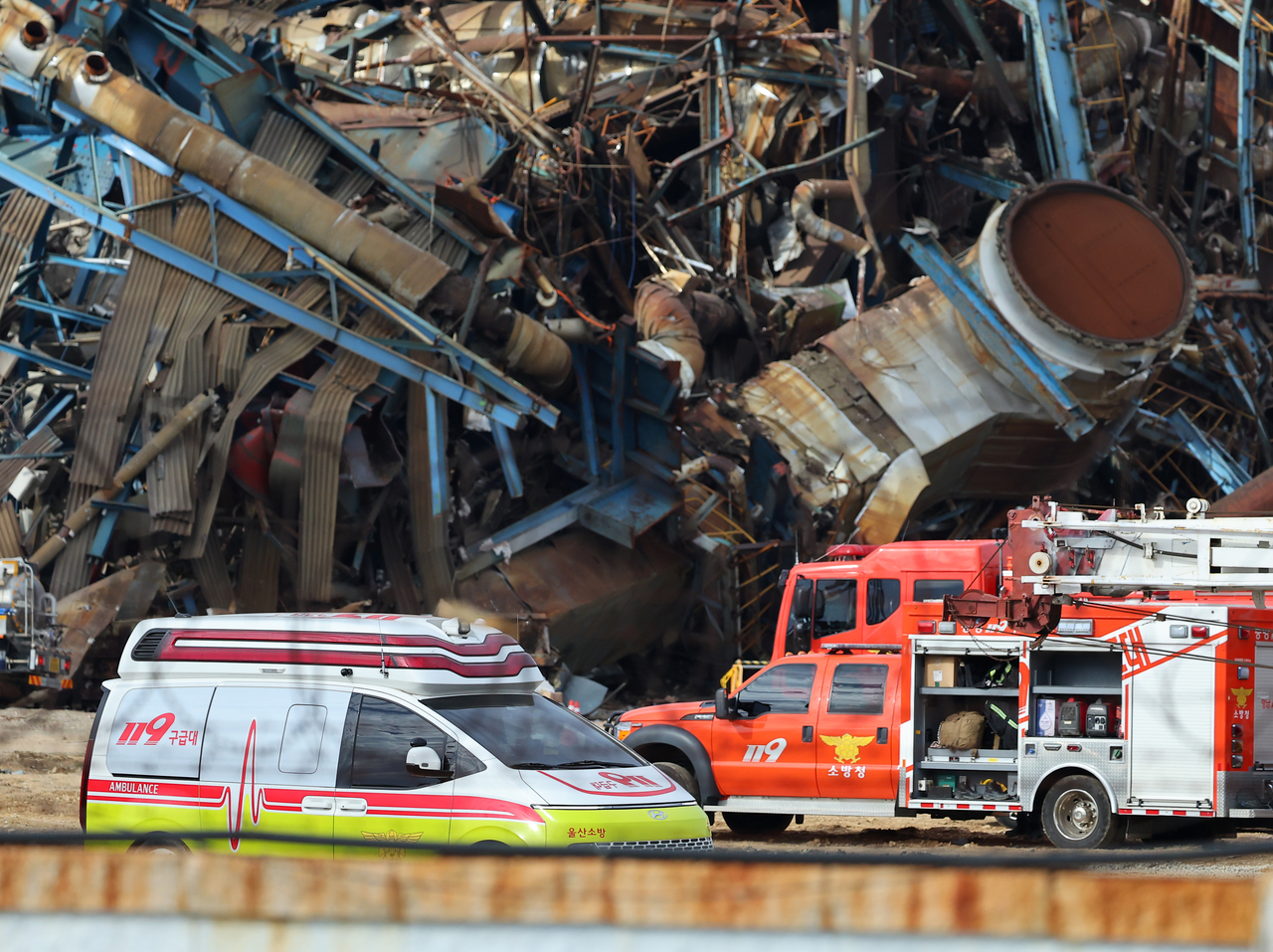
Eight of the nine workers killed or injured in last week's boiler tower collapse in Ulsan were found to be employed by subcontractors, reigniting outrage over South Korea’s practice of outsourcing dangerous work as the search for two missing workers continues.
According to local media reports, the demolition of the tower at the Korea East-West Power Co. site, which was already underway before the deadly collapse, was carried out through multiple layers of subcontracting. The state-run facility had outsourced some of the work to HJ Heavy Industries, which in turn subcontracted demolition operations to a smaller specialist firm, Korea Kacoh.
Of the nine workers deployed at the site on Nov. 6, only one was a full-time employee, while the others were short-term day laborers hired for the demolition project.
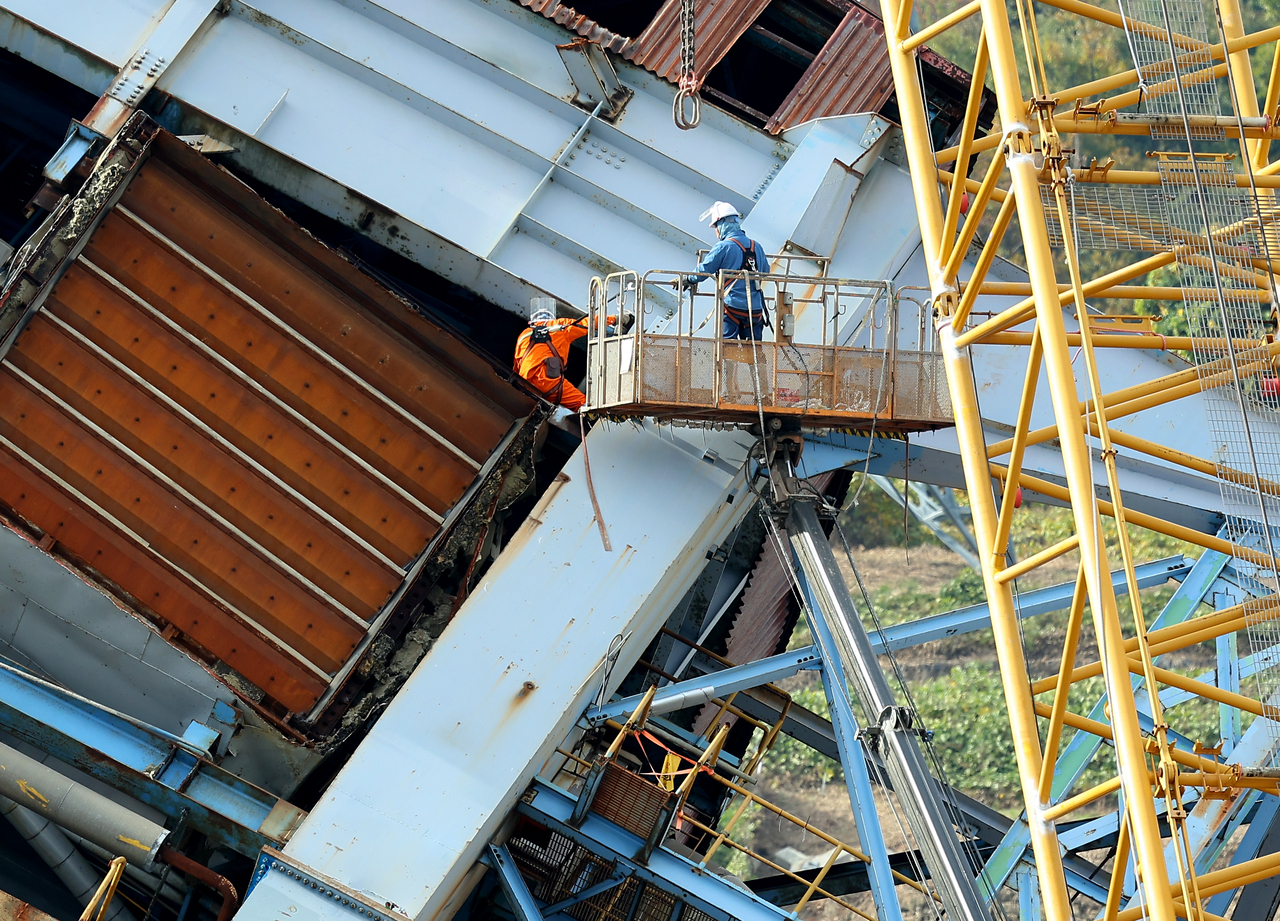
The workers had been conducting “weakening” procedures — partially cutting steel structures in the boiler tower to make it easier to demolish — on the 44-year-old boiler tower before the structure collapsed.
Due to its dangerous nature, the process is considered one of the riskiest stages in demolition. It is typically handled by temporary or subcontracted laborers, a practice that allows major firms to cut costs and evade liability while exposing the most precarious laborers to the highest risks.
“The (boiler tower collapse) incident in Ulsan exposes the consequences of Korea’s multilayered contracting system, which often prioritizes cost reduction over worker safety,” said Professor Lee Byoung-hoon from Chung-Ang University's Department of Sociology.
“Contract workers are often pressured to meet deadlines with limited resources and time, leaving little room for adequate safety training or the hiring of skilled workers to take place.”
Labor groups have also condemned the incident as a “disaster foretold,” calling for fundamental reform of Korea’s subcontracting system, which they say perpetuates “a cycle of exploitation and unsafe working conditions.”
“The multilayered contracting chain — from the main contractor to subcontractors and ultimately to contract workers — has once again resulted in a fatal accident that could have been prevented,” the Korean Confederation of Trade Unions said in a statement. “It is essential to determine whether risk assessments and safety measures were properly conducted during the demolition, and whether working conditions, such as pressure to meet construction deadlines, pushed workers into unsafe situations.”
The issue of outsourcing industrial work to contract workers was also raised during a parliamentary audit of Korea’s state-run power companies on Oct. 23, including Korea East-West Power Co.
Data presented during this audit showed that of the 38 workers who suffered industrial accidents at the power company, only two were full-time workers. The remaining 36 victims, or 94.7 percent, were subcontracted workers, the highest proportion among Korea’s five state-run power generation firms.
The boiler tower at the Korea East-West Power Co. site in Ulsan collapsed at around 2 p.m. on Nov. 6, trapping seven workers under the debris.
Two towers near the collapsed tower were demolished Tuesday to help in the search for missing workers. Out of the seven trapped workers, five have been recovered and two remain missing as of press time.
lee.jungjoo@heraldcorp.com