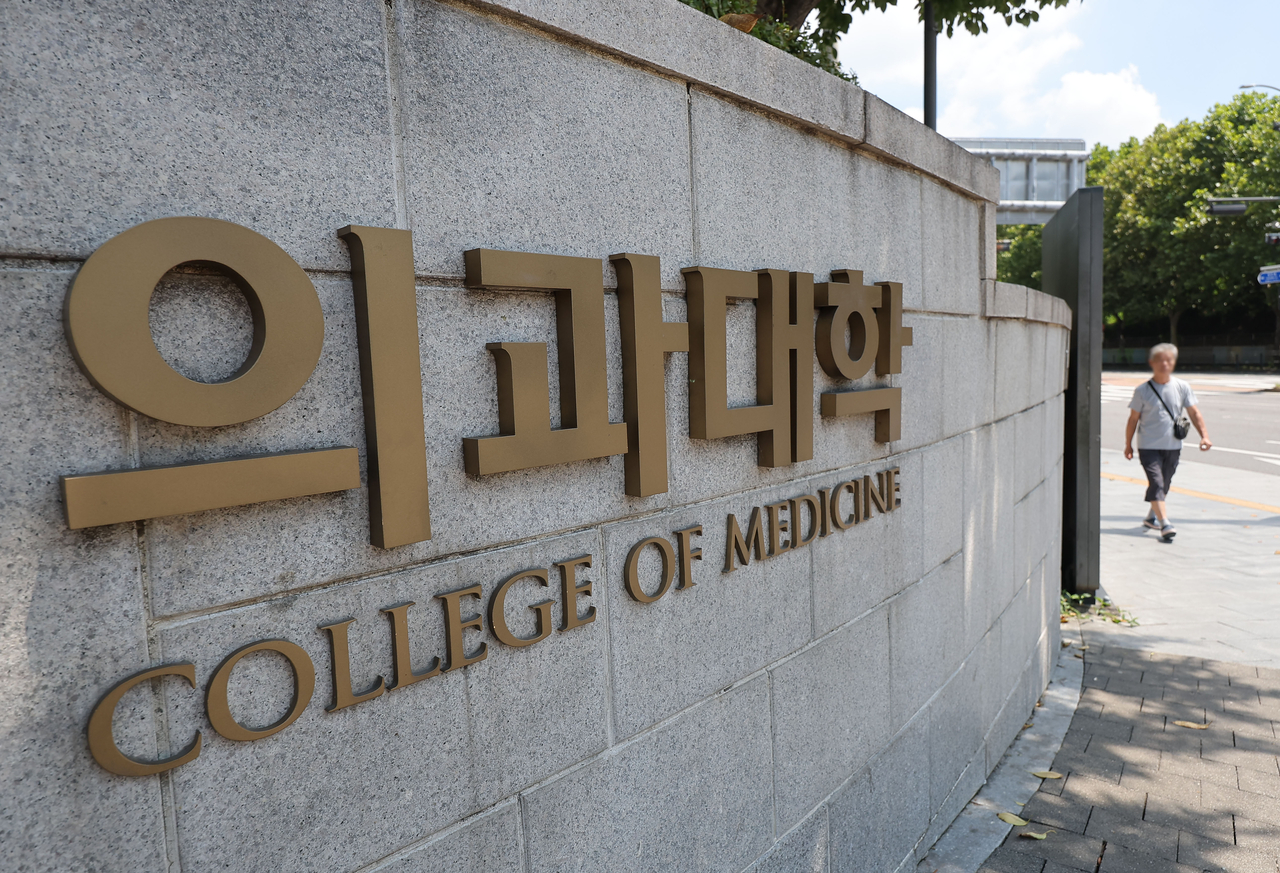
The proportion of female students entering medical schools in South Korea has been steadily increasing in recent years, with a similar trend observed across other health-related disciplines such as pharmacy, veterinary medicine and dentistry.
According to data collected by Jongro Academy — a private cram school dedicated to university entry prep — female students made up 38.4 percent of the new medical school cohort for the 2025 academic year, based on official university disclosures.
Jongro Academy noted that the share of female medical school students has risen for five consecutive years, reaching 37.7 percent nationwide in 2024, up from 34.1 percent in 2021.
The academy noted that the trend is evident in institutions affiliated with South Korea’s “Big 5” hospitals: Seoul National University, Yonsei University, Sungkyunkwan University, the Catholic University of Korea and the University of Ulsan.
In 2025, the University of Ulsan, which runs Asan Medical Center, marked the highest proportion of female first-year medical school students at 50 percent. This was followed by the Catholic University of Korea and Yonsei University at 34.4 percent and 31.8 percent, respectively.
Jongro Academy reported that Seoul National University and Sungkyunkwan University had a similar proportion of female first-year medical students this year, at 31.3 percent and 31.2 percent, respectively.
Pharmacy, veterinary and dental schools in Korea have also observed similar trends.
In undergraduate pharmacy programs, the enrollment proportion of female students rose to 58.1 percent in 2025, a 3.2 percent increase from 2022.
Veterinary medicine also had a major shift, with women accounting for 50.4 percent of newly admitted students this year, surpassing the halfway mark for the first time since reaching 42.5 percent in 2021. Dentistry followed suit, rising to 38.1 percent from 33 percent in 2021.
In contrast, female representation in high-tech majors — particularly those in the semiconductor sector — remains low.
At top universities offering industry-aligned programs in semiconductors and emerging technologies, the proportion of female first-year students was 15.8 percent in 2025, a 2.5 percent increase compared to the academy’s data from 2023.
lee.jungjoo@heraldcorp.com