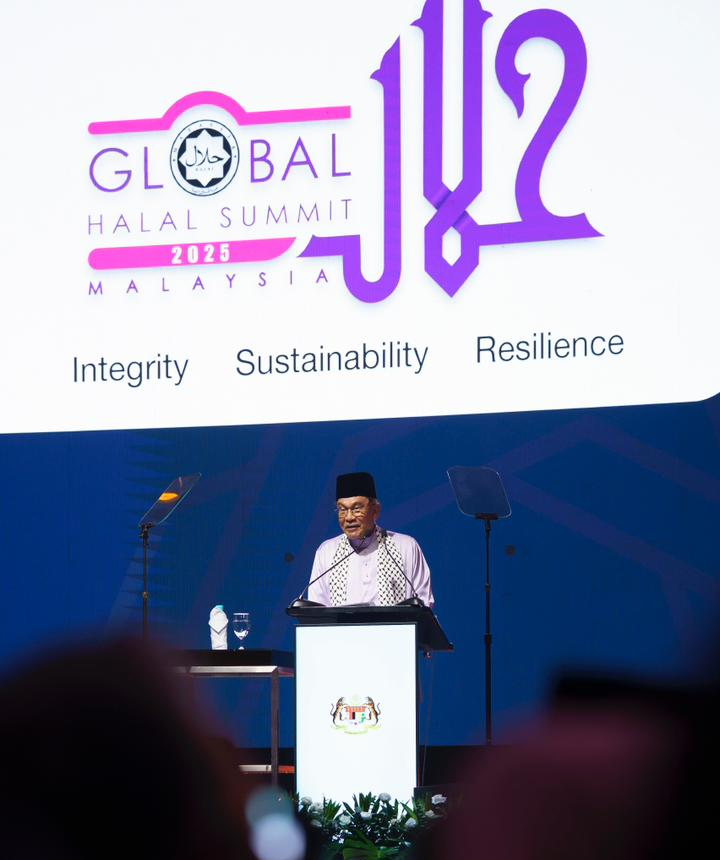
KUALA LUMPUR, Malaysia — Sustainability, integrity and resilience came to the fore in Malaysian Prime Minister Anwar Ibrahim’s vision for a more comprehensive understanding of what halal means in today’s world.
Speaking at the opening ceremony of the Global Halal Summit in Kuala Lumpur, Malaysia, Friday — which runs alongside the Malaysia International Halal Showcase 2025 — Anwar highlighted Malaysia’s commitment to advancing halal standards and innovation in a world where halal is scaling fast and wide.
"As we navigate the complexities of the modern era, it is essential that we return to the very foundation of halal, which represents a holistic view and way of life, grounded in cleanliness, integrity and accountability," Anwar said.
He noted that halal is no longer a strictly religious concept, but a global value system gaining traction even in non-Muslim-majority countries, extending far outside food into health care, cosmetics, tourism and Islamic finance.
“It is a system of values, one that champions ethical consumption, social justice, human dignity and environmental sustainability,” he explained. "Because of its universal appeal to all segments of society, halal products and services are now an increasingly popular choice among consumers, including those in predominantly non-Muslim countries."
According to the prime minister, Malaysia’s halal certification authority, the Department of Islamic Development Malaysia, sits at the center of this global ecosystem, with nearly 10,000 companies certified under the country’s comprehensive halal standards.
The Malaysian government is moving forward with efforts to position the halal industry as a major pillar of the national economy.
"In every investment mission and bilateral engagement, I must say this without exception, Malaysia positions halal as a universal economic model," he said, adding that the halal sector is projected to contribute 10.8 percent to Malaysia’s gross domestic product by 2030.
"The global halal market is valued at over 16.02 trillion Malaysian ringgit ($3.8 trillion) and is expected to reach 22.88 trillion ringgit by 2030," he said.
In tandem with the sector’s growth, he also highlighted MIHAS’s digital evolution, stating, “MIHAS 2025 will fully leverage the Madani Digital Trade Platform, an artificial intelligence-driven tool designed to optimize cross-border business matching.”
minmin@heraldcorp.com