The ruling Democratic Party of Korea is pushing a bill to expand prosecutorial staff, extend deadlines and boost transparency for special counsel probes into former President Yoon Suk Yeol’s botched martial law declaration on Dec. 3, 2024, aiming to pass it during this month’s Assembly session.
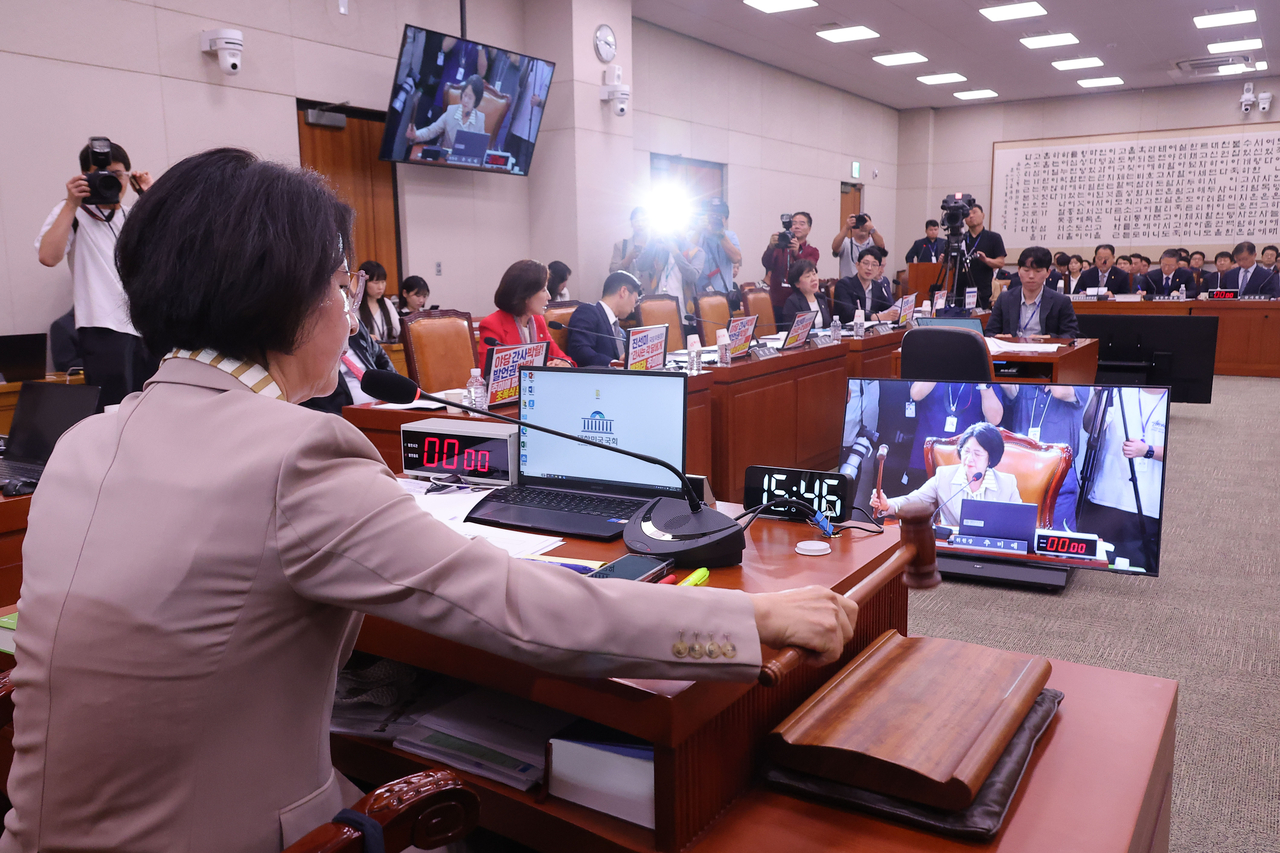
The Assembly’s Legislation and Judiciary Committee approved the bill during a general meeting Thursday. The Democratic Party holds nine of the committee’s 18 seats, including the committee chair, Rep. Choo Mi-ae.
The bill had faced strong opposition from lawmakers of the main opposition People Power Party, which was the ruling party at the time of Yoon’s martial law attempt. The party had called for the formation of an agenda coordination committee within the judiciary panel to delay the process.
However, the bill eventually proceeded as the subcommittee — where the Democratic Party controls three out of six seats — passed it as is, with support from one lawmaker of the minor progressive Rebuilding Korea Party. All subcommittee members were appointed by Choo.
The Democratic Party said it plans to bring the bill to a full floor vote as early as next week’s plenary session.
Under the revision, special counsel teams can now extend investigations by 30 days on their own, allowing up to 60 days at their discretion. Upon request, a further 30-day extension may be granted with presidential approval, bringing the total to 90 days.
The revision also expands the number of prosecutors involved in each case.
The team investigating insurrection charges tied to Yoon’s martial law declaration would gain 10 additional prosecutors, totaling 70. The probe into Yoon's wife Kim Keon Hee would add 30 prosecutors, also totaling 70. The team investigating the death of Marine Cpl. Chae, who died during a flood rescue mission in 2023, will consist of 30 prosecutors.
Additionally, the revision mandates the live broadcasting of the first round of trials in the martial law case, citing the need for transparency and judicial fairness.
"Trials concerning grave national crimes such as insurrection or treason are directly tied to the public’s right to know and interest in justice," the bill states.
If the investigation is not completed within the allowed period or if the special counsel cannot decide on indictment, the case must be transferred to the National Office of Investigation, a specialized police unit created to ensure investigative independence from the prosecution.
The revision has drawn criticism not only from the People Power Party, but also from the judiciary.
"It would be seen as a direct breach of judicial independence if external political forces are allowed to be involved in the formation of court panels," said Supreme Court Justice Chun Dae-yeop, who also serves as head of the National Court Administration, during Thursday’s session of the Legislation and Judiciary Committee.
"Indirectly, this could influence trials in ways the public cannot ignore," Chun added.
In protest against the bill’s passage, the People Power Party filed a motion with the National Assembly secretariat to refer Choo to the Assembly's ethics committee, accusing her of unilaterally appointing subcommittee members favorable to the ruling bloc.
"The judiciary panel has degenerated into a unilateral committee controlled solely by Choo Mi-ae and the Democratic Party," Rep. Choi Eun-seok, the People Power Party’s senior spokesperson, told reporters Friday at the National Assembly.
"The one-sided appointment of subcommittee members constitutes a clear violation of parliamentary rules," he added.
flylikekite@heraldcorp.com