As China accelerates the integration of artificial intelligence, drones and robotics into its military systems, South Korea must rethink its arms export strategy to maintain global competitiveness, a state-run think tank said Wednesday.
In a report titled "China’s Defense Industry: Status and Implications," the Korea Institute for Industrial Economics and Trade said that Beijing was channeling significant resources into unmanned and intelligent warfare capabilities, even amid domestic economic headwinds.
China’s defense budget for 2024 was raised 7.2 percent from the previous year to 1.78 trillion yuan ($248 billion), highlighting the country’s strategic intent. Once focused on meeting internal demand, China’s defense industry is now rapidly expanding its presence in the global arms market, supported by technological innovation and strong state backing.
China accounted for 5.9 percent of global arms exports between 2020 and 2024, ranking fourth behind the United States, France and Russia, according to the Stockholm International Peace Research Institute. By comparison, South Korea ranked 10th with a 2.2 percent share.
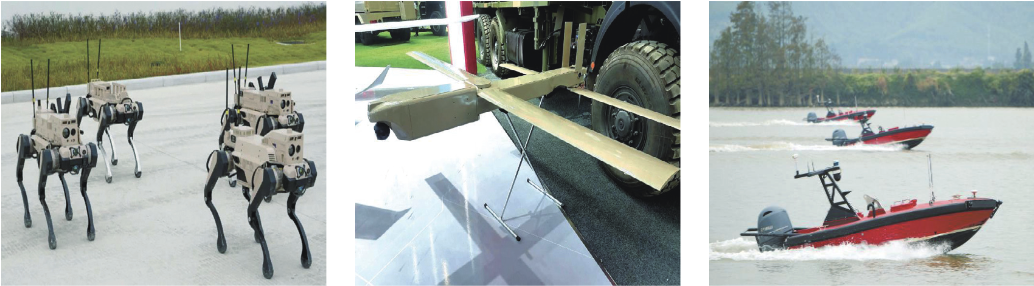
A key driver behind China’s growing influence is its push for high-tech, next-generation weapons systems. Six Chinese firms are now listed among SIPRI’s top 20 global defense companies. State-run manufacturers such as Aviation Industry Corporation of China, Norinco, China Electronics Technology Corporation, and China State Shipbuilding Corporation have unveiled AI-powered combat robots, drone swarms and unmanned naval vessels in recent years.
KIET pointed to China’s “Robot Wolf” — an autonomous combat robot developed using civilian AI technology from Zhensin Technology — as a prominent example of military-civil fusion. The export of such advanced systems to countries such as Pakistan, Thailand and Algeria, it said, illustrates China’s transformation into a major supplier of cutting-edge weaponry.
Despite South Korea's "globally competitive" civilian AI, drone and robotics technologies, the report warned that "the systems to connect them to military applications remain weak.”
“There is an urgent need to establish structural mechanisms that link civilian technologies to actual weapons systems through civil-military cooperation programs, rapid acquisition projects, and broader policy support for the defense industry ecosystem,” it added.
flylikekite@heraldcorp.com