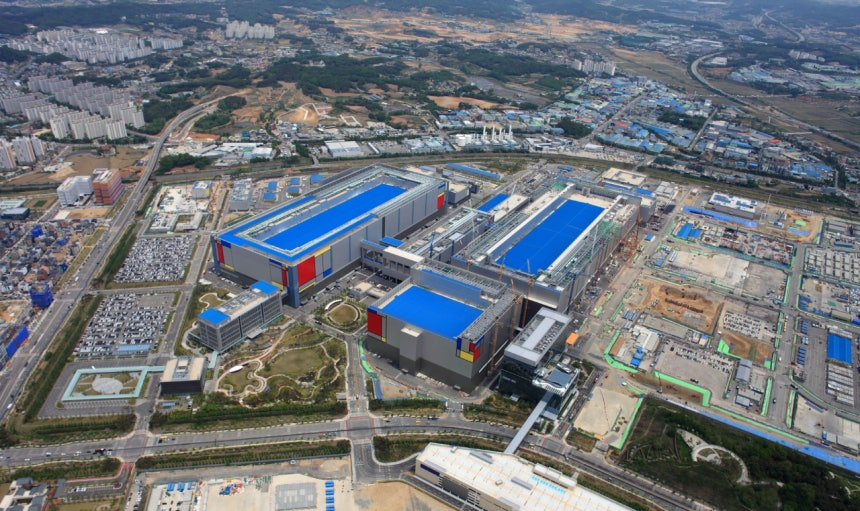
South Korean semiconductor giants are ramping up facility investments to expand their future market share, encouraged by upbeat projections of explosive growth in the artificial intelligence chip sector.
Samsung Electronics is reviewing plans to restart construction of new chip manufacturing plants in Korea, while SK hynix recently began construction of a new back-end processing facility.
According to industry sources Thursday, Samsung is preparing to resume the construction of the Pyeongtaek Campus Line 4 (P4), which was halted last year.
P4 is Samsung’s fourth large-scale chip plant under construction, divided into four phases. Phases 1 and 3 are in their final stages of construction, while sources say orders have recently been issued to resume work on Phases 2 and 4. Full-scale construction is expected to begin within two to three months.
Two areas at the P4 facility were originally planned for foundry production lines, but they are now expected to be converted into DRAM production lines to manufacture sixth-generation 1c DRAM using a 10-nanometer process. The chip giant confirmed this week that it has successfully developed the advanced technology, which will be used for the next-generation high bandwidth memory (HBM4) chips.
Samsung Electronics Vice Chair Jun Young-hyun, who oversees the company’s semiconductor business, traveled to the US last week to meet with Nvidia, signaling a renewed commitment to close the gap with competitors and secure new orders for the lucrative HBM chips.
Phase 4 is expected to have a monthly capacity of 80,000 wafers, accounting for 40 percent of P4’s total monthly capacity of 200,000 wafers based on 12-inch wafers.
While Samsung did not confirm, there are reports that the chip giant is also considering restarting construction of what would be its fifth manufacturing plant at the Pyeongtaek Campus, known as P5. Groundwork for P5 began in 2023, but was halted early last year.
P5 is expected to require an investment of more than 30 trillion won ($22 billion) and will be built as a complex fab capable of producing DRAM, NAND flash and foundry products.
“We are continuously reviewing various scenarios for resuming construction of our facilities,” a Samsung official said.
SK hynix, a leading memory chip maker, is also preparing to expand its manufacturing volume for the coming years.
Later this year, the chipmaker is expected to complete the construction of its new M15X plant in Cheongju, North Chungcheong Province, where it will start production of its fifth-generation 10nm-class DRAM chips for the next-generation HBM4 products. The facility is expected to have a capacity of around 90,000 wafers per month.
SK hynix is also expanding investments to build a new back-end production facility, dubbed “P&T 7,” on a site in Cheongju in a bid to strengthen its packaging capabilities to improve the performance and power efficiency of its advanced chips.
The DRAM market is expected to show solid demand in the second half of the year, led by HBM chips, the critical DRAM components supporting AI processors.
According to the Export-Import Bank of Korea, the global AI semiconductor market is projected to expand from $41.1 billion in 2022 to $133 billion by 2028.
herim@heraldcorp.com