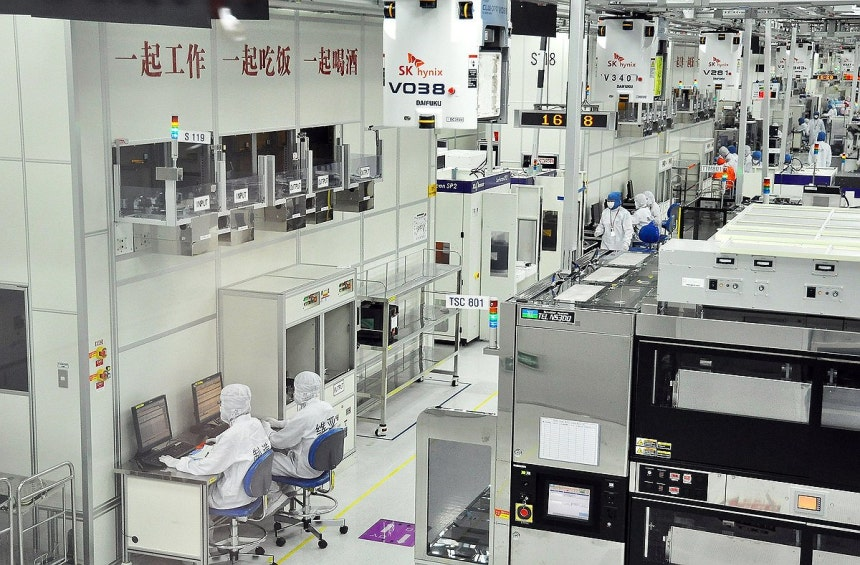
South Korean chipmakers are facing renewed uncertainty over their operations in China, as Washington reportedly considers revoking waivers that have allowed them to bring in American chip equipment for facility upgrades.
Samsung Electronics and SK hynix, Korea’s leading chipmakers with major semiconductor fabs in China, were reportedly notified last week that the US government plans to cancel the exemptions, according to a report by The Wall Street Journal on Saturday.
The waivers had been granted under the Biden administration’s export controls, which aim to prevent the shipment of advanced chip manufacturing tools — including those from Applied Materials and Lam Research — to China. To avoid disrupting global supply chains, however, the US had offered one-year waivers to major chipmakers such as Samsung Electronics, SK hynix and TSMC, allowing them to import equipment without individual licensing.
In the latest development, Jeffrey Kessler, former undersecretary of commerce for industry and security during US President Donald Trump's second term, reportedly informed the firms of the government’s intention to cancel the waivers. Kessler described the move as “part of the Trump administration’s crackdown on critical US technology going to China.”
White House officials added that the licensing system for chip equipment could resemble China’s controls on rare-earth exports.
While the US has stepped up efforts in recent years to curb China’s growth in the semiconductor sector, South Korean chipmakers have already taken steps to mitigate potential risks, leading to expectations of limited immediate impact. However, the companies remain on alert, as their Chinese fabs still account for a significant share of their total production.
“The US regulations are primarily intended to limit Chinese companies, not global firms, so there could be exemptions,” an industry official said. “We are closely monitoring the situation, as no formal measure has been announced yet.”
Kim Yang-paeng, a senior researcher at the Korea Institute for Industrial Economics and Trade, noted that companies have had time to prepare.
“Restrictions on expanding facilities or bringing in US-made equipment to China have long been in place,” he said. “While the latest move may have some impact, it is not likely to pose a significant threat to Korean firms for now.”
Samsung Electronics operates a NAND flash production facility in Xi’an, Shaanxi Province, and a chip packaging plant in Suzhou, Jiangsu Province. The company relies on China for roughly a quarter of its chip sales.
SK hynix, which recently became the world’s largest memory chip-maker, runs a DRAM fab in Wuxi, Jiangsu Province, a packaging facility in Chongqing, and a NAND flash plant in Dalian, Liaoning Province, which it acquired from Intel in 2020. According to industry sources, the company produces about 40 percent of its total DRAM output and about 30 percent of its NAND flash volume in China.
Just three months ago, SK hynix completed a final payment of $2.24 billion to Intel for the Dalian facility.
herim@heraldcorp.com