Corporate registrations of high-end imported cars jump 27%, raising questions over deterrent effect
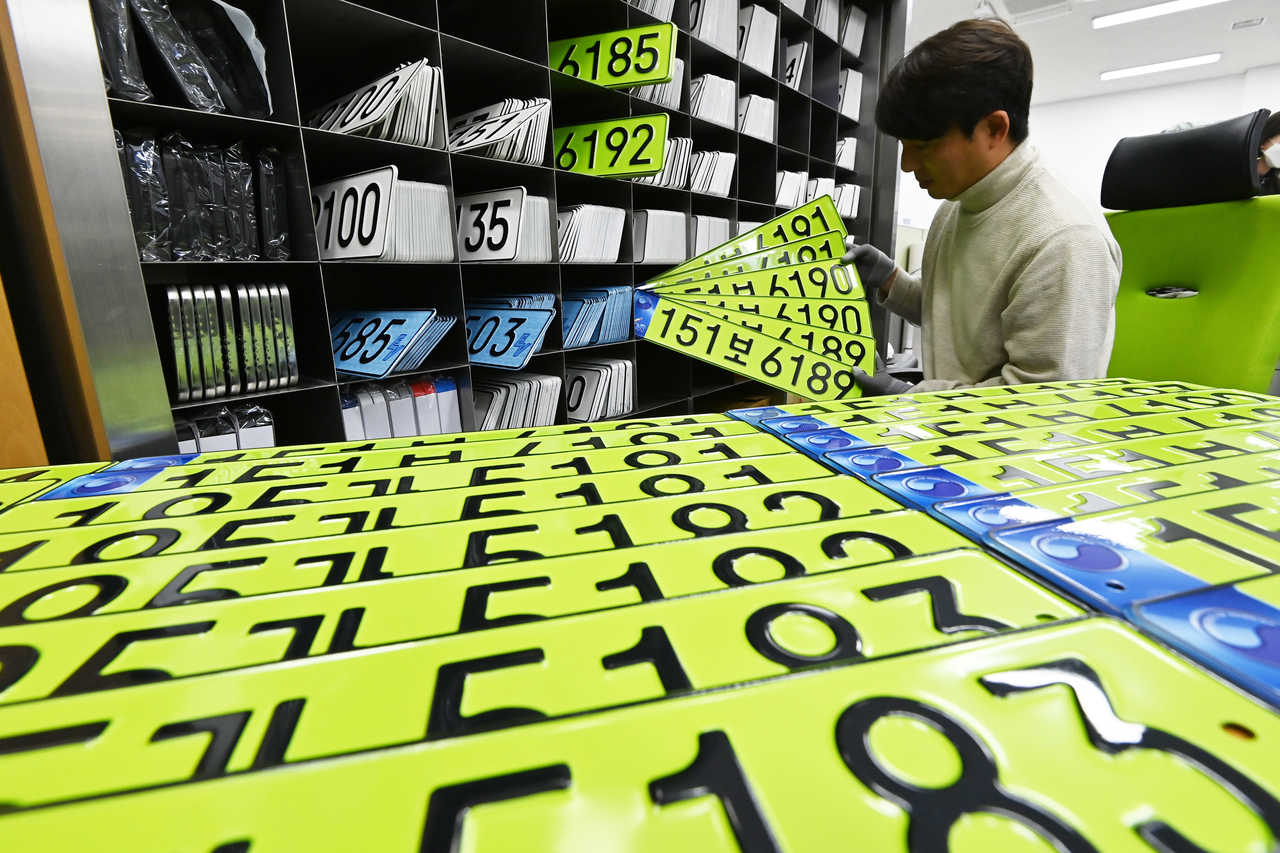
The lime-green license plate, introduced last year to curb the misuse of high-priced corporate vehicles, is facing growing skepticism over its effectiveness, as it is increasingly seen as a symbol of success rather than a social stigma.
The number of luxury imported cars registered under corporate names has jumped 27 percent this year, following last year’s sharp decline, which was widely attributed to the new plate system. The rebound has raised concerns that vehicles intended for private use may once again be registered as corporate cars.
According to the Korea Automobile Importers & Distributors Association, the number of imported cars priced over 100 million won ($73,000) registered under corporate names rebounded to 16,351 between January and May this year, up from 12,795 during the same period last year.
The proportion of corporate registrations among all imported vehicles at that price point also rose to 58 percent, up from 54 percent the previous year.
Luxury carmakers with higher-priced models showed even greater shares of corporate registrations. Ferrari and Lamborghini, whose vehicles are priced over 100 million won in Korea, each sold 158 units between January and May — with corporate purchases accounting for 89 percent and 78 percent of those sales, respectively.
They were followed by Maserati at 73 percent, Rolls-Royce at 71 percent, and Bentley at 67 percent. The so-called German Big Three — BMW, Mercedes-Benz and Audi — also recorded corporate registration rates exceeding 50 percent.
This rise follows a notable decline in the same period of 2024, when the number of such vehicles fell by 30 percent year-on-year, and the corporate registration ratio decreased from 64 percent the year before.
These vehicles fall under the lime-green license plate policy, which applies to newly registered corporate cars priced over 80 million won.
The system was designed to make such vehicles more easily identifiable to the public, based on the belief that increased visibility would lead to more reporting of non-business use and, in turn, help deter misuse of corporate vehicle benefits.
Under Korean income tax law, businesses can deduct up to 15 million won per year from their taxable income by claiming vehicle-related expenses as business costs, without objective proof of business use, such as a driving log.
While the industry has consistently denied that the new license plate had any meaningful impact, arguing that the earlier decline in corporate registrations was driven by a shortage of new models and global supply chain disruptions, the market response to the scheme was still noticeable.
Fearing detection, some even tried to evade the distinctive plates by manipulating contract prices below the 80-million-won threshold or registering vehicles under personal insurance before switching to corporate coverage, according to Rep. Kim Eun-hye of the main opposition People Power Party.
However, the recent rebound in the high-priced corporate vehicle registrations reflects an apparent decrease in such worries, experts say.
“When it was first introduced, it was effective. We often refer to it as a ‘nudge phenomenon,’ where people felt psychological pressure to comply,” said Kwon Yong-joo, an automotive design professor at Kookmin University.
“But as more people began receiving high-end vehicles under corporate names, it started to feel normalized, like, ‘oh, I guess it’s okay for us to drive them too.’”
This diminishing sense of concern is also felt on the ground.
“Some buyers of sports cars (which are generally not considered business-oriented) may have initially been wary of the regulation, but that seems not to be the case now,” said an official from a luxury automobile brand.
“There is little customer reaction to the license plate these days, likely because time has passed since the system was introduced,” said another official at an imported car dealership.
Experts are calling it a predictable failure, arguing that the color change did little more than incur additional costs, including the need to recalibrate traffic cameras.
“The policy seemed intended to create a stigma effect through the distinctive color, but now, some even treat it as a symbol of success,” said Kim Pil-su, a professor of automotive engineering at Daelim University, referring to social media posts that praise how the lime-green plate complements a luxury car’s design.
“The misuse deterrence system should start from the basics, clearly defining where corporate vehicles are permitted to operate, and thoroughly managing driving logs and GPS records.”
forestjs@heraldcorp.com