As wildfires rage across South Korea, fire prevention experts are calling on the government to reallocate its budget to strengthen personnel and equipment for large-scale fires.
Since March 21, Korea has been battling one of the worst string of wildfires in the country's history, with the death toll rising to 27 as of 4 p.m., Thursday, and authorities estimating 36,009 hectares to have been damaged.
With factors such as poor governmental assistance in evacuation, climate change and the heavy concentration of pine trees in wildfire-struck areas cited as main reasons as to why the scale of wildfire damage was so high, fire prevention experts told The Korea Herald that Korea is currently “ill-equipped” to effectively extinguish large-scale fires.
“Wildfires, like the one that’s swept over southeastern parts of Korea recently, require quick responses with equipment that is specifically catered to handle large fires, such as firefighting helicopters that carry large amounts of water,” professor Kong Ha-sung in Woosuk University’s Department of Fire and Disaster Prevention, told The Korea Herald.
“Korea is equipped with such helicopters but doesn’t have enough of them.”
According to the Korea Forest Service, up to 30 helicopters have been deployed for the past six days to fight the wildfires in the southeastern Gyeongsang provinces. However, most of the choppers are small to medium-sized, with a water-carrying capacity of 1,000 to 3,000 liters.
Kong added that larger models, which are capable of dropping 5,000 to 8,000 liters of water, “would be more effective in handling fires that are large in size and have a high likelihood of spreading rapidly.”
"Currently, Korea only holds five large fire-responsive helicopters. Its lack of large fire-responsive helicopters, which can be said to be a key force in responding to wildfires, could be one of the reasons as to why initial fire containment efforts failed,” Kong continued.
Kong added that a government budget allocation for renewing old firefighting equipment is also necessary, mentioning Wednesday’s crash of a firefighting helicopter during wildfire containment efforts in Uiseong-gun, North Gyeongsang Province.
“For wildfires to be extinguished and contained more effectively in the future, all firefighting equipment should undergo thorough examinations, and any that are deemed in need of replacement should be replaced immediately,” said Kong.
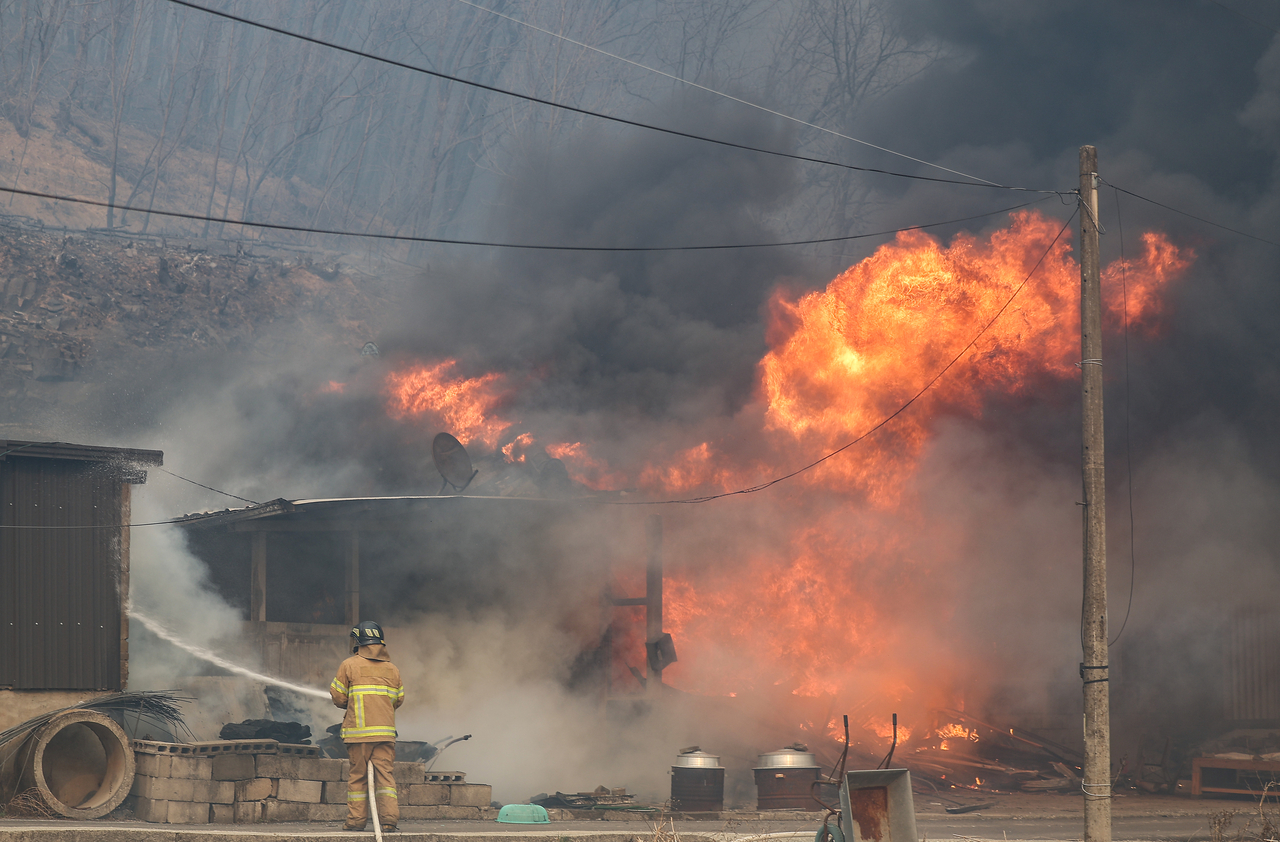
Professor Lee Young-ju from the School of Fire Safety in Kyungil University also told The Korea Herald that Korea needs more full-time firefighting personnel who are “specifically trained to handle wildfires.”
“Wildfires, especially those that occur in mountains, are different in terms of their nature compared to other fires,” said Lee. “They need specific training considering topographical differences as well as differences in wind gust speeds. Hiring part-time responders to cover personnel gaps should not be the answer."
Most wildfire responders are part-time personnel, who are mostly recruited by local governments to supplement permanent emergency services during wildfire seasons, as Korea has faced shortages in personnel for years. However, with a majority being older, part-time workers, speculations have risen following the recent wildfires as to whether this is the best solution.
On Saturday, three wildfire part-time responders, all in their 60s, died while responding to the fires in Sancheong-gun, South Gyeongsang Province. Two wildfire responders, both in their 70s, were also injured while trying to contain a blaze in North Jeolla Province. With such cases being reported, criticism is mounting regarding Korea’s frontline firefighting personnel system.
“These wildfire part-time responders, who are made up of seniors, often lack proper firefighting training. They lack support in terms of their gear and protective equipment and there is barely any budget currently allocated to proper education and training for these responders,” Lee added.
“It’s unrealistic to expect such responders to effectively respond to emergencies when working conditions for them aren’t favorable in the first place.”
lee.jungjoo@heraldcorp.com