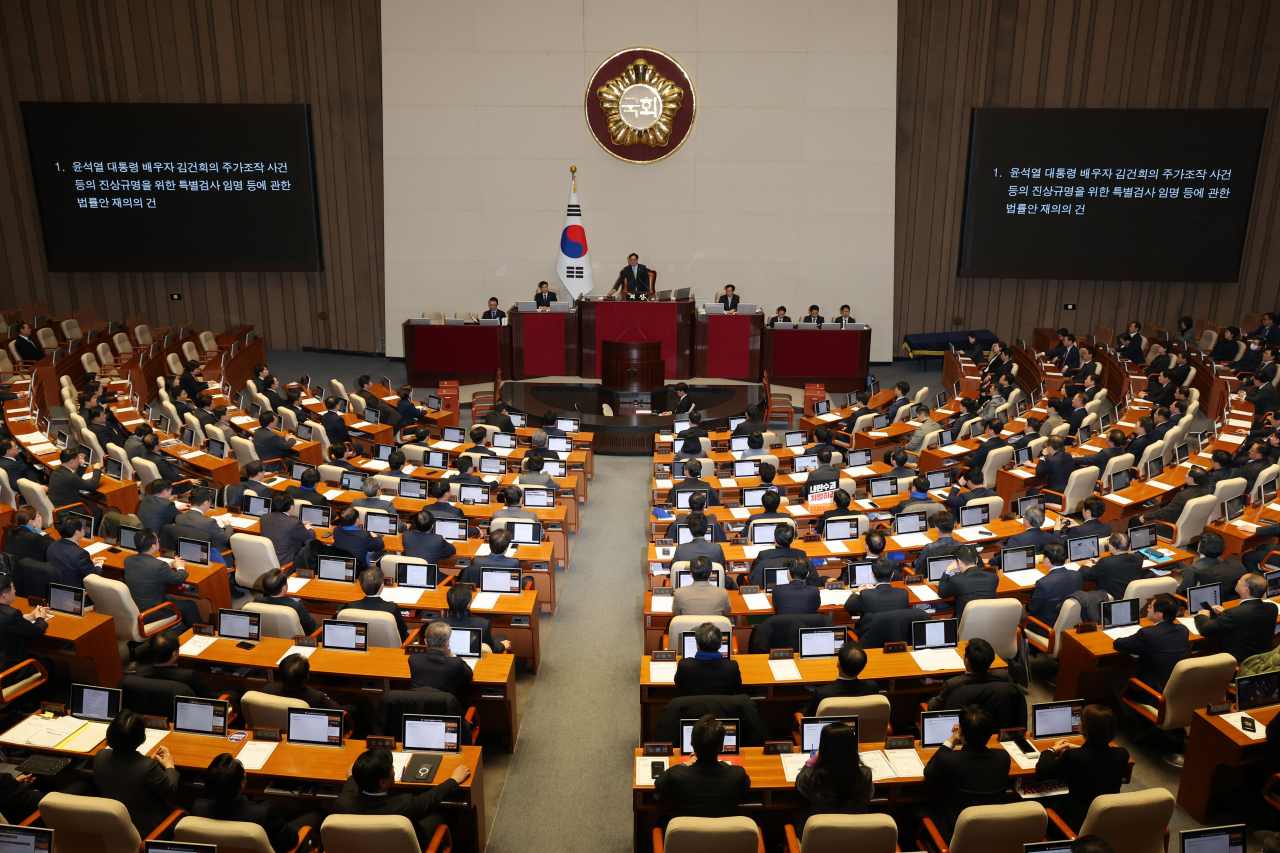
The National Assembly is set to kick off an extraordinary session Monday, as the ruling People Power Party and main opposition Democratic Party of Korea lock horns over key livelihood issues, with the looming potential of an early presidential election adding to the political stakes.
The approval of a supplementary budget will be the key focus of the extraordinary Assembly session.
The Democratic Party is calling for the swift formulation of the supplementary budget.
The People Power Party has continued to insist on executing the first-quarter budget before considering additional spending, criticizing the opposition’s unilateral budget cuts last year and contending that the Democratic Party's push for a supplementary budget is politicking in anticipation of an early presidential election.
However, speaking at a news conference on Sunday, Kweon Seong-dong called on Democratic Party leader Lee Jae-myung to return to the interparty negotiation committee — comprising representatives of the ruling and opposition parties along with the administration — to discuss the supplementary budget.
The committee, established by the parties to ensure governmental stability, has been at a standstill following two rounds of practical discussions. The only outcome from last month's sessions was the confirmation of four participants for the committee: acting Speaker Choi Sang-mok, Assembly Speaker Woo Won-sik and the respective leaders of the People Power Party and Democratic Party.
In response to Kweon’s call, Democratic Party Secretary-General Rep. Kim Yun-duk said on Sunday that the top priority should be for the government and the ruling party to clearly state whether they plan to formulate a supplementary budget.
"Our fundamental position is that we should pursue any forum available — whether it’s the ruling-opposition-government consultation council or another platform — if possible. However, we ask that the People Power Party and the government clearly articulate their positions regarding the supplementary budget," Kim said during a news conference.
A key issue in the extraordinary session is whether the parties can agree on pending economic legislation issues, particularly bills related to semiconductors and energy.
Among these, the semiconductor bill proposed by the People Power Party remains stalled due to disagreements over a proposed 52-hour workweek exemption for semiconductor industry workers.
Rep. Kweon Seong-dong, floor leader of the People Power Party, on Friday said, "The "Semiconductor Special Act must be passed at the February session of the National Assembly," highlighting that the act "has been stalled in the National Assembly due to the Democratic Party's opposition."
The ruling party argues that relaxing working hour limits is necessary for the semiconductor sector to stay competitive globally. The Democratic Party opposes the measure, citing concerns over its impact on labor protections.
To review its stance on the exemption, the opposition party will hold an internal policy debate Monday led by party leader Lee. The ruling party will visit the Pyeongtaek Godeok Substation in Gyeonggi Province on Wednesday to highlight industry concerns over the bill.
The special session will begin at 2 p.m. Monday, with the People Power Party and the Democratic Party of Korea set to deliver their negotiation group speeches on Feb. 10 and 11, respectively. The speakers for each party have yet to be decided.
The People Power Party is largely expected to emphasize the stability of the ruling party and its role in preventing a leadership vacuum amid the ongoing impeachment proceedings for suspended President Yoon Suk Yeol during the negotiation group speech. The ruling party also plans to highlight Democratic Party leader Rep. Lee Jae-myung’s past policies and political actions to challenge the credibility of recent shifts.
In contrast, the Democratic Party is expected to focus on presenting its policy agenda on economic recovery and public welfare, emphasizing the urgency of these issues amid the paralysis of state affairs caused by the impeachment proceedings following Yoon’s short-lived martial law in December.
flylikekite@heraldcorp.com